

UPSC Mapping
- Prelims: Governance & Technology
- Mains: GS Paper 2 (Governance) & GS Paper 3 (Technology)
| Digital Economy Share | 12–14% of GDP |
|---|---|
| Aadhaar Coverage | 145 crore+ |
| GeM GMV | ₹18.4 lakh crore |
What is Digital Public Infrastructure?
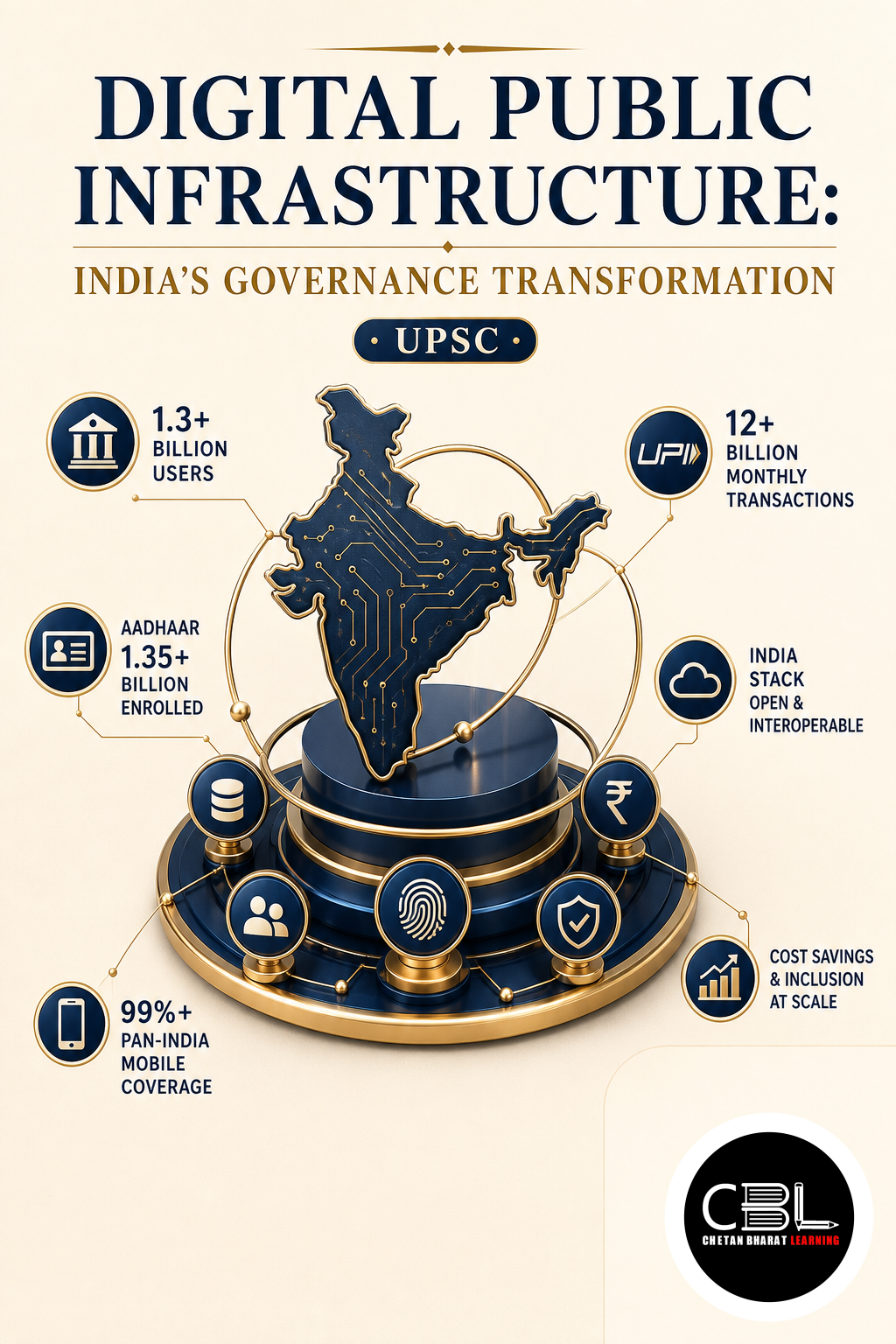
Digital Public Infrastructure refers to the foundational digital systems—identity, payments, and data-sharing—that enable inclusive access to public services. India’s DPI is built on three pillars: Digital Identity (Aadhaar), Digital Payments (UPI), and Data Sharing through the Data Empowerment and Protection Architecture (DEPA). Unified service gateways like UMANG and DigiLocker consolidate government services into single apps.
The DPI model has been globally recognised for its scale and impact. It has enabled the digital economy to contribute 12–14% of GDP, with UPI processing thousands of crores of transactions annually and Aadhaar providing a verifiable identity to over 145 crore citizens.
Why is Digital Public Infrastructure in News?
Digital Public Infrastructure is in the news because of its transformative impact on governance and the economy. India has become the world’s second-largest mobile phone manufacturer, and electronics goods have become the third-largest export category. UPI now accounts for 85% of India’s digital payments and has reached 11 countries.
The Open Network for Digital Commerce (ONDC) has connected over 20 crore buyers and 5 lakh sellers across 1,000 cities. The Skill India Digital Hub (SIDH) has registered over 20 million youth. For more details, refer to this PIB release.
Key Features of Digital Public Infrastructure
- Digital Identity: Aadhaar enables over 145 crore citizens to access services directly, reducing fraud and leakages.
- Digital Payments: UPI provides instant, low-cost, interoperable payments, supporting financial inclusion.
- Data Sharing: DEPA allows individuals to securely share personal data via consent-driven Account Aggregators.
- Unified Gateways: UMANG and DigiLocker consolidate services, enabling paperless and instant access.
- Digital Commerce: ONDC democratises e-commerce, connecting small sellers to a national market.
Challenges in Digital Public Infrastructure
- Rural Disconnect: Power outages and poor BharatNet fiber maintenance hinder e-governance in villages.
- Biometric Failure: Technical glitches in Aadhaar-enabled Payment Systems exclude manual labourers and elderly beneficiaries.
- Cyber Warfare: Shortages of cybersecurity personnel leave state data vulnerable to ransomware.
- Integration Friction: Proprietary software platforms create financial liabilities and hinder API integration.
- Operational Friction: Legacy IT architectures delay DPDP Act compliance, affecting welfare delivery. For more on digital governance, visit the governance section.
Way Forward for Digital Public Infrastructure
To strengthen Digital Public Infrastructure, India must invest in BharatNet maintenance and rural power backup to bridge the digital divide. Improving biometric systems with alternative authentication methods can enhance inclusion. Building a robust cybersecurity workforce and promoting open-source platforms can reduce costs and integration friction.
Ensuring seamless DPDP Act compliance while maintaining service delivery is critical. India should also share its DPI model with other developing countries, fostering global digital public goods. For international best practices, refer to the UNDP.
Prelims Practice Corner
- Q1. What is the current contribution of the digital economy to India’s GDP?
(a) 5–7% (b) 8–10% (c) 12–14% (d) 15–18%
Answer: (c) The digital economy contributes 12–14% of GDP. - Q2. Which platform consolidates government services into a single app?
(a) UPI (b) UMANG (c) ONDC (d) GeM
Answer: (b) UMANG is the unified mobile app for government services. - Q3. What percentage of India’s digital payments does UPI account for in FY 2025–26?
(a) 65% (b) 75% (c) 85% (d) 95%
Answer: (c) UPI accounts for 85% of India’s digital payments. - Q4. What is the Gross Merchandise Value (GMV) of GeM?
(a) ₹10 lakh crore (b) ₹18.4 lakh crore (c) ₹25 lakh crore (d) ₹30 lakh crore
Answer: (b) GeM’s GMV reached ₹18.4 lakh crore. - Q5. What is the DEPA framework?
(a) Digital education platform (b) Data Empowerment and Protection Architecture for secure data sharing (c) A defence procurement system (d) A healthcare database
Answer: (b) DEPA enables individuals to securely share personal data via consent-driven Account Aggregators.
Mains Practice Questions
Q1. Discuss the role of Digital Public Infrastructure in transforming governance and service delivery in India. (250 words, 15 marks)
Answer Structure:
- Intro: Introduce DPI and its contribution to GDP.
- Body: Discuss the three pillars: Aadhaar, UPI, DEPA. Highlight achievements: mobile manufacturing, UPI reach, ONDC, GeM. Analyse challenges: rural disconnect, biometric failure, cybersecurity, integration friction.
- Conclusion: Suggest measures to bridge the digital divide and enhance data security.
Q2. What are the key challenges in implementing Digital Public Infrastructure in rural India, and how can they be addressed? (150 words, 10 marks)
Answer Structure:
- Intro: Note the rural-urban digital divide.
- Body: Discuss challenges: power outages, poor BharatNet maintenance, biometric failures. Suggest solutions: solar power backup, fiber maintenance, alternative authentication methods, and capacity building.
- Conclusion: Conclude that inclusive DPI requires sustained investment in rural infrastructure.
FAQs on Digital Public Infrastructure
What is Digital Public Infrastructure?
It is the foundational digital systems—identity, payments, and data-sharing—that enable inclusive access to public services.
What are the key pillars of DPI?
Digital Identity (Aadhaar), Digital Payments (UPI), and Data Sharing (DEPA), along with unified service gateways like UMANG and DigiLocker.
What is the Open Network for Digital Commerce (ONDC)?
It is an open digital commerce network connecting over 20 crore buyers and 5 lakh sellers across 1,000 cities, democratising e-commerce.
Related Current Affairs
Preparing for UPSC, PCS or HCS?
Talk to a mentor at Chetan Bharat Learning, Chandigarh. Free guidance on choosing the right exam and building a study plan.
Chat on WhatsAppCall 97793 53345UPSC / IAS / PCS coaching in Chandigarh · Trusted by aspirants across Punjab & Haryana
Leave a Reply
You must be logged in to post a comment.