
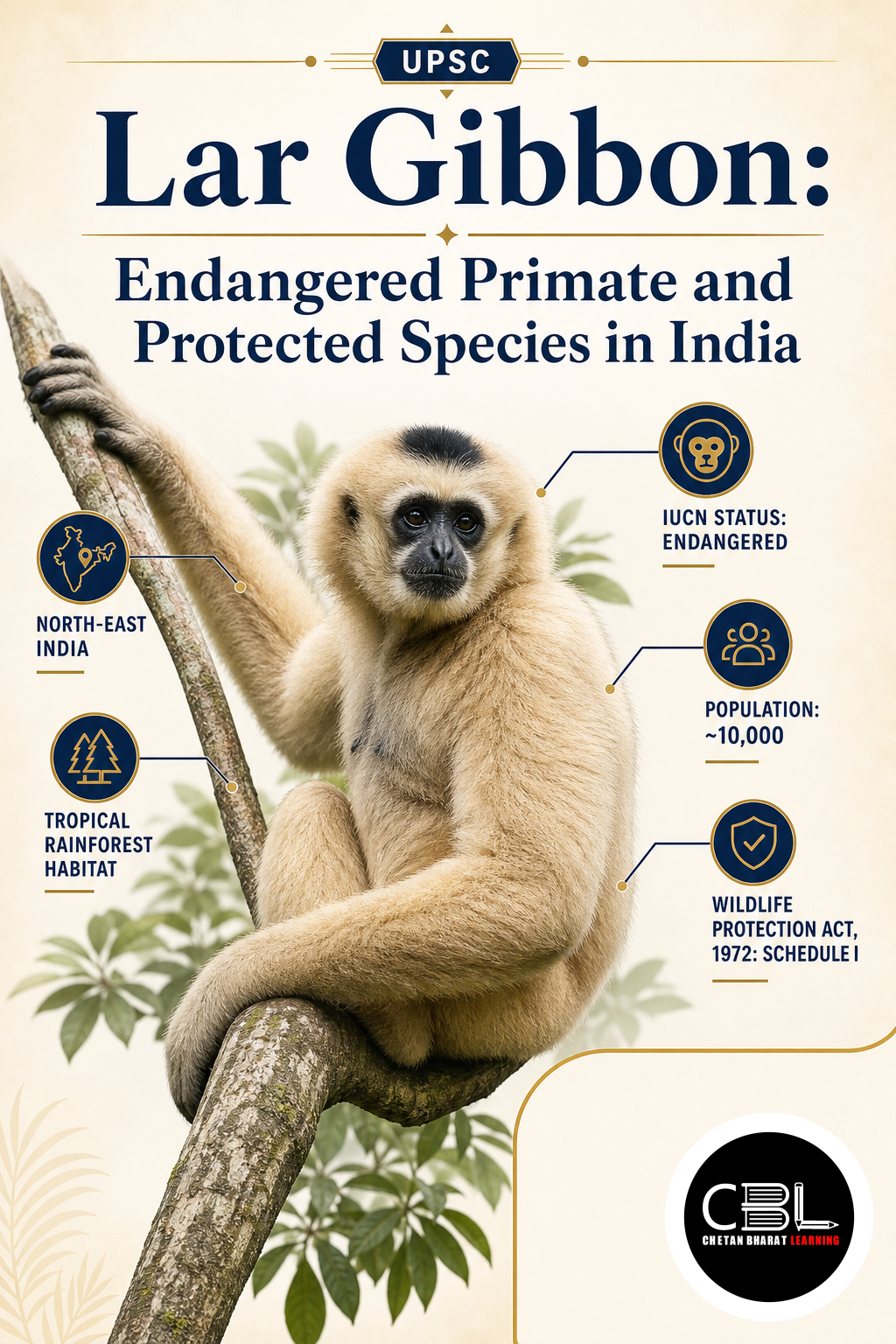

UPSC Mapping
| Prelims | Environment & Biodiversity |
|---|---|
| Mains | GS Paper 3 (Environment & Biodiversity) |
Quick Facts
| IUCN Status | Endangered |
|---|---|
| CITES | Appendix I |
| WPA Schedule | Schedule IV |
What is the Lar Gibbon?
The Lar Gibbon (Hylobates lar), also called the white-handed gibbon, is a small, highly agile ape found in the high canopies of primary lowland, submontane, and mixed-deciduous tropical rainforests in Southeast Asia. They live in monogamous groups and vocalize in duets to strengthen bonds and defend territory.
As specialized brachiators, they have long arms, curved fingers, and no tail, enabling them to swing through the forest canopy with remarkable speed. They are frugivorous, eating ripe fruits, figs, and also young leaves, flowers, shoots, and insects, acting as vital seed dispersers for tropical forest regeneration.
Why is the Lar Gibbon in News?
The Lar Gibbon is in the news after a Tamil actor’s video featuring the primate as a pet prompted a wildlife probe. Private ownership of this species is highly regulated in India, as it is listed under Schedule IV of the Wildlife Protection Act and Appendix I of CITES.
The incident has highlighted the issue of illegal wildlife trade and the keeping of endangered species as pets. The Lar Gibbon is also endangered due to habitat loss and the pet trade. For more details, refer to the PIB release.
Key Features of the Lar Gibbon
- Brachiator: Long arms, curved fingers, and no tail for swinging through the canopy.
- Monogamous: Lives in monogamous pairs with strong pair bonds.
- Duet Vocalisation: Male-female vocal duets to defend territory and strengthen bonds.
- Frugivorous: Diet primarily consists of ripe fruits and figs, with some leaves and insects.
- Seed Disperser: Plays a vital role in tropical forest regeneration.
Challenges in Lar Gibbon Conservation
- Habitat Loss: Deforestation and conversion of forests to agriculture and plantations destroy their habitat.
- Illegal Pet Trade: Gibbons are captured for the exotic pet trade, reducing wild populations.
- Hunting: They are sometimes hunted for bushmeat or traditional medicine.
- Fragmentation: Forest fragmentation isolates populations, affecting genetic diversity.
- Low Reproductive Rate: They have slow reproductive cycles, making population recovery difficult.
Way Forward for Lar Gibbon Conservation
To protect the Lar Gibbon, stricter enforcement of the Wildlife Protection Act and CITES is needed to curb illegal trade. Protecting and restoring forest habitats, especially in Southeast Asia, is essential.
Community awareness programmes can reduce hunting and the pet trade. Transboundary conservation efforts involving range countries can strengthen protection. Captive breeding programmes and reintroduction can help recover populations in areas where they have been extirpated. For international best practices, refer to the IUCN.
Prelims Practice Corner
Q1. What is the scientific name of the Lar Gibbon?
(a) Hylobates lar (b) Symphalangus syndactylus (c) Nomascus leucogenys (d) Hoolock hoolock
Answer: (a) The scientific name is Hylobates lar.
Q2. What is the IUCN status of the Lar Gibbon?
(a) Vulnerable (b) Endangered (c) Critically Endangered (d) Least Concern
Answer: (b) The Lar Gibbon is listed as Endangered on the IUCN Red List.
Q3. Under which schedule of the Wildlife Protection Act is the Lar Gibbon protected in India?
(a) Schedule I (b) Schedule II (c) Schedule IV (d) Schedule V
Answer: (c) It is listed under Schedule IV.
Q4. What is the primary diet of the Lar Gibbon?
(a) Insects (b) Fruits and figs (c) Leaves (d) Small mammals
Answer: (b) They are primarily frugivorous, eating ripe fruits and figs.
Q5. What is a key conservation challenge for the Lar Gibbon?
(a) Climate change (b) Illegal pet trade (c) Overpopulation (d) Disease
Answer: (b) The illegal pet trade is a major threat to wild populations.
Mains Practice Questions
Q1. Discuss the conservation challenges faced by gibbon species in India and Southeast Asia, with reference to the Lar Gibbon. (250 words, 15 marks)
Answer Structure:
- Intro: Introduce the Lar Gibbon and its conservation status.
- Body: Discuss threats: habitat loss, illegal pet trade, hunting, fragmentation. Analyse conservation measures: WPA, CITES, habitat protection. Suggest transboundary collaboration and community engagement.
- Conclusion: Emphasise the need for stricter enforcement and habitat restoration.
Q2. What is the ecological role of gibbons in tropical forests, and why is their conservation important? (150 words, 10 marks)
Answer Structure:
- Intro: Highlight gibbons as seed dispersers.
- Body: Explain their role in forest regeneration through seed dispersal. Their conservation is vital for maintaining forest health and biodiversity. Discuss threats and the importance of protecting their habitat.
- Conclusion: Conclude that gibbon conservation is integral to tropical forest conservation.
FAQs on Lar Gibbon
What is the Lar Gibbon?
The Lar Gibbon is a small, highly agile ape found in Southeast Asian rainforests, known for its long arms and brachiation.
Where is the Lar Gibbon found?
It inhabits the high canopies of primary lowland, submontane, and mixed-deciduous tropical rainforests in Southeast Asia.
Why is the Lar Gibbon endangered?
Habitat loss, illegal pet trade, hunting, and forest fragmentation have led to its Endangered status.
Related Current Affairs
Preparing for UPSC, PCS or HCS?
Talk to a mentor at Chetan Bharat Learning, Chandigarh. Free guidance on choosing the right exam and building a study plan.
Chat on WhatsAppCall 97793 53345UPSC / IAS / PCS coaching in Chandigarh · Trusted by aspirants across Punjab & Haryana
Leave a Reply
You must be logged in to post a comment.