

UPSC Mapping
- Prelims: Environment & Energy
- Mains: GS Paper 3 (Energy & Environment)
Quick Facts
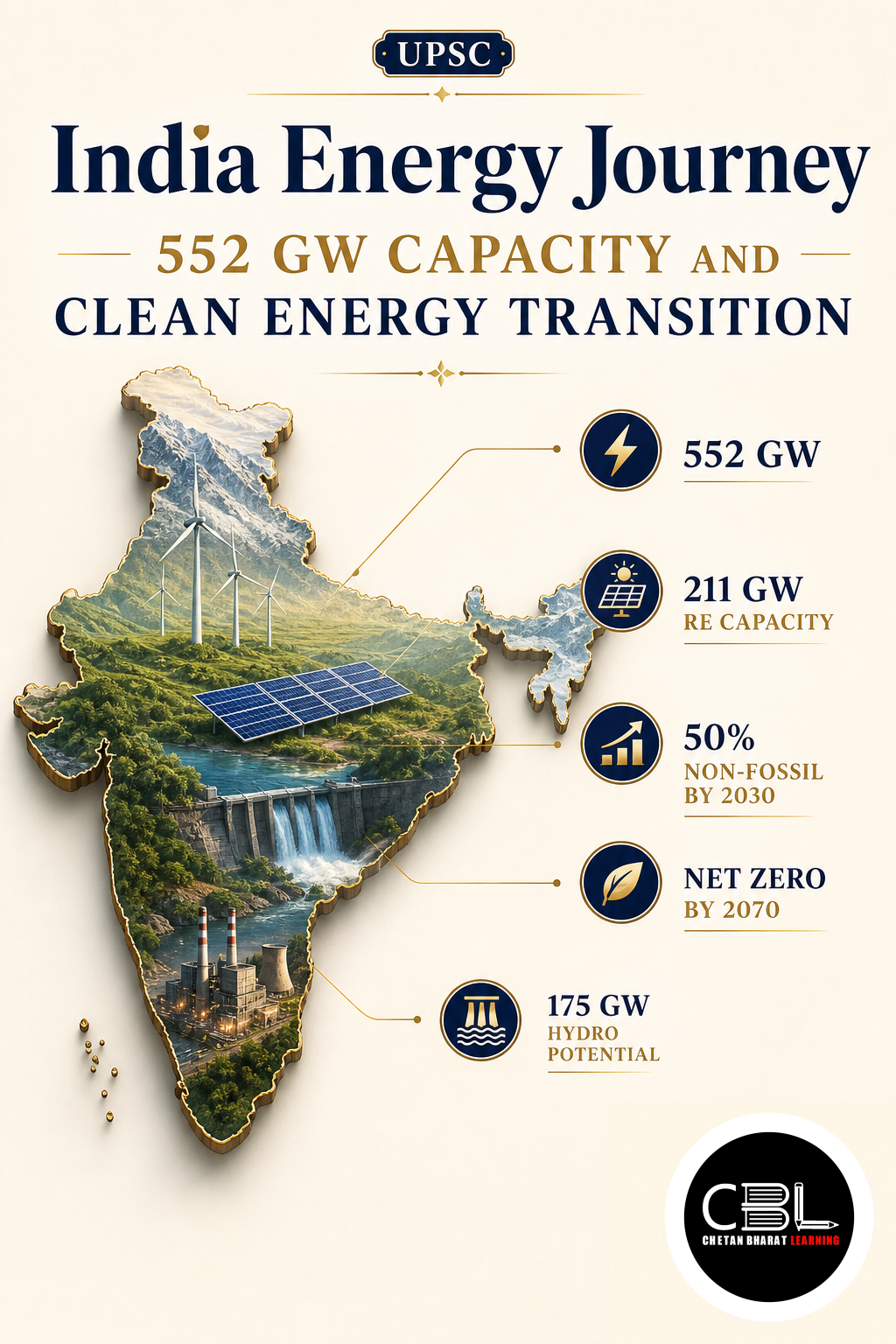
| Total Capacity | ~552 GW |
|---|---|
| Solar Capacity | 164.59 GW |
| Nuclear Target (2047) | 100 GW |
What is India Energy Journey?
India Energy Journey encompasses the evolution of the country’s power sector from coal-dominated to a diversified mix of renewable, nuclear, and clean energy sources. Non-fossil sources now account for over 54% of installed capacity, with solar leading the renewable component at 164.59 GW, followed by wind at 58.14 GW and bio-energy at 11.75 GW.
Coal still accounts for nearly 55% of primary energy needs and over 70% of electricity generation, but its share is gradually declining. India is the world’s fourth-largest crude refiner with 22 refineries, and national LPG coverage has grown to 107.2%. The Nuclear Energy Mission targets 100 GW by 2047, with the 500 MWe Prototype Fast Breeder Reactor at Kalpakkam achieving first criticality in 2026.
Why is India Energy Journey in News?
India Energy Journey is in the news because of major milestones: the 500 MWe Prototype Fast Breeder Reactor achieved first criticality; India’s first indigenous hydrogen fuel cell-powered train began operating in July 2026; and PM-Surya Ghar has benefited 51.58 lakh households.
The SHANTI Act, 2025, permits private-sector nuclear participation and grants statutory status to the Atomic Energy Regulatory Board (AERB). The government has also launched schemes like Samudra Manthan for offshore oil exploration and GOBARdhan for bioenergy. For more details, refer to the PIB release.
Key Features of India Energy Journey
- Renewable Leadership: Solar (164.59 GW), wind (58.14 GW), and bio-energy (11.75 GW) drive the clean energy transition.
- Nuclear Expansion: PFBR at Kalpakkam; SHANTI Act enables private participation; target of 100 GW by 2047.
- Green Hydrogen: 8,000 tonnes per annum capacity commissioned; first hydrogen fuel cell train operational.
- Energy Security: Coal gasification target of 100 MT by 2030; Samudra Manthan for offshore oil and gas.
- Rooftop Solar: PM-Surya Ghar targets 1 crore households; over 51 lakh households already benefited.
Challenges in India Energy Journey
- Coal Dependence: Coal still accounts for over 70% of electricity generation, making decarbonisation difficult.
- Grid Integration: Variable renewable energy requires significant investment in storage and grid modernisation.
- Nuclear Liability: The Civil Liability for Nuclear Damage Act remains a concern for private investors.
- Land Acquisition: Renewable projects face land acquisition challenges and local opposition.
- Financing: The energy transition requires massive capital investment, estimated at hundreds of billions of dollars.
Way Forward for India Energy Journey
To accelerate India Energy Journey, the government should focus on energy storage solutions—pumped hydro, battery storage—to address grid integration challenges. Scaling up green hydrogen production and reducing the cost of electrolysers can support industrial decarbonisation.
Speeding up the nuclear expansion through private participation and liability insurance mechanisms is essential. Strengthening the grid infrastructure and promoting smart metering can improve efficiency. International collaborations, especially in technology transfer and financing, can accelerate the transition. For international best practices, refer to the IRENA.
Prelims Practice Corner
Q1. What percentage of India’s installed capacity comes from non-fossil sources?
- (a) 35%
- (b) 44%
- (c) 54%
- (d) 65%
Answer: (c) Non-fossil sources account for over 54% of installed capacity.
Q2. What is India’s current solar power capacity?
- (a) 100 GW
- (b) 164.59 GW
- (c) 200 GW
- (d) 250 GW
Answer: (b) India’s solar capacity is 164.59 GW.
Q3. Which nuclear reactor achieved first criticality in 2026?
- (a) Kudankulam Unit 1
- (b) Prototype Fast Breeder Reactor
- (c) Tarapur 3
- (d) Rajasthan 7
Answer: (b) The PFBR at Kalpakkam achieved first criticality in 2026.
Q4. What is India’s nuclear capacity target by 2047?
- (a) 50 GW
- (b) 100 GW
- (c) 150 GW
- (d) 200 GW
Answer: (b) The Nuclear Energy Mission targets 100 GW by 2047.
Q5. Which Act enables private-sector nuclear participation?
- (a) Atomic Energy Act
- (b) SHANTI Act, 2025
- (c) Nuclear Liability Act
- (d) Electricity Act
Answer: (b) The SHANTI Act, 2025, permits private-sector nuclear participation.
Mains Practice Questions
Q1. Discuss India’s energy transition journey, highlighting the role of renewable, nuclear, and conventional energy sources. (250 words, 15 marks)
Answer Structure:
- Intro: Introduce India’s energy capacity and the shift to clean sources.
- Body: Discuss renewable growth: solar, wind, bio-energy. Nuclear progress: PFBR, SHANTI Act. Coal’s continued role. Major schemes: PM-Surya Ghar, GOBARdhan, Samudra Manthan. Analyse challenges: grid integration, financing, land acquisition.
- Conclusion: Suggest storage solutions, green hydrogen, and international partnerships.
Q2. What are the key government schemes driving India’s clean energy transition? (150 words, 10 marks)
Answer Structure:
- Intro: Highlight the policy push for clean energy.
- Body: Discuss PM-Surya Ghar (rooftop solar), National Green Hydrogen Mission, SHANTI Act (nuclear), Samudra Manthan (offshore oil), GOBARdhan (bioenergy), and coal gasification.
- Conclusion: Conclude that these schemes collectively drive the energy transition.
FAQs on India Energy Journey
What is India’s total installed power capacity?
India’s installed capacity is about 552 GW, with non-fossil sources accounting for over 54%.
What is the significance of the PFBR at Kalpakkam?
It is India’s 500 MWe Prototype Fast Breeder Reactor, which achieved first criticality in 2026, marking a milestone in the nuclear programme.
What is the National Green Hydrogen Mission?
It aims to build green hydrogen production capacity, with around 8,000 tonnes per annum already commissioned.
Related Current Affairs
Preparing for UPSC, PCS or HCS?
Talk to a mentor at Chetan Bharat Learning, Chandigarh. Free guidance on choosing the right exam and building a study plan.
Chat on WhatsAppCall 97793 53345UPSC / IAS / PCS coaching in Chandigarh · Trusted by aspirants across Punjab & Haryana
Leave a Reply
You must be logged in to post a comment.