

UPSC Mapping
| Exam | Paper & Topic |
|---|---|
| Prelims | Economy & Governance |
| Mains | GS Paper 3 (Economic Development & Governance) |
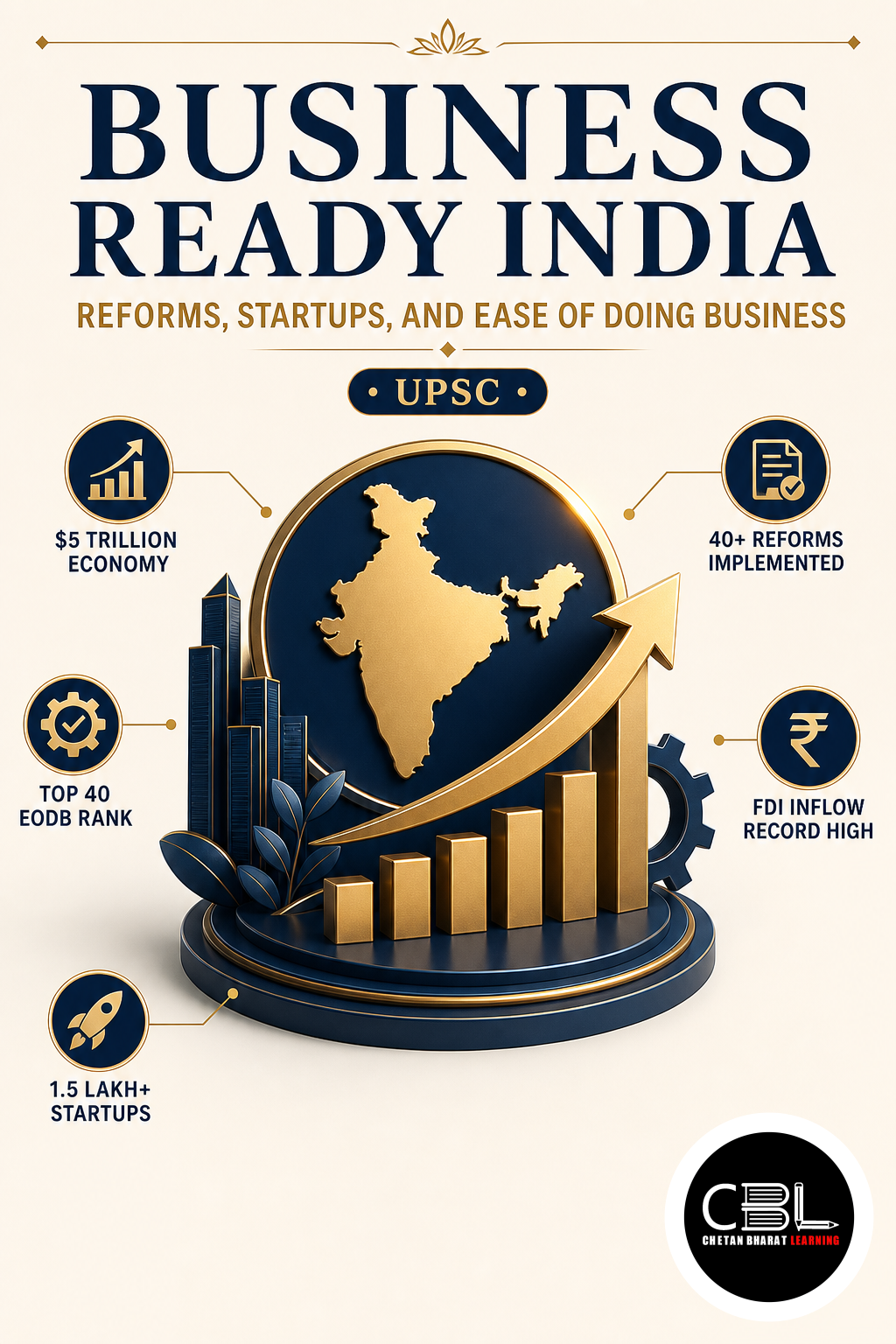
Business Ready India: Reforms, Startups, and Ease of Doing Business
Business Ready India has emerged as a strategic priority, with the government implementing significant reforms to reduce compliance burdens, enhance transparency, and encourage entrepreneurship. From the National Single Window System (NSWS) to Startup India, GST, and GeM, the reform agenda has transformed India’s business environment. For more such economic updates, explore the economy archive.
Quick Facts
| Indicator | Value |
|---|---|
| DPIIT Startups (2026) | 2.47 lakh+ |
| GST Taxpayers | 1.68 crore+ |
| GeM Procurement | ₹20 lakh crore+ |
What is Business Ready India?
Business Ready India refers to the comprehensive reform agenda aimed at making India a preferred destination for business and investment. Key initiatives include the National Single Window System (NSWS), which provides access to over 686 central and 7,498 state approvals; Startup India, which has grown from 502 to over 2.47 lakh DPIIT-recognised startups; and Udyam Registration, which has registered over 9.27 lakh MSMEs.
The reforms span reducing compliance burdens (over 47,000 compliances simplified or decriminalised), unlocking finance (MUDRA loans worth ₹40.07 lakh crore), promoting trust-based governance (Jan Vishwas Act decriminalising 717 provisions), and expanding markets (GeM procurement of ₹20 lakh crore+).
Why is Business Ready India in News?
Business Ready India is in the news following the release of cumulative data showing the impact of reforms. GST 2.0 has unified the tax framework with over 1.68 crore registered taxpayers. The government has reduced more than 47,000 compliances, including 16,108 simplified, 22,287 digitised, and 4,458 decriminalised.
The PM GatiShakti platform has evaluated 352 projects worth ₹16.10 lakh crore, while the Open Network for Digital Commerce (ONDC) has over 7.64 lakh sellers across 616+ cities. The Export Promotion Mission and Trade Connect e-Platform are facilitating global market access. For more details, refer to this PIB release.
Key Features of Business Ready India
- Single Window System: NSWS guides businesses through approvals, reducing time and cost.
- Startup Ecosystem: Startup India has transformed India into a nation of job creators.
- Trust-Based Governance: Jan Vishwas Act decriminalises minor offences; GST 2.0 simplifies taxation.
- Access to Finance: MUDRA, CGTMSE, and CAM ensure collateral-free credit for MSMEs.
- Market Access: GeM digitises public procurement; ONDC promotes open digital commerce.
Challenges in Business Ready India
- Compliance at State Level: Many states still have complex regulations not aligned with central reforms.
- Credit Access: MSMEs, especially micro-enterprises, still face credit constraints despite MUDRA and CGTMSE.
- Infrastructure Gaps: Logistics and power infrastructure remain inadequate in some regions.
- Technology Adoption: Small businesses struggle to adopt digital platforms like GeM and ONDC.
- Global Competition: India must compete with established manufacturing hubs like China and Vietnam. For more on business reforms, visit the economy section.
Way Forward for Business Ready India
To deepen Business Ready India, reforms should be extended to the state and local levels through the Business Reform Action Plan (BRAP). Simplifying land and labour regulations can attract manufacturing investment. Enhancing digital infrastructure and financial literacy for MSMEs can improve adoption.
Strengthening dispute resolution mechanisms and contract enforcement will boost investor confidence. Regular stakeholder consultations and impact assessments can ensure reforms remain relevant. For international best practices, refer to the World Bank.
Prelims Practice Corner
-
Q1. How many DPIIT-recognised startups are there as of August 2026?
(a) 50,000 (b) 1 lakh (c) 2.47 lakh (d) 5 lakh
Answer
Answer: (c) Over 2.47 lakh startups are DPIIT-recognised.
-
Q2. What is the cumulative procurement value on GeM?
(a) ₹5 lakh crore (b) ₹10 lakh crore (c) ₹20 lakh crore+ (d) ₹50 lakh crore
Answer
Answer: (c) GeM has facilitated procurement worth over ₹20 lakh crore.
-
Q3. Which Act decriminalised 717 provisions?
(a) Companies Act (b) Jan Vishwas Act (c) GST Act (d) Insolvency and Bankruptcy Code
Answer
Answer: (b) Jan Vishwas (Amendment of Provisions) Act, 2026, decriminalised 717 provisions.
-
Q4. How many GST taxpayers are registered as of July 2026?
(a) 60 lakh (b) 1.68 crore (c) 2.5 crore (d) 5 crore
Answer
Answer: (b) Over 1.68 crore taxpayers are registered under GST.
-
Q5. What is the Credit Assessment Model (CAM) for MSMEs?
(a) A credit guarantee scheme (b) A digital appraisal system using verifiable data (c) A tax incentive (d) A subsidy programme
Answer
Answer: (b) CAM uses digitally fetched data for automated MSME loan appraisal.
Mains Practice Questions
-
Q1. Discuss the key reforms undertaken by the government to make India business-ready and their impact on the ease of doing business. (250 words, 15 marks)
Answer Structure:
- Intro: Introduce the reform agenda and its objectives.
- Body: Discuss key reforms: NSWS, Startup India, Jan Vishwas, GST, GeM, PM GatiShakti. Analyse impact: reduced compliance, increased startups, MSME formalisation, improved market access. Address challenges: state-level implementation, credit access.
- Conclusion: Suggest extending reforms to states and strengthening dispute resolution.
-
Q2. What is the significance of the Jan Vishwas Act in promoting trust-based governance? (150 words, 10 marks)
Answer Structure:
- Intro: Define trust-based governance and the Act’s role.
- Body: Explain that the Act decriminalises minor offences, reducing regulatory anxiety for businesses. This fosters a culture of compliance and innovation, moving from a punitive to a facilitative approach.
- Conclusion: Conclude that such reforms are vital for boosting business confidence.
FAQs on Business Ready India
What is the National Single Window System (NSWS)?
It is a digital platform that guides businesses in identifying and applying for approvals, providing access to over 686 central and 7,498 state approvals.
How many compliances have been reduced under the reforms?
More than 47,000 compliances have been reduced, including 16,108 simplified, 22,287 digitised, and 4,458 decriminalised.
What is the Credit Guarantee Fund Trust for Micro and Small Enterprises (CGTMSE)?
It enables MSEs to access credit without collateral, covering credit facilities of up to ₹10 crore.
Related Current Affairs
Preparing for UPSC, PCS or HCS?
Talk to a mentor at Chetan Bharat Learning, Chandigarh. Free guidance on choosing the right exam and building a study plan.
Chat on WhatsAppCall 97793 53345UPSC / IAS / PCS coaching in Chandigarh · Trusted by aspirants across Punjab & Haryana
Leave a Reply
You must be logged in to post a comment.