

UPSC Mapping
| Prelims | Environment & Biodiversity |
|---|---|
| Mains | GS Paper 3 (Environment & Biodiversity) |
Quick Facts
| Population (2025) | 22,446 |
|---|---|
| Decline from 2017 | 17.81% |
| Elephant Reserves | 33 |
What is Elephant Conservation India?
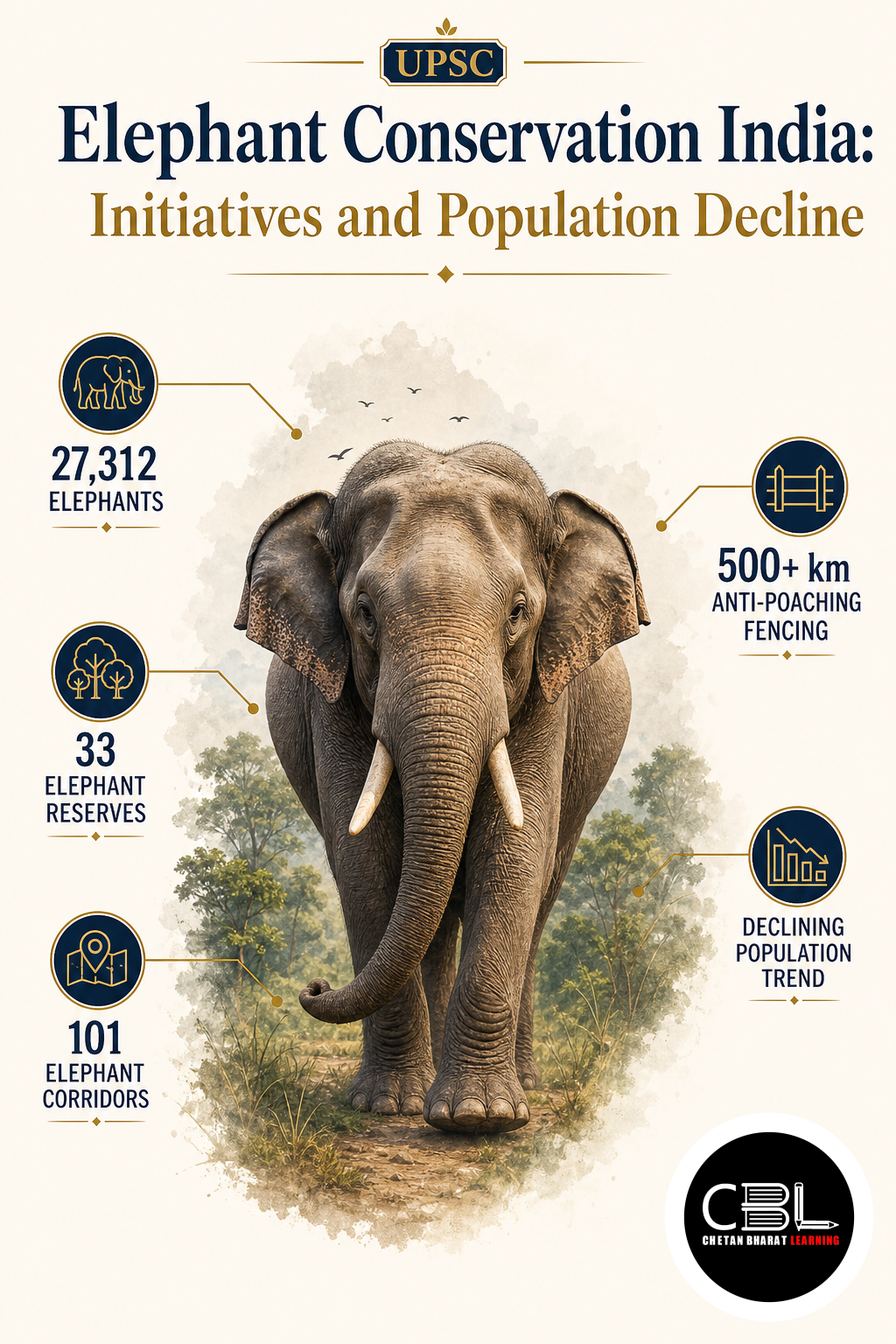
Elephant Conservation India encompasses initiatives to protect wild Asian elephants, their habitats, and migration corridors. India has established 33 Elephant Reserves across 14 states and about 150 elephant corridors. Karnataka holds the highest population at 6,013, followed by Assam, Tamil Nadu, and Kerala.
The Western Ghats account for about 53.17% of the population, followed by the Northeastern Hills, the Shivalik Hills, and Central India. The elephant is declared a National Heritage Animal, reflecting its cultural and ecological significance.
Why is Elephant Conservation India in News?
Elephant Conservation India made headlines with the SAIEE 2021–25 estimates showing a 17.81% decline from the 2017 census. The survey used DNA-based dung sampling to identify individual elephants and avoid duplicate counts.
World Elephant Day (August 12, 2026) was observed under the theme “Bringing the world together to help elephants.” The government highlighted Project Elephant, RE-HAB, Gajraj Suraksha, and the Surakhsya Portal for human–elephant conflict management.
Key Features of Elephant Conservation India
- Project Elephant: Financial and technical support to 22 range states.
- Project RE-HAB: Bee boxes to deter herds from human habitations.
- Gajraj Suraksha: AI-powered optical fibre networks to detect elephant vibrations.
- Hathi Mitra Dal: Community volunteers for early warnings to prevent human–wildlife encounters.
- Surakhsya Portal: Centralised spatial mapping of conflict hotspots.
Challenges in Elephant Conservation India
- Habitat Fragmentation: Roads and railways fragment corridors, disrupting migration.
- Human–Elephant Conflict: Crop raids, property damage, and casualties due to encroachment.
- Poaching: Continued illegal ivory and body-parts trade.
- Corridor Loss: Many of the 150 identified corridors are shrinking from development.
- Population Decline: The 17.81% drop signals the need for intensified conservation efforts.
Way Forward for Elephant Conservation India
A landscape-level approach—corridor protection, habitat restoration, and community engagement—is essential. Legal notification of 150 corridors and eco-friendly infrastructure (underpasses, viaducts) can secure migratory routes.
Community-based programmes (compensation for crop damage, livelihood alternatives) can reduce conflict. Modern monitoring (satellite tracking, AI-based early warnings) can improve management. International cooperation for transboundary conservation with Nepal, Bangladesh, and Myanmar is crucial.
Prelims Practice Corner
Q1. What is India’s wild elephant population as per the SAIEE 2021–25 estimate?
- (a) 27,312
- (b) 22,446
- (c) 30,000
- (d) 18,500
Answer: (b) The population is estimated at 22,446 elephants.
Q2. Which state has the highest number of wild elephants?
- (a) Assam
- (b) Kerala
- (c) Karnataka
- (d) Tamil Nadu
Answer: (c) Karnataka has the highest population at 6,013 elephants.
Q3. What is Project RE-HAB?
- (a) Rehabilitation of captive elephants
- (b) Deploying bee boxes to deter elephants from human settlements
- (c) A census project
- (d) A corridor protection project
Answer: (b) Project RE-HAB uses bee boxes along forest passageways to deter elephants.
Q4. How many elephant corridors have been identified in India?
- (a) 50
- (b) 100
- (c) 150
- (d) 200
Answer: (c) Approximately 150 elephant corridors have been identified.
Q5. What is the Gajraj Suraksha initiative?
- (a) An anti-poaching unit
- (b) AI-powered optical fibre network to detect elephant vibrations
- (c) A breeding programme
- (d) A tourist safari project
Answer: (b) Gajraj Suraksha uses AI to detect elephant vibrations and alert locomotive pilots.
Mains Practice Questions
Q1. Discuss the major threats to elephant conservation in India and evaluate the effectiveness of government initiatives to address them. (250 words, 15 marks)
Answer Structure:
- Intro: Introduce India’s elephant population and the 17.81% decline.
- Body: Discuss threats (habitat fragmentation, human–elephant conflict, poaching). Evaluate initiatives (Project Elephant, RE-HAB, Gajraj Suraksha, corridors). Analyse gaps (enforcement, community engagement).
- Conclusion: Suggest landscape-level conservation and conflict mitigation measures.
Q2. What is the significance of elephant corridors, and what measures are needed to protect them? (150 words, 10 marks)
Answer Structure:
- Intro: Define elephant corridors as migratory pathways.
- Body: Explain importance (genetic connectivity, reducing conflict). Suggest measures (legal notification, eco-sensitive infrastructure, community-based monitoring).
- Conclusion: Conclude that corridor protection is vital for long-term elephant survival.
FAQs on Elephant Conservation India
What is Project Elephant?
It provides financial and technical support to 22 states for managing elephant populations, habitats, and corridors.
Why has India’s elephant population declined?
Habitat fragmentation, human–elephant conflict, poaching, and loss of corridors have contributed to the decline.
What is the status of the Asian elephant?
The Asian elephant is listed as Endangered on the IUCN Red List and is protected under Schedule I of India’s Wildlife Protection Act.
Related Current Affairs
Preparing for UPSC, PCS or HCS?
Talk to a mentor at Chetan Bharat Learning, Chandigarh. Free guidance on choosing the right exam and building a study plan.
Chat on WhatsAppCall 97793 53345UPSC / IAS / PCS coaching in Chandigarh · Trusted by aspirants across Punjab & Haryana
Leave a Reply
You must be logged in to post a comment.