

UPSC Mapping
| Prelims | Economy & Industry |
|---|---|
| Mains | GS Paper 3 (Economic Development & Industry) |
Article
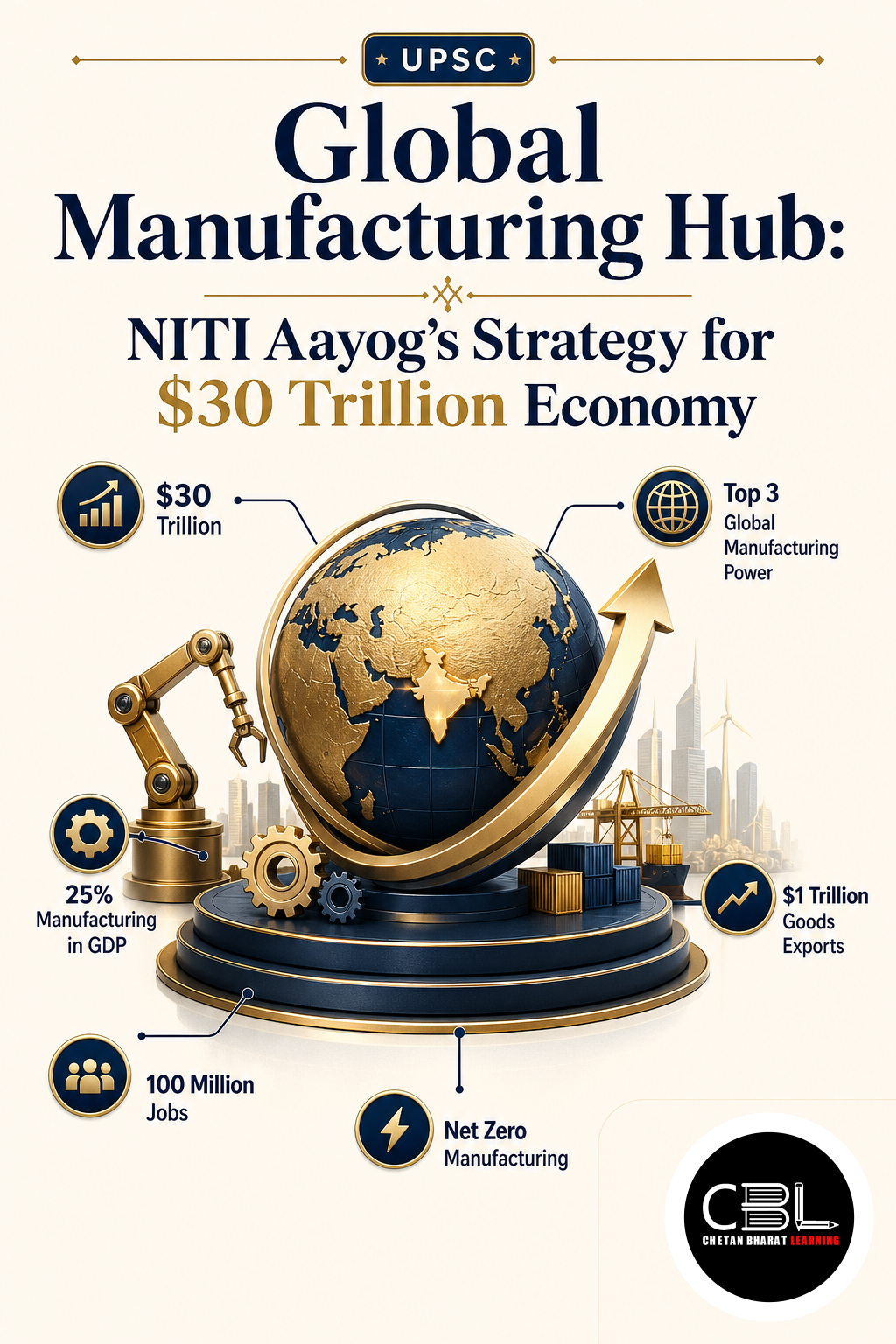
Global Manufacturing Hub is the vision outlined in a NITI Aayog report assessing 12 high-potential manufacturing sectors to position India as a manufacturing powerhouse and drive its transition to a $30 trillion economy by 2047. The first volume assesses the chemicals, textiles, telecommunications, and solar photovoltaic sectors.
The report is part of India’s broader ambition to transition to a $30 trillion economy by 2047. It provides sector-specific recommendations, including scaling up man-made fiber (MMF) production, deepening telecom manufacturing, strengthening upstream solar supply chains, and expanding downstream chemical production.
What is the Global Manufacturing Hub Report?
The Global Manufacturing Hub report, released by NITI Aayog, assesses 12 high-potential manufacturing sectors to position India as a global manufacturing powerhouse. The first volume evaluates the chemicals, textiles, telecommunications, and solar photovoltaic sectors, analysing their current landscape, market potential, and global competitiveness.
Why is Global Manufacturing Hub in News?
The Global Manufacturing Hub report is in the news because it outlines a strategic roadmap for India’s manufacturing renaissance, aligning with the Make in India and Atmanirbhar Bharat initiatives. The textile sector alone supports more than 45 million people and contributes 11% to manufacturing GVA.
The telecom sector, the world’s second-largest with over 1.2 billion subscribers, is targeted to double exports and create 1 million jobs by 2030. The solar sector, with 106 GW installed capacity, aims to strengthen upstream ingot and wafer manufacturing.
Key Features of the Global Manufacturing Hub Report
- Textiles: Second-largest employer, exports $37.7 billion; recommends scaling up MMF and technical textiles.
- Telecom: World’s second-largest market; recommends deepening domestic manufacturing and creating integrated clusters.
- Solar PV: Installed 106 GW; recommends strengthening upstream ingot and wafer manufacturing.
- Chemicals: Limited downstream value addition; recommends expanding production and negotiating balanced FTAs.
- Cross-Sectoral: Integrated clusters, G2G partnerships, and viability gap funding are common recommendations.
Challenges in Achieving Global Manufacturing Hub Status
- Infrastructure Gaps: Logistics, power, and transport infrastructure need significant upgrades.
- Skill Shortages: A skilled workforce for advanced manufacturing is lacking.
- Technology Adoption: Slow adoption of Industry 4.0 and automation.
- Trade Barriers: Protectionist measures in target markets and import duties on raw materials.
- Competition: China and other Asian countries have established manufacturing ecosystems.
Way Forward for Global Manufacturing Hub
To realise the Global Manufacturing Hub vision, India must implement the report’s recommendations with clear timelines and accountability. Strengthening public-private partnerships for infrastructure and skill development is crucial. Sector-specific policies—such as PLI schemes, R&D incentives, and market access agreements—should be tailored to each sector’s needs.
Regulatory reforms to reduce compliance burden and attract FDI are essential. A focus on sustainability and circular economy practices can enhance global competitiveness. Regular monitoring and evaluation of sectoral performance will ensure the strategy remains dynamic.
Prelims Practice Corner
Q1. Which organisation released the ‘Global Manufacturing Hub’ report?
(a) Ministry of Commerce (b) NITI Aayog (c) RBI (d) CII
Answer: NITI Aayog released the report.
Q2. What is India’s economic target by 2047?
(a) $10 trillion (b) $20 trillion (c) $30 trillion (d) $50 trillion
Answer: The target is a $30 trillion economy by 2047.
Q3. How many sectors are assessed in the first volume of the report?
(a) 2 (b) 3 (c) 4 (d) 5
Answer: The first volume assesses chemicals, textiles, telecom, and solar PV.
Q4. Which sector supports more than 45 million people in India?
(a) Telecom (b) Chemicals (c) Textiles (d) Solar PV
Answer: Textiles is the second-largest employer after agriculture.
Q5. What is the installed solar capacity in India as of March 2025?
(a) 50 GW (b) 106 GW (c) 150 GW (d) 200 GW
Answer: India had 106 GW of installed solar capacity by March 2025.
Mains Practice Questions
Q1. Discuss the strategic importance of the Global Manufacturing Hub report for India’s economic transformation and the key sectors identified for growth. (250 words, 15 marks)
Intro: Introduce the report and its vision.
Body: Discuss the four sectors: current status, challenges, recommendations. Analyse how these fit into India’s $30 trillion economy target. Address cross-cutting challenges: infrastructure, skills, competition.
Conclusion: Suggest implementation strategies and policy coherence.
Q2. What is the significance of the textile sector in India’s manufacturing landscape, and what reforms are needed to boost its global competitiveness? (150 words, 10 marks)
Intro: Highlight the textile sector’s employment and export significance.
Body: Discuss challenges: technology adoption, competition from MMF, trade barriers. Suggest reforms: scaling up technical textiles, infrastructure support, trade integration.
Conclusion: Conclude that textile modernisation is key to India’s manufacturing success.
FAQs on Global Manufacturing Hub
What is the Global Manufacturing Hub report?
It is a NITI Aayog report assessing 12 high-potential manufacturing sectors to position India as a global manufacturing powerhouse and achieve a $30 trillion economy by 2047.
Which sectors are covered in the first volume?
The first volume covers chemicals, textiles, telecommunications, and solar photovoltaic sectors.
What is India’s target for the textile sector?
The report recommends scaling up MMF products and technical textiles, and expanding market access through trade integration.
Related Current Affairs
Preparing for UPSC, PCS or HCS?
Talk to a mentor at Chetan Bharat Learning, Chandigarh. Free guidance on choosing the right exam and building a study plan.
Chat on WhatsAppCall 97793 53345UPSC / IAS / PCS coaching in Chandigarh · Trusted by aspirants across Punjab & Haryana
Leave a Reply
You must be logged in to post a comment.