
UPSC Mapping
| Prelims | Science & Technology – Space Technology |
|---|---|
| Mains | GS Paper III – Space Technology and International Cooperation |
Quick Facts
| Current Development | NASA invitation to ISRO |
|---|---|
| Framework | Artemis Accords |
| Key Location | Lunar South Pole |
| Indian Link | Chandrayaan and Gaganyaan |
What is the Moon Base programme?
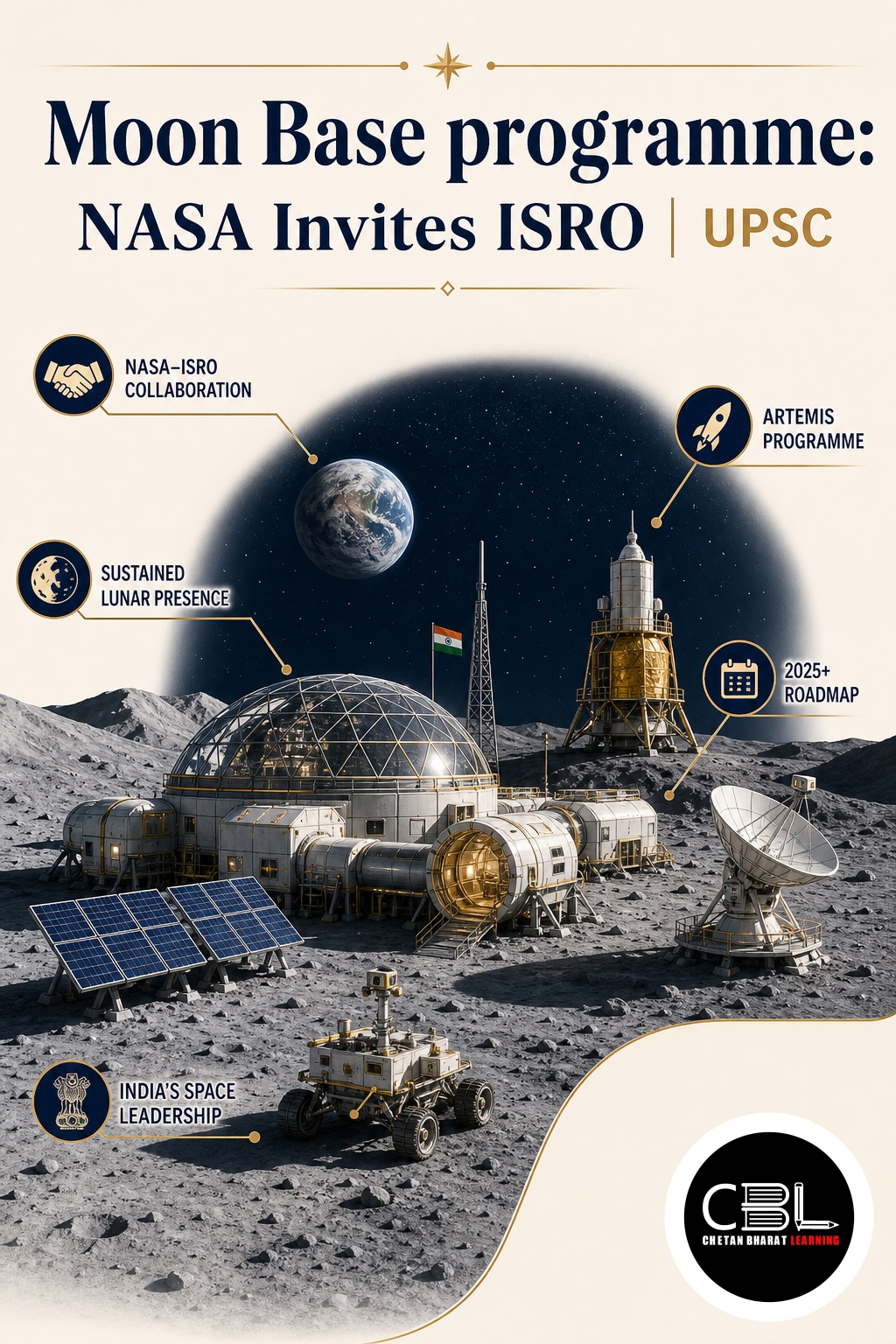
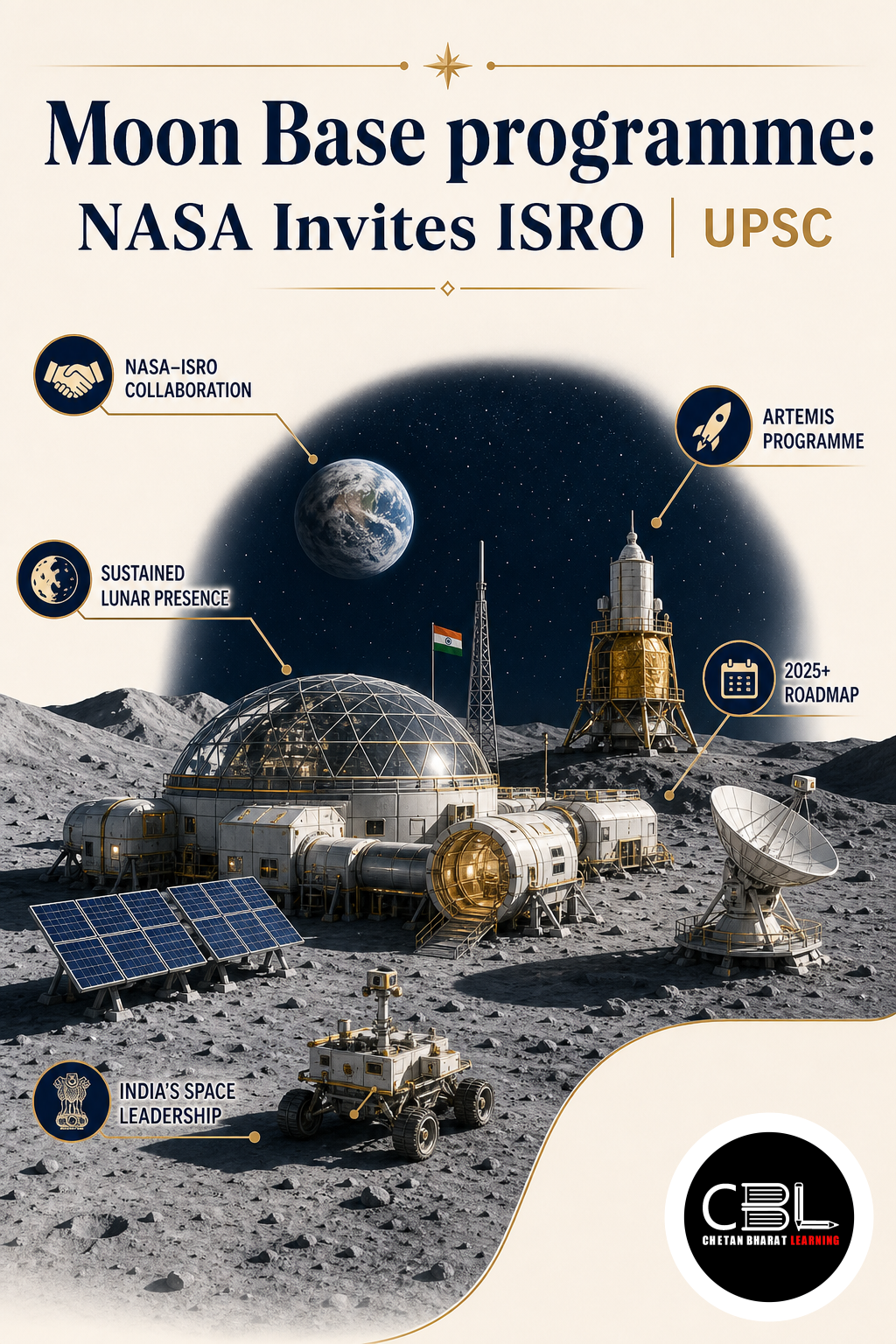
The Moon Base programme refers to NASA’s effort to develop the infrastructure and capabilities required for an enduring human presence on the Moon. Rather than a single spacecraft or one-time landing, it envisions a sustainable outpost involving commercial industry, academia and international partners, with a focus on the lunar South Pole.
Key technology areas include reliable power, autonomous robotics, dust mitigation and in-situ resource utilisation to support repeated missions, scientific research and longer-duration human activity.
Why is the Moon Base programme in News?
NASA has formally invited ISRO to join this long‐duration lunar infrastructure effort, reflecting a shift from episodic scientific missions to sustained exploration and habitation. India’s proven expertise in Chandrayaan missions, launch vehicles and planetary science positions it to contribute technology, science and institutional frameworks within the Artemis Accords.
Key Features
- Sustained lunar presence: Infrastructure for repeated, longer-duration missions rather than short visits.
- South Pole focus: Scientifically valuable terrain with potential water-ice resources.
- International cooperation: Partnerships with agencies, commercial firms and research institutions.
- Technology development: Emphasis on power systems, robotics, resource utilisation and dust mitigation.
- Rules-based exploration: Guided by the Artemis Accords’ principles of peaceful, sustainable and interoperable civil space activities.
Challenges
- Technological complexity: Reliable life-support, power, communications and maintenance systems for long-duration operations.
- Cost and resources: High investment and specialised technologies with long-term institutional commitment.
- Governance and sustainability: Planetary protection, heritage preservation, resource governance under international space law.
- Strategic autonomy: Balancing international collaboration with indigenous capabilities and decision-making.
- Institutional coordination: Aligning ISRO, Department of Space, academia, private sector and foreign partners.
Way Forward
- Adopt capability-based cooperation by identifying durable contributions in lunar science, robotics, communications, life-support and resource utilisation.
- Leverage partnerships to advance India’s human-spaceflight programme, including space medicine and crew training.
- Strengthen space-law and governance expertise to shape responsible lunar operations under the Artemis Accords and Outer Space Treaty.
- Develop a robust private space ecosystem for launch services, robotics, sensors, materials and specialized manufacturing.
- Maintain strategic autonomy through diversified international partnerships beyond the US.
Prelims Practice Corner
-
Q1. With reference to the Artemis Accords, consider the following statements:
1. They provide principles for civil exploration and use of outer space.
2. India became a signatory in 2023.
3. They replace the Outer Space Treaty.
Which of the statements given above are correct?- (a) 1 and 2 only
- (b) 2 and 3 only
- (c) 1 and 3 only
- (d) 1, 2 and 3
Answer: (a) The Accords provide principles for civil exploration and reinforce existing space-law commitments; they do not replace the Outer Space Treaty.
-
Q2. The Moon Base initiative discussed in current affairs is primarily associated with which organisation?
- (a) ESA
- (b) NASA
- (c) ISRO
- (d) JAXA
Answer: (b) NASA is developing the Moon Base effort as part of its broader lunar exploration strategy.
-
Q3. Why is the lunar South Pole important for future exploration?
- (a) It is the only region with an atmosphere
- (b) It offers scientifically valuable terrain and potential access to water ice
- (c) It has Earth’s strongest gravity
- (d) It is permanently connected to Earth by a natural satellite bridge
Answer: (b) The South Pole has scientific importance and areas with potential water-ice resources relevant to sustained exploration.
-
Q4. India became which numbered signatory to the Artemis Accords?
- (a) 21st
- (b) 25th
- (c) 27th
- (d) 30th
Answer: (c) India became the 27th country to sign the Artemis Accords in June 2023.
-
Q5. Which of the following is most directly related to in-situ resource utilisation on the Moon?
- (a) Using locally available lunar materials to support exploration
- (b) Increasing Earth’s atmospheric pressure
- (c) Launching satellites from the ocean
- (d) Replacing all terrestrial resources
Answer: (a) In-situ resource utilisation involves using resources available at the exploration site to support missions and infrastructure.
Mains Practice Questions
-
Q1. Examine the significance of India’s participation in emerging international lunar exploration initiatives. (10 marks)
Answer Structure:
- Intro: Link India’s lunar achievements with the transition from episodic missions towards sustained international lunar exploration.
- Body: Discuss scientific gains, technology transfer, human spaceflight, private-sector opportunities, Artemis Accords, space diplomacy, strategic autonomy and governance challenges.
- Conclusion: Emphasise capability-based cooperation supported by indigenous technological strength and responsible space governance.
-
Q2. The expansion of lunar exploration requires both technological capability and effective international governance. Discuss in the context of India-US space cooperation. (15 marks)
Answer Structure:
- Intro: Explain the shift from short-duration lunar missions towards sustained infrastructure and human presence.
- Body: Cover lunar infrastructure, resource utilisation, scientific cooperation, Artemis Accords, Outer Space Treaty, safety, sustainability, space debris, strategic competition and India’s role in norm-building.
- Conclusion: Advocate peaceful, transparent and sustainable exploration with strong Indian technological and institutional capacity.
FAQs on Moon Base programme
What is NASA’s Moon Base initiative?
It is NASA’s effort to establish infrastructure and capabilities for an enduring human presence on the Moon. The programme focuses on technologies and partnerships needed for sustained exploration, particularly near the lunar South Pole.
Why is NASA’s invitation to ISRO important?
It can broaden India-US space cooperation from existing scientific and human-spaceflight projects towards sustained lunar exploration. It also creates opportunities for Indian scientific and technological capabilities to contribute to an international lunar architecture.
What is India’s connection with the Artemis Accords?
India signed the Artemis Accords on 21 June 2023 and became the 27th signatory. The Accords establish principles for safe, peaceful and sustainable civil exploration while reinforcing existing international space-law commitments.
Related Current Affairs
Preparing for UPSC, PCS or HCS?
Talk to a mentor at Chetan Bharat Learning, Chandigarh. Free guidance on choosing the right exam and building a study plan.
Chat on WhatsAppCall 97793 53345UPSC / IAS / PCS coaching in Chandigarh · Trusted by aspirants across Punjab & Haryana
Leave a Reply
You must be logged in to post a comment.