

UPSC Syllabus Mapping
- GS Paper: GS-III
- Subject: Environment & Ecology — Biodiversity, Species Discovery, Pollinators and Traditional Ecological Knowledge
What is Tetragonula yikhumensis?
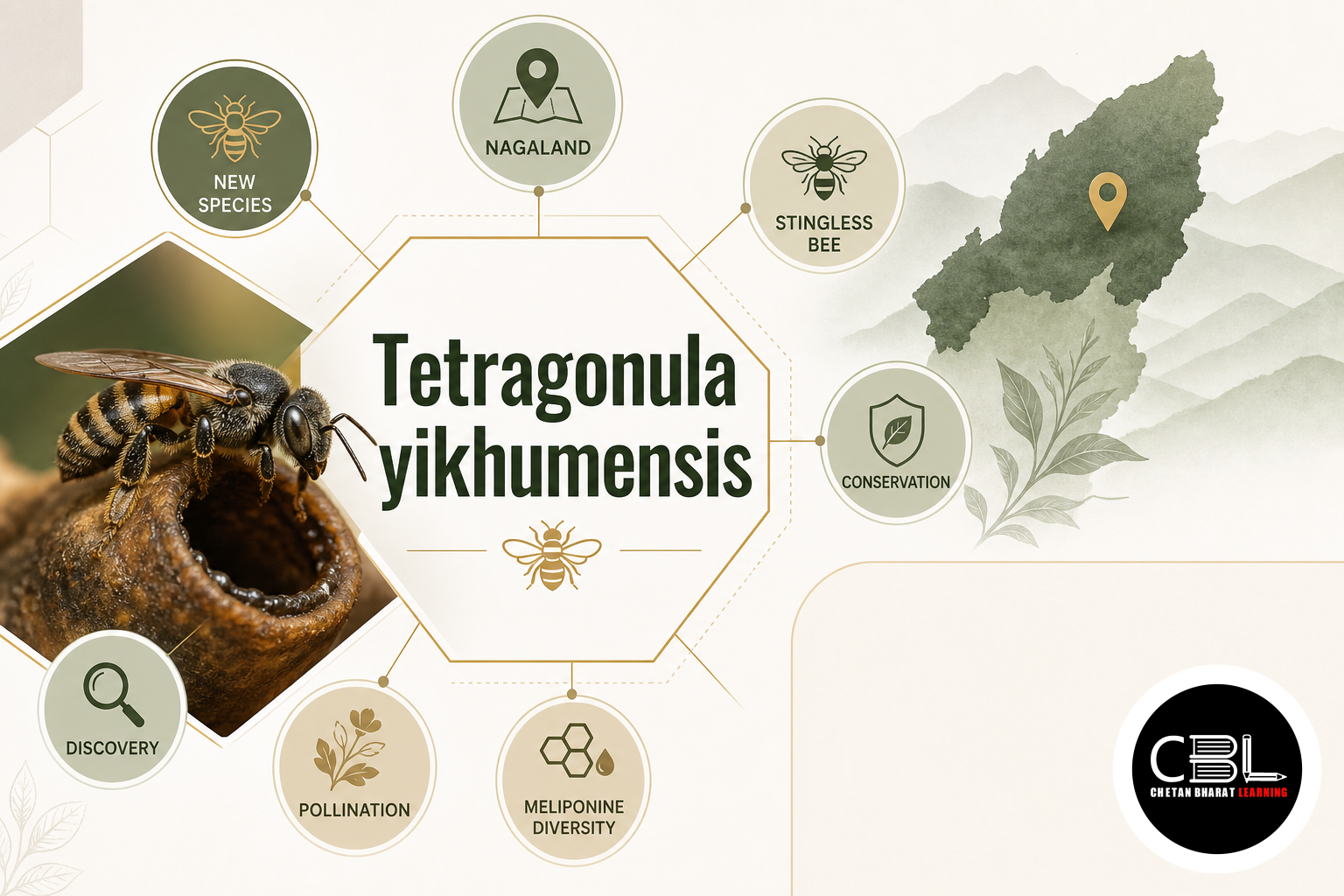
It is a newly identified species belonging to the genus Tetragonula, a group of stingless bees. It was collected from Yikhum village in Wokha district, Nagaland, from which its species name is derived. Stingless bees are social bees belonging to the tribe Meliponini. Despite their common name, they possess greatly reduced stingers that are not used for defensive stinging in the manner familiar from many honey bees.
The newly described bee is remarkable for its subterranean nesting behaviour. Researchers found colonies more than two metres below the ground, connected to the surface by narrow entrance tunnels. The species measures about 5.59 mm in body length and has been reported as the largest stingless bee recorded from India. Its combination of morphology, size and nest characteristics helped researchers distinguish it from previously known Indian members of the genus.
Why is Tetragonula yikhumensis in News?
Researchers recently reported the species from Nagaland’s Wokha district. According to the findings reported with the discovery, its recognition increases the number of known stingless bee species in India from 25 to 26. The genus Tetragonula is now represented by 18 recorded species in the country. It is also reported to be only the second underground-nesting species of this genus documented from India.
The discovery is important beyond the addition of another name to a taxonomic catalogue. Previously undocumented species can provide information about ecological adaptation, pollinator diversity and evolutionary relationships. The finding from Nagaland further underlines the need for systematic biodiversity surveys in India’s Northeast, where complex terrain and diverse habitats can support specialised organisms that remain scientifically under-documented. The Zoological Survey of India is India’s premier institution for faunal exploration, survey, documentation and taxonomy.
Key Features of the New Stingless Bee
Its underground nest is among the most striking aspects of the discovery. Instead of simply occupying a shallow cavity, the observed colonies occurred at substantial depth. This behaviour can influence nest temperature, moisture, defence and interactions with surrounding soil. Understanding such architecture can therefore provide ecological information in addition to helping identify the species.
- Location: The species was discovered in Wokha district of Nagaland in Northeast India.
- Name: It is named after Yikhum village, the locality from which it was first collected.
- Subterranean habitat: Colonies were found more than two metres beneath the ground.
- Large body size: At approximately 5.59 mm in body length, it has been reported as India’s largest recorded stingless bee.
- Organised nest: The underground colonies contain distinct areas associated with honey, pollen and brood.
- Protective material: Nest structures include hard batumen layers. In stingless bees, batumen is a protective construction material produced using substances such as plant resins and wax.
- Surface connection: Narrow tunnels connect the deeply buried colony to the outside environment.
The Lotha community of Wokha refers to subterranean stingless bees as litsuk, meaning ground bees. Their honey and pollen have traditionally been valued locally, including for perceived medicinal uses. Such knowledge can help scientists locate species, understand seasonal behaviour and document ecological relationships. However, traditional medicinal use should be distinguished from scientifically established therapeutic efficacy unless supported by appropriate clinical evidence.
Challenges Related to Pollinator Conservation
Pollinators perform an important ecological function by transferring pollen between flowers, supporting reproduction in many wild and cultivated plants. Bees are among the most prominent animal pollinators. Their ecological value extends beyond honey production because healthy pollinator communities support plant diversity, ecosystem functioning and agricultural production. Less-studied native bees can be particularly important because different species interact with different plants and environmental conditions.
Species with specialised nesting requirements can face distinctive conservation pressures. Land-use change, soil disturbance, habitat degradation, pesticide exposure and loss of flowering resources can affect bee populations. For a deeply subterranean species, activities that disturb soil and underground nest sites may be particularly relevant, although species-specific threats require further ecological research before firm conclusions can be drawn.
Taxonomic gaps create an additional challenge. A species cannot be effectively assessed or conserved if its distribution and ecology are poorly understood. Newly described organisms therefore demonstrate why field surveys, museum collections and taxonomic expertise remain essential components of biodiversity policy. Aspirants can connect such discoveries with broader environmental developments through the UPSC current affairs library.
Way Forward for Native Pollinator Conservation
The discovery strengthens the case for systematic biodiversity inventories across Northeast India. Surveys should document not merely species presence but also nesting habitats, floral associations, geographic range and seasonal activity. Such baseline information is necessary before conservation status, population trends and specific threats can be assessed reliably.
Traditional ecological knowledge should be incorporated ethically into biodiversity research. Local communities often possess detailed knowledge of species locations, behaviour and resource use accumulated through long interaction with their environment. Research partnerships should recognise these contributions and promote sustainable harvesting where bee products are collected. Protecting colonies is particularly important when honey extraction could damage slow-growing or geographically restricted populations.
At a wider level, conservation policy should protect diverse pollinator habitats rather than focusing only on managed honey bees. Reduced pesticide risks, flowering habitat, protection of nesting sites and scientific monitoring can support native bee diversity. The National Biodiversity Authority provides an institutional framework relevant to biodiversity conservation, sustainable use and access and benefit-sharing in India. The Nagaland discovery illustrates how taxonomy, community knowledge and habitat conservation can reinforce one another.
Prelims Practice Corner
1. The recently discovered species Tetragonula yikhumensis is a:
(a) Butterfly
(b) Stingless bee
(c) Beetle
(d) Wasp
Answer
(b) Stingless bee.
2. The species was discovered in:
(a) Wokha district, Nagaland
(b) Tawang district, Arunachal Pradesh
(c) Senapati district, Manipur
(d) West Garo Hills, Meghalaya
Answer
(a) Wokha district, Nagaland.
3. Consider the following statements about the newly discovered bee:
1. It nests underground.
2. Its colonies have been found more than two metres below ground.
3. It belongs to the genus Tetragonula.
Which of the statements given above are correct?
(a) 1 only
(b) 1 and 2 only
(c) 2 and 3 only
(d) 1, 2 and 3
Answer
(d) 1, 2 and 3.
4. Batumen, in the context of stingless bees, is associated with:
(a) Protective nest construction
(b) Wing pigmentation
(c) Venom production
(d) Seasonal migration
Answer
(a) Protective nest construction.
5. Pollinators are ecologically important primarily because they:
(a) Prevent all crop diseases
(b) Facilitate sexual reproduction in many flowering plants
(c) Convert atmospheric nitrogen directly into plant protein
(d) Eliminate invasive plants
Answer
(b) Pollination facilitates reproduction in many flowering plants by transferring pollen.
Mains Practice Questions
1. Recent species discoveries in Northeast India demonstrate the importance of taxonomy for biodiversity conservation. Discuss. (10 marks)
Outline: Species discovery → biodiversity-rich Northeast → taxonomic gaps → ecological baseline → distribution and threat assessment → conservation planning → scientific institutions → community participation.
2. Traditional ecological knowledge can complement modern scientific research in documenting and conserving India’s biodiversity. Examine with suitable examples. (15 marks)
Outline: Meaning of traditional ecological knowledge → community familiarity with species → local names and uses → locating habitats → sustainable resource management → scientific validation → intellectual contribution and benefit-sharing → integration with conservation policy.
FAQs on Tetragonula yikhumensis
What is Tetragonula yikhumensis?
It is a newly described species of stingless bee discovered in Wokha district of Nagaland and distinguished by its morphology, relatively large size and subterranean nesting behaviour.
Why was the species given this name?
The species name refers to Yikhum village in Nagaland, where researchers first collected specimens associated with its scientific description.
What makes this stingless bee unusual?
Its colonies occur deep underground, with observations reporting nests more than two metres below the surface. The nests contain organised honey, pollen and brood areas protected by nest material and connected to the surface through narrow tunnels.
Related Current Affairs
Preparing for UPSC, PCS or HCS?
Talk to a mentor at Chetan Bharat Learning, Chandigarh. Free guidance on choosing the right exam and building a study plan.
Chat on WhatsAppCall 97793 53345UPSC / IAS / PCS coaching in Chandigarh · Trusted by aspirants across Punjab & Haryana
Leave a Reply
You must be logged in to post a comment.