
Why Is This News Important?
The Middle East remains one of the most sensitive regions in global politics.
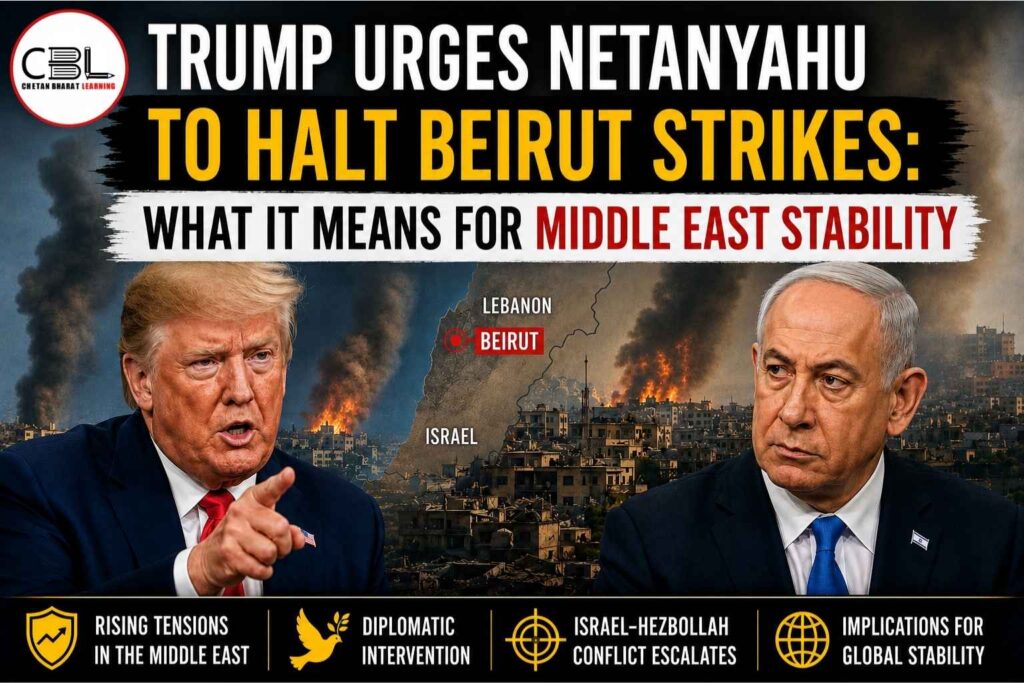
Recently, former US President Donald Trump claimed that he persuaded Israeli Prime Minister Benjamin Netanyahu to halt a planned strike on Beirut. However, Israeli attacks reportedly continued in southern Lebanon, resulting in civilian casualties.
The development highlights the fragile security situation in the region and the challenges of maintaining peace between Israel, Lebanon, and Hezbollah.
For UPSC aspirants, this issue is important from the perspective of International Relations, Regional Security, and Global Geopolitics.
What Happened?
Donald Trump stated that he had a conversation with Benjamin Netanyahu and requested him not to launch a major attack on Beirut.
According to reports, Netanyahu agreed to scale back the operation.
However, Israeli drone strikes continued in southern Lebanon, where at least 11 people were reportedly killed.
At the same time, Hezbollah also remained involved in cross-border tensions, keeping the situation highly volatile.
Background of the Israel-Lebanon Conflict
The conflict between Israel and Lebanon has deep historical roots.
A major factor behind these tensions is Hezbollah, a powerful political and militant group based in Lebanon.
Over the years, clashes between Israel and Hezbollah have repeatedly threatened regional stability.
Moreover, regional powers such as Iran have also played an important role in shaping the conflict.
Why Does Beirut Matter?
Beirut is Lebanon’s capital and political center.
Any large-scale military action in the city could:
- Increase civilian casualties
- Damage critical infrastructure
- Trigger regional escalation
- Worsen humanitarian conditions
Therefore, avoiding direct attacks on Beirut remains a major diplomatic concern.
Key Geopolitical Implications
Rising Regional Instability
The conflict increases tensions across the Middle East.
As a result, neighboring countries remain concerned about a wider regional confrontation.
Impact on Diplomacy
Efforts to maintain ceasefires become more difficult when military operations continue.
This creates challenges for international mediators and peace initiatives.
Iran’s Role
Iran has historically supported Hezbollah.
Consequently, any escalation between Israel and Hezbollah could also affect broader regional power dynamics.
Global Security Concerns
Instability in the Middle East often affects:
- Global energy markets
- International trade routes
- Diplomatic relations
- Regional security arrangements
Therefore, developments in Lebanon receive global attention.
India’s Perspective
India maintains friendly relations with both Israel and Arab nations.
As a result, India generally supports:
- Peaceful dialogue
- Regional stability
- Diplomatic solutions
- Protection of civilians
India also closely monitors developments because instability in the Middle East can impact energy security and the Indian diaspora.
Major Challenges
Several obstacles continue to complicate the situation.
These include:
- Ongoing cross-border attacks
- Political mistrust
- Regional rivalries
- Humanitarian concerns
Without sustained diplomacy, tensions could rise further.
Way Forward
A long-term solution requires cooperation from all stakeholders.
Important steps include:
- Strengthening ceasefire mechanisms
- Encouraging diplomatic dialogue
- Protecting civilians
- Reducing regional tensions
Sustained international engagement will be essential for lasting peace.
Prelims Pointers
| Topic | Key Fact |
|---|---|
| Country | Lebanon |
| Capital | Beirut |
| Major Group | Hezbollah |
| Regional Actor | Israel |
| Region | Middle East |
Mains Perspective
Possible UPSC Question
“The Israel-Lebanon conflict continues to influence regional stability in the Middle East.” Discuss its geopolitical implications.
Key Dimensions
- Regional security
- Role of Hezbollah
- Iran-Israel rivalry
- Humanitarian concerns
- Energy security
- Diplomatic challenges
Frequently Asked Questions (FAQ)
Why is Beirut strategically important?
Beirut is Lebanon’s political, economic, and administrative center.
Who is Hezbollah?
Hezbollah is a Lebanese political and militant organization with significant influence in the region.
Why is the Middle East important globally?
The region plays a crucial role in energy supplies, trade routes, and international security.
What is India’s position?
India supports peaceful dialogue and regional stability.
Conclusion
Trump’s intervention and the continuing strikes in southern Lebanon highlight the complexity of the Israel-Lebanon conflict.
While diplomatic efforts continue, the risk of escalation remains significant. Ensuring regional stability will require dialogue, restraint, and sustained international cooperation.
“Lasting peace in the Middle East depends on diplomacy, trust, and regional cooperation.”
Related Current Affairs
Preparing for UPSC, PCS or HCS?
Talk to a mentor at Chetan Bharat Learning, Chandigarh. Free guidance on choosing the right exam and building a study plan.
Chat on WhatsAppCall 97793 53345UPSC / IAS / PCS coaching in Chandigarh · Trusted by aspirants across Punjab & Haryana
Leave a Reply
You must be logged in to post a comment.