

UPSC Mapping
| Prelims | Indo-Pacific, Strait of Hormuz, Strait of Malacca, IMEC, INSTC |
|---|---|
| Mains | GS Paper II – International Relations and India’s Foreign Policy |
| Theme | Strategic Autonomy |
|---|---|
| Focus | Geometry of Interests |
| Subject | International Relations |
Article
What is India strategic autonomy?
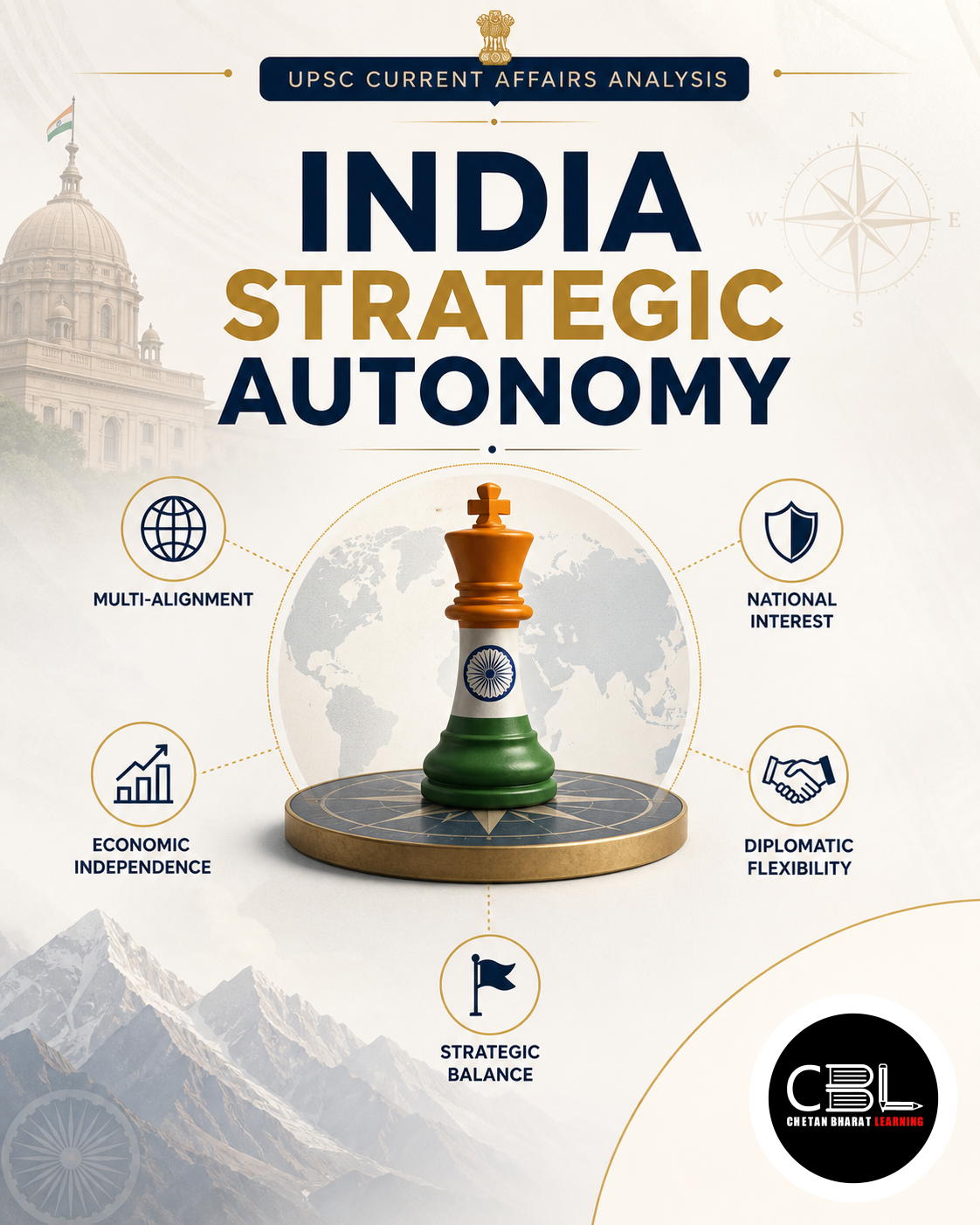
India strategic autonomy refers to the country’s ability to pursue its national interests independently without becoming permanently aligned with any major power bloc. It enables India to cooperate with multiple countries while retaining the freedom to make sovereign foreign policy decisions.
The concept has evolved from the earlier doctrine of non-alignment into a pragmatic approach that balances partnerships with the United States, Europe, Russia, Japan, ASEAN, the Gulf countries and Africa according to India’s interests.
Why is India strategic autonomy in News?
India’s strategic thinking should move beyond a purely geographical perspective and adopt a broader geometry of interests. Economic connectivity, energy security, supply chains and maritime routes now influence national security as much as geographical proximity.
The article highlights that India’s expanding interests stretch from the Indo-Pacific to West Asia, Africa and Europe through maritime partnerships and connectivity initiatives. Information on India’s foreign policy priorities is available from the Ministry of External Affairs (MEA website).
Key Features
- Geometry of interests: Partnerships are based on shared strategic and economic interests rather than only geographical proximity.
- Maritime security: Protecting sea lanes, ports and underwater infrastructure has become central to national security.
- Energy security: Stable access to crude oil and natural gas from West Asia remains a strategic priority.
- Indo-Pacific vision: India supports a free, open, inclusive and rules-based Indo-Pacific.
- Connectivity initiatives: Corridors such as IMEC and INSTC seek to improve trade, logistics and regional integration.
Challenges
- Geopolitical rivalry: Intensifying competition among major powers affects regional stability.
- Maritime threats: Piracy, terrorism and disruptions to shipping lanes threaten trade.
- Energy dependence: Heavy reliance on imported energy exposes India to external shocks.
- Supply chain disruptions: Global conflicts can interrupt critical imports and exports.
- Balancing partnerships: Maintaining strategic autonomy while deepening multiple partnerships requires careful diplomacy.
Way Forward
India should continue strengthening maritime capabilities, diversify energy sources and improve strategic connectivity through regional corridors. Greater investment in logistics, digital infrastructure and resilient supply chains will reinforce long-term strategic autonomy.
At the diplomatic level, India should continue engaging multiple partners while preserving policy independence based on national interests. Additional policy information is available from the Ministry of External Affairs (MEA website).
Prelims Practice Corner
-
Q1. Strategic autonomy implies:
- (a) Permanent military alliances
- (b) Independent decision-making based on national interest
- (c) Isolation from global affairs
- (d) Fixed neutrality
Answer: (b)
-
Q2. Which strait is critical for India’s energy imports from West Asia?
- (a) Bosporus
- (b) Strait of Hormuz
- (c) Bering Strait
- (d) Dover Strait
Answer: (b)
-
Q3. The Strait of Malacca connects:
- (a) Indian Ocean and Pacific Ocean
- (b) Atlantic and Pacific Oceans
- (c) Mediterranean and Black Sea
- (d) Arctic and Atlantic Oceans
Answer: (a)
-
Q4. IMEC stands for:
- (a) India-Middle East-Europe Corridor
- (b) International Maritime Energy Council
- (c) Indian Military Economic Command
- (d) Indo-Mediterranean Export Council
Answer: (a)
-
Q5. India’s Indo-Pacific vision emphasizes:
- (a) Territorial expansion
- (b) Free, open and inclusive maritime order
- (c) Military bloc politics
- (d) Economic isolation
Answer: (b)
Mains Practice Questions
-
Q1. Explain the concept of strategic autonomy in India’s foreign policy. (10 Marks)
Answer Structure:
- Intro: Define strategic autonomy.
- Body: Evolution, objectives, examples and challenges.
- Conclusion: Importance in a multipolar world.
-
Q2. Discuss how the ‘geometry of interests’ is reshaping India’s foreign policy priorities. (15 Marks)
Answer Structure:
- Intro: Explain the concept.
- Body: Maritime security, energy security, connectivity, Indo-Pacific and strategic partnerships.
- Conclusion: National interest as the guiding principle.
FAQs on India strategic autonomy
What is strategic autonomy?
It is India’s ability to pursue independent foreign policy decisions based on national interests without permanent alignment with any power bloc.
What is the geometry of interests?
It refers to building partnerships based on shared strategic, economic and security interests rather than only geographical proximity.
Why is the Indo-Pacific important for India?
The Indo-Pacific carries a large share of global trade and energy flows, making it central to India’s economic growth, maritime security and regional diplomacy.
Related Current Affairs
Preparing for UPSC, PCS or HCS?
Talk to a mentor at Chetan Bharat Learning, Chandigarh. Free guidance on choosing the right exam and building a study plan.
Chat on WhatsAppCall 97793 53345UPSC / IAS / PCS coaching in Chandigarh · Trusted by aspirants across Punjab & Haryana
Leave a Reply
You must be logged in to post a comment.