
Why the Debate Has Emerged
Recent geopolitical developments have highlighted a growing challenge for countries engaged in global trade: the increasing use of unilateral sanctions as a foreign policy tool.
In response, India is exploring legal mechanisms to protect domestic businesses from the impact of foreign sanctions that are not approved under international law.
The proposed framework seeks to ensure that Indian companies can continue legitimate commercial activities without facing indirect pressure from external sanctions regimes.
The discussion reflects a broader shift toward economic sovereignty and strategic autonomy in an increasingly fragmented global order.
Students preparing through UPSC Coaching in Chandigarh and IAS Coaching in Chandigarh should closely follow topics like sanctions, economic statecraft, strategic autonomy, international trade law, and geopolitical competition because these themes are highly important for GS Paper 2, GS Paper 3, Essay, and UPSC Interview preparation.
What Is an Anti-Sanctions Law?
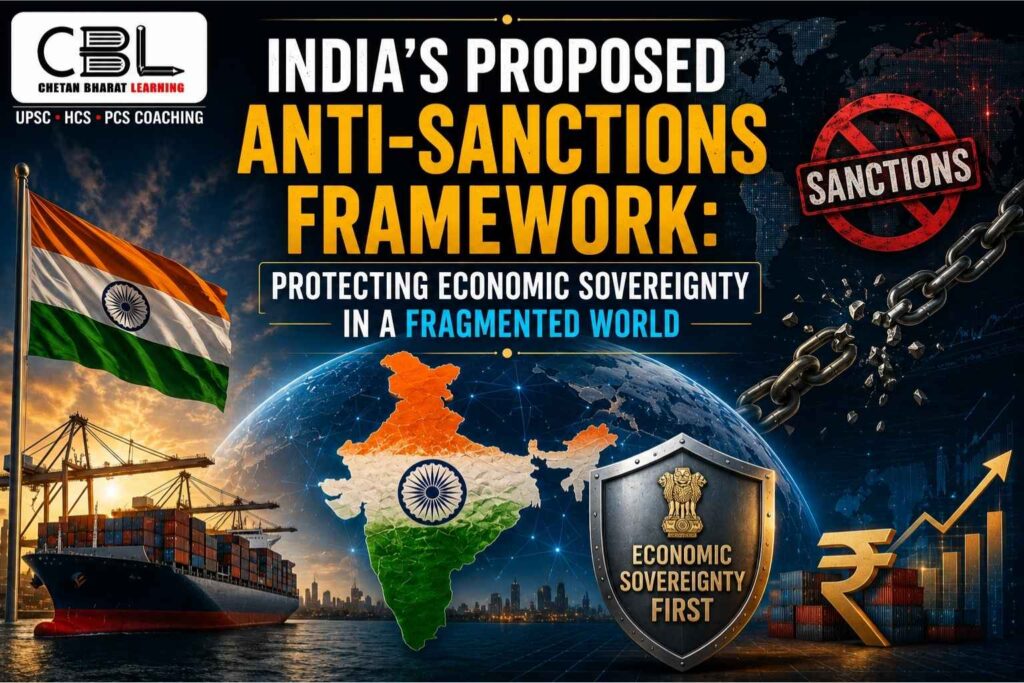
An anti-sanctions law is a legal framework designed to protect domestic individuals and companies from the extraterritorial impact of foreign sanctions.
Such laws generally aim to:
- Prevent compliance with certain foreign sanctions
- Protect domestic commercial interests
- Preserve national economic sovereignty
- Reduce vulnerability to external economic pressure
Many countries have adopted similar legal mechanisms to safeguard their businesses from foreign regulatory actions.
Understanding the Concept of a Blocking Statute
A blocking statute is one of the most common anti-sanctions tools used globally.
It is designed to:
✔ Prevent recognition of certain foreign judgments
✔ Restrict compliance with specific foreign sanctions
✔ Protect domestic businesses from external legal pressures
The objective is to ensure that domestic law remains the primary legal authority for businesses operating within national jurisdiction.
Why Is India Considering Such a Framework?
1. Increasing Use of Economic Sanctions
Sanctions have become an important instrument of modern geopolitical competition.
Countries increasingly use:
- Trade restrictions
- Financial sanctions
- Technology controls
- Investment limitations
to influence the behavior of other states.
This has expanded the economic dimension of international relations.
2. Protecting Domestic Businesses
Indian companies engaged in global trade may face uncertainty when different jurisdictions impose conflicting legal requirements.
An anti-sanctions framework could:
- Provide legal clarity
- Reduce compliance uncertainty
- Strengthen investor confidence
- Protect legitimate commercial activities
3. Strengthening Strategic Autonomy
India’s foreign policy traditionally emphasizes strategic autonomy.
This principle allows India to:
- Pursue independent decision-making
- Maintain diversified partnerships
- Avoid excessive dependence on any single bloc
An anti-sanctions framework aligns with this broader strategic objective.
The International Legal Dimension
The issue raises important questions about:
- Sovereignty
- Jurisdiction
- International trade law
- Enforcement of foreign judgments
Different countries often interpret sanctions and extraterritorial jurisdiction differently, creating legal complexities for multinational businesses.
As global economic interdependence increases, such disputes are becoming more frequent.
Potential Benefits of an Anti-Sanctions Framework
Economic Benefits
✔ Protection of domestic firms
✔ Greater legal certainty
✔ Improved business confidence
Strategic Benefits
✔ Enhanced policy autonomy
✔ Reduced external economic pressure
✔ Stronger national resilience
Diplomatic Benefits
✔ Greater flexibility in foreign policy
✔ Balanced engagement with multiple partners
Challenges and Concerns
Despite its potential advantages, an anti-sanctions framework may face several challenges.
Legal Complexity
Conflicting legal obligations across jurisdictions may create compliance difficulties for multinational companies.
Trade and Investment Risks
Foreign investors may seek greater clarity regarding regulatory expectations and dispute resolution mechanisms.
Diplomatic Sensitivities
Anti-sanctions measures can sometimes create friction with countries imposing sanctions.
Balancing national interests with international partnerships remains important.
Sanctions and the Changing Global Order
The debate reflects a broader transformation in global politics.
Economic instruments such as:
- Sanctions
- Export controls
- Supply-chain restrictions
- Technology barriers
are increasingly being used as tools of geopolitical competition.
This trend is often described as the rise of economic statecraft.
Countries are therefore seeking mechanisms to improve resilience against external economic shocks.
Prelims Pointers
Key Concept
Blocking Statute
Related Themes
- Economic Sovereignty
- Strategic Autonomy
- International Trade Law
- Extraterritorial Jurisdiction
Important Area
Economic Statecraft
Mains Perspective
Possible Question
“Economic sanctions have emerged as a major instrument of geopolitical competition. Discuss the implications for India’s strategic autonomy and economic sovereignty.”
Key Dimensions to Include
- Strategic autonomy
- Economic sovereignty
- Global trade governance
- International law
- Geopolitical competition
- Economic statecraft
Frequently Asked Questions (FAQ)
What is a blocking statute?
A blocking statute is a legal mechanism used to protect domestic businesses from the effects of certain foreign sanctions or judgments.
Why is India considering an anti-sanctions framework?
India seeks to protect domestic businesses, strengthen economic sovereignty, and preserve strategic autonomy amid growing geopolitical competition.
How are sanctions used in international relations?
Sanctions are economic and financial measures used by countries to influence the behavior of other states or entities.
What is economic statecraft?
Economic statecraft refers to the use of economic tools such as trade, investment, and sanctions to achieve foreign policy objectives.
Conclusion: Balancing Sovereignty and Global Integration
India’s proposed anti-sanctions framework reflects a larger global trend in which countries are seeking to protect their economic interests amid rising geopolitical tensions.
The debate is not simply about sanctions. It touches upon:
- Sovereignty
- Strategic autonomy
- Trade governance
- Economic resilience
As the global economy becomes increasingly shaped by geopolitical competition, countries will continue searching for mechanisms that balance international integration with national economic security.
“In an era where economics and geopolitics are deeply intertwined, economic sovereignty is becoming an essential pillar of national power.”
Related Current Affairs
Preparing for UPSC, PCS or HCS?
Talk to a mentor at Chetan Bharat Learning, Chandigarh. Free guidance on choosing the right exam and building a study plan.
Chat on WhatsAppCall 97793 53345UPSC / IAS / PCS coaching in Chandigarh · Trusted by aspirants across Punjab & Haryana
Leave a Reply
You must be logged in to post a comment.