
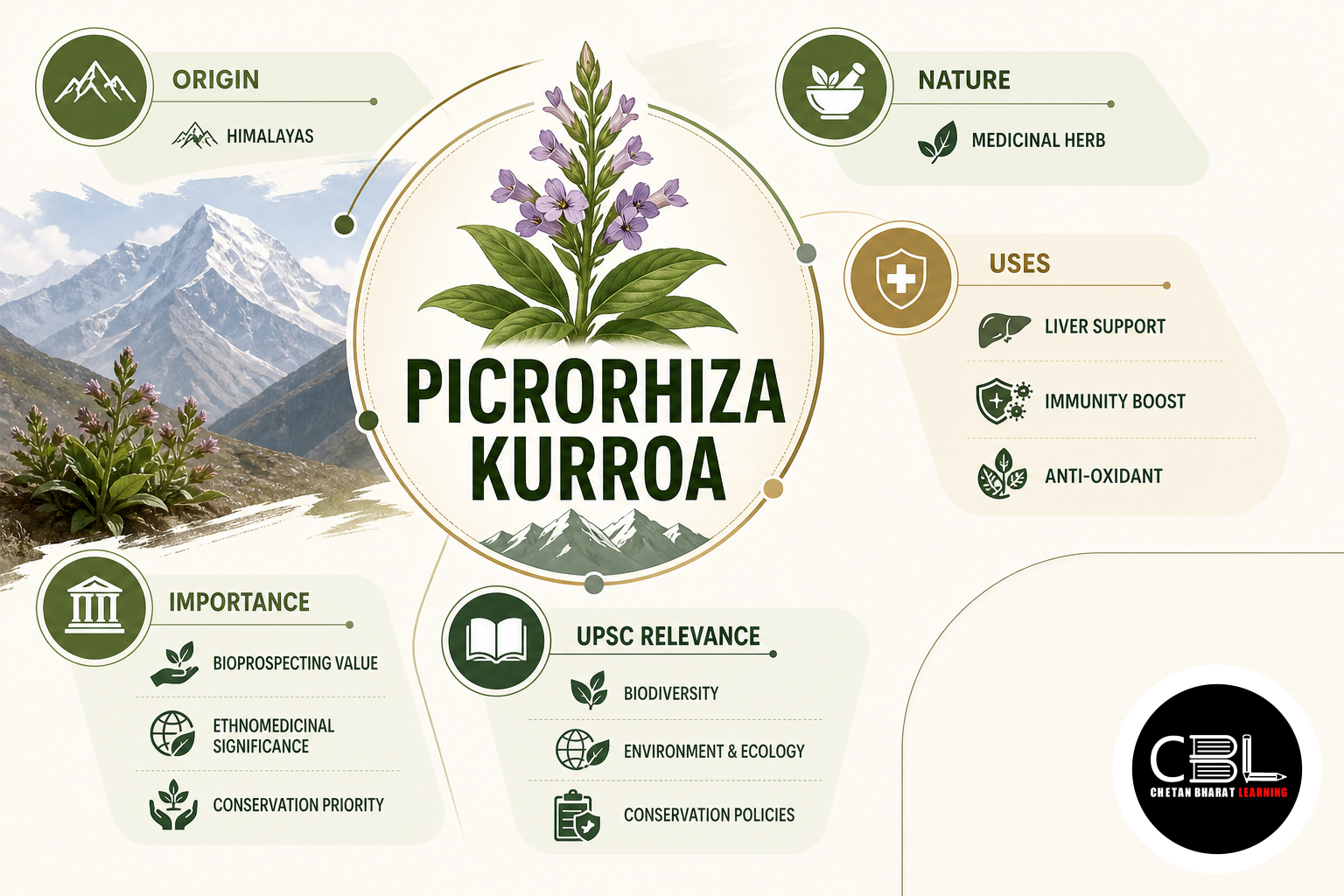

UPSC Syllabus Mapping
- GS Paper: GS-III
- Subject: Environment & Ecology — Biodiversity Conservation, Himalayan Ecosystems, Medicinal Plants and Sustainable Agriculture
What is Picrorhiza kurroa?
It is a perennial herbaceous medicinal plant associated with the Himalayan region and commonly known as Kutki. The plant possesses underground rhizomes, which are modified stems capable of storing nutrients and producing new shoots. The name is derived from Greek roots associated with the idea of a bitter root, reflecting the strongly bitter character for which the medicinal plant is known.
Kutki occurs in high-altitude alpine and sub-alpine habitats, generally in cool and moist Himalayan environments. It has been reported across Himalayan regions extending through parts of India and neighbouring areas. In India, its occurrence is associated with the western and eastern Himalayas, including regions from Kashmir and Uttarakhand towards Sikkim. Its specialised ecological requirements make the species sensitive to changes in habitat and harvesting pressure.
Why is Picrorhiza kurroa in News?
A sustainable cultivation initiative involving farmers in Himachal Pradesh’s Mandi district has shown promise in reducing dependence on collection from wild populations. Cultivation is important for commercially valuable medicinal plants because market demand can otherwise translate into intensive extraction from natural habitats. In species where underground parts such as roots or rhizomes are harvested, destructive collection can be particularly damaging because removing the commercially valuable portion may kill or severely weaken the plant.
Cultivating medicinal plants on farms can create a legal and traceable source of raw material while providing income opportunities in mountain regions. However, successful cultivation requires suitable planting material, appropriate altitude, soil and moisture conditions, as well as reliable market linkages. India’s National Medicinal Plants Board works to support conservation, cultivation and sustainable management of medicinal plant resources.
Key Features of Picrorhiza kurroa
The plant is adapted to demanding mountain environments. Its natural habitats occur at elevations of roughly 2,700 to 4,500 metres, where temperatures remain relatively low and growing seasons are constrained. It generally favours moist sites and can perform well on comparatively less-exposed slopes. These ecological preferences help explain why large-scale cultivation outside suitable Himalayan conditions can be difficult.
- Growth form: Perennial herb possessing underground rhizomes.
- Local name: Known as Kutki in India.
- Habitat: Alpine and sub-alpine Himalayan environments at high elevations.
- Moisture requirement: Moist, relatively protected slopes.
- Soil: Porous and well-structured soils aid rhizome spread and shoot production.
- Propagation: By seeds or vegetatively through rhizomes, stolons or offsets.
- Rainfall sensitivity: Requires good drainage to avoid waterlogging.
A stolon is a stem growing along or above the soil that produces new plants at its nodes; a rhizome is a horizontally growing underground stem. Both structures support propagation and survival in perennial plants. Proper soil porosity and drainage are essential for rhizome development in cultivation.
Challenges Related to Himalayan Medicinal Plants
The principal conservation challenge is balancing demand with regeneration. Wild collection becomes unsustainable when extraction exceeds recovery. Harvesting underground parts can remove reproductive and storage organs, threatening population viability.
High-altitude Himalayan ecosystems are vulnerable to climate change, habitat disturbance, grazing pressure and poorly regulated collection. Sustainable cultivation can reduce hunting pressure but cannot replace the need to conserve genetically diverse populations in situ.
International trade controls also apply. Kutki is listed in CITES Appendix II, meaning trade is regulated to ensure it does not threaten the species’ survival in the wild. Understanding this distinction is important for UPSC.
Way Forward for Medicinal Plant Conservation
A balanced strategy should combine in-situ and ex-situ conservation. In-situ protection maintains wild populations in their natural setting, preserving genetic diversity and ecological interactions. Ex-situ approaches—nurseries, seed banks, botanical collections and cultivation—provide planting material, support research and relieve pressure on wild stocks.
Farmer-based cultivation becomes attractive with quality planting material, technical guidance, assured procurement and transparent pricing. Traceability systems distinguish cultivated material from unsustainably collected wild stocks. Local communities should share economic benefits, as their knowledge and stewardship are vital.
Research should focus on propagation techniques, genetic diversity, climate resilience and sustainable harvesting protocols. Traditional use does not guarantee clinical efficacy, so unsupported medical claims should be avoided. International trade must adhere to CITES safeguards. Sustainable cultivation, habitat conservation and regulated trade together provide a stronger model than reliance on wild extraction alone.
Prelims Practice Corner
1. Kutki, sometimes seen in environmental current affairs, refers to:
- (a) A Himalayan medicinal herb
- (b) A cold-water fish
- (c) A high-altitude pheasant
- (d) A traditional irrigation system
Answer: (a) A Himalayan medicinal herb.
2. Consider the following statements regarding Kutki:
1. It is associated with alpine and sub-alpine Himalayan habitats.
2. It is a perennial herb with rhizomes.
3. Its propagation can occur through both seeds and vegetative structures.
Which of the statements given above are correct?
- (a) 1 only
- (b) 1 and 2 only
- (c) 2 and 3 only
- (d) 1, 2 and 3
Answer: (d) 1, 2 and 3.
3. A rhizome is best described as:
- (a) A modified underground stem
- (b) A specialised flower
- (c) A fungal spore
- (d) A type of taproot only
Answer: (a) A modified underground stem.
4. If a species is included in CITES Appendix II, it generally means that:
- (a) All possession of the species is globally prohibited
- (b) International trade is regulated to avoid utilisation incompatible with its survival
- (c) It has necessarily become extinct in the wild
- (d) It can be traded internationally without documentation
Answer: (b) Appendix II regulates trade to ensure it does not threaten survival.
5. Which of the following can help conserve threatened medicinal plants?
1. Cultivation outside wild populations
2. Habitat protection
3. Sustainable harvesting protocols
4. Traceability of commercial plant material
Select the correct answer:
- (a) 1 and 2 only
- (b) 2 and 3 only
- (c) 1, 3 and 4 only
- (d) 1, 2, 3 and 4
Answer: (d) 1, 2, 3 and 4.
Mains Practice Questions
1. Sustainable cultivation of high-value medicinal plants can simultaneously support biodiversity conservation and mountain livelihoods. Discuss. (10 marks)
Outline: Medicinal plant demand → wild harvesting pressure → Himalayan ecological vulnerability → cultivation → farmer income → traceability → market linkages → in-situ conservation → sustainable livelihood-conservation model.
2. Conservation of Himalayan medicinal flora requires an approach extending beyond legal protection of individual species. Examine. (15 marks)
Outline: High-altitude ecosystems → habitat loss and climate change → destructive harvesting → genetic diversity → in-situ and ex-situ conservation → community participation → cultivation → research → regulated trade under CITES → landscape-level protection.
FAQs on Picrorhiza kurroa
Where is Kutki naturally found?
Kutki is associated with alpine and sub-alpine environments of the Himalayan region, generally occurring at high elevations in cool and moist habitats.
Which parts of Kutki are traditionally used?
The underground rhizomes and roots are important plant materials used in traditional medicinal preparations. Their commercial value is also one reason sustainable cultivation and harvesting are important.
Why can cultivation help conserve the species?
Farm cultivation can provide an alternative source of medicinal raw material, potentially reducing destructive collection from wild populations while creating livelihood opportunities for Himalayan farmers.
Related Current Affairs
Preparing for UPSC, PCS or HCS?
Talk to a mentor at Chetan Bharat Learning, Chandigarh. Free guidance on choosing the right exam and building a study plan.
Chat on WhatsAppCall 97793 53345UPSC / IAS / PCS coaching in Chandigarh · Trusted by aspirants across Punjab & Haryana
Leave a Reply
You must be logged in to post a comment.