
Important for:
UPSC, Haryana HCS, Punjab PCS
Prelims: Internal security, counter-terror operations, defence preparedness
Mains: GS Paper 3 — Internal Security, Defence, Terrorism
Why in News?
On the first anniversary of:
→ Operation Sindoor
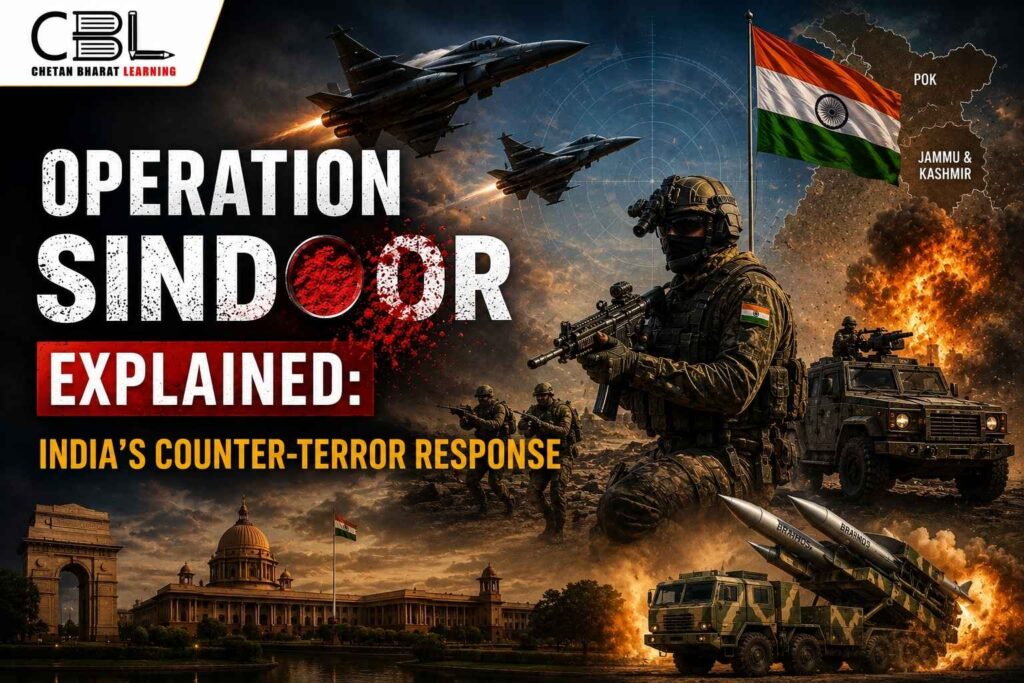
Prime Minister Narendra Modi praised the armed forces for their role in conducting precision strikes against terror camps and military infrastructure in Pakistan and Pakistan-occupied Kashmir (PoK).
What Was Operation Sindoor?
Operation Sindoor was:
→ A coordinated military counter-terror operation
involving:
✔ Indian Army
✔ Indian Air Force
✔ Indian Navy
The operation reportedly targeted:
✔ Terror infrastructure
✔ Militant camps
✔ Strategic military locations
Objectives of the Operation
1. Counter-Terror Action
To respond against:
→ Terror threats and attacks.
2. National Security
To strengthen:
✔ India’s security posture
✔ Border preparedness
3. Strategic Deterrence
To send a message against:
→ Cross-border terrorism.
Key Features Highlighted
Precision Strikes
The operation reportedly used:
✔ Coordinated strikes
✔ High operational preparedness
✔ Joint military action
Defence Coordination
The mission showcased:
→ Jointness among armed forces.
Self-Reliance Push
The operation also highlighted:
→ Atmanirbhar Bharat in defence preparedness.
Why Counter-Terror Operations Matter
Such operations aim to:
✔ Deter terror groups
✔ Protect civilians
✔ Maintain territorial integrity
✔ Strengthen strategic credibility
Strategic Challenges
1. Escalation Risks
Military actions can increase:
⇢ Regional tensions.
2. Diplomatic Sensitivity
Cross-border operations require:
✔ Strategic balancing
✔ International communication
3. Hybrid Warfare
Modern terrorism increasingly uses:
✔ Technology
✔ Proxy networks
✔ Asymmetric warfare
Broader Security Context
India’s security strategy now focuses on:
✔ Intelligence coordination
✔ Precision operations
✔ Border surveillance
✔ Defence modernisation
Special Note for Aspirants
Students preparing through:
UPSC coaching Chandigarh
or
IAS coaching Chandigarh
should focus on:
✔ Internal Security
✔ Cross-border terrorism
✔ Defence modernisation
✔ Military jointness
These topics are highly important for:
⇢ GS3 + Essay + Interview.
Key Insight for UPSC
⇢ Modern national security is not limited to warfare alone.
It combines:
✔ Technology
✔ Intelligence
✔ Diplomacy
✔ Strategic deterrence
PRELIMS PRACTICE QUESTIONS
Q1. Operation Sindoor is related to:
A. Agriculture reforms
B. Counter-terror operations
C. Banking regulation
D. Space exploration
⇢ Answer: B
Q2. Which GS paper covers Internal Security?
A. GS1
B. GS2
C. GS3
D. GS4
⇢ Answer: C
Q3. Joint military operations involve:
A. Only Army
B. Only Navy
C. Coordination among multiple armed forces
D. Police forces only
⇢ Answer: C
Q4. Cross-border terrorism is mainly associated with:
A. Climate policy
B. Internal security challenges
C. Agriculture issues
D. Judicial reforms
⇢ Answer: B
Q5. “Atmanirbhar Bharat” in defence focuses on:
A. Import dependence
B. Self-reliance in defence production
C. Foreign military bases
D. Tourism
⇢ Answer: B
CBL Mains Practice Question
“Counter-terror operations are increasingly shaped by technology, military coordination and strategic deterrence.”
Discuss with reference to India’s internal security framework.
FAQs
1. What was Operation Sindoor?
A counter-terror military operation by Indian armed forces.
2. Which forces participated?
Army, Air Force and Navy.
3. Why is it important?
It reflects India’s counter-terror preparedness.
4. Which GS paper covers this topic?
GS Paper 3.
5. What is the broader theme?
Internal security and defence modernisation.
Leave a Reply
You must be logged in to post a comment.