
UPSC Syllabus Mapping
- GS Paper: GS-III
- Subject: Indian Economy — FDI, External Trade, MSMEs and Digital Economy
What is E-commerce Exports?
The term refers to goods and services sold to overseas customers through digital commerce channels. Unlike conventional export chains, online platforms can connect relatively small Indian producers directly with consumers or businesses in foreign markets. Digital discovery, electronic payments and platform-based logistics can reduce some of the traditional barriers associated with finding international buyers and establishing overseas distribution networks.
Two business models are important for understanding the policy. Under a marketplace model, the platform primarily provides digital infrastructure connecting independent buyers and sellers and does not own the inventory offered by sellers. Under an inventory-based model, the e-commerce entity owns or controls the goods and sells them to consumers. India’s FDI rules have traditionally treated these models differently, particularly where domestic retail competition is concerned.
Why is E-commerce Exports in News?
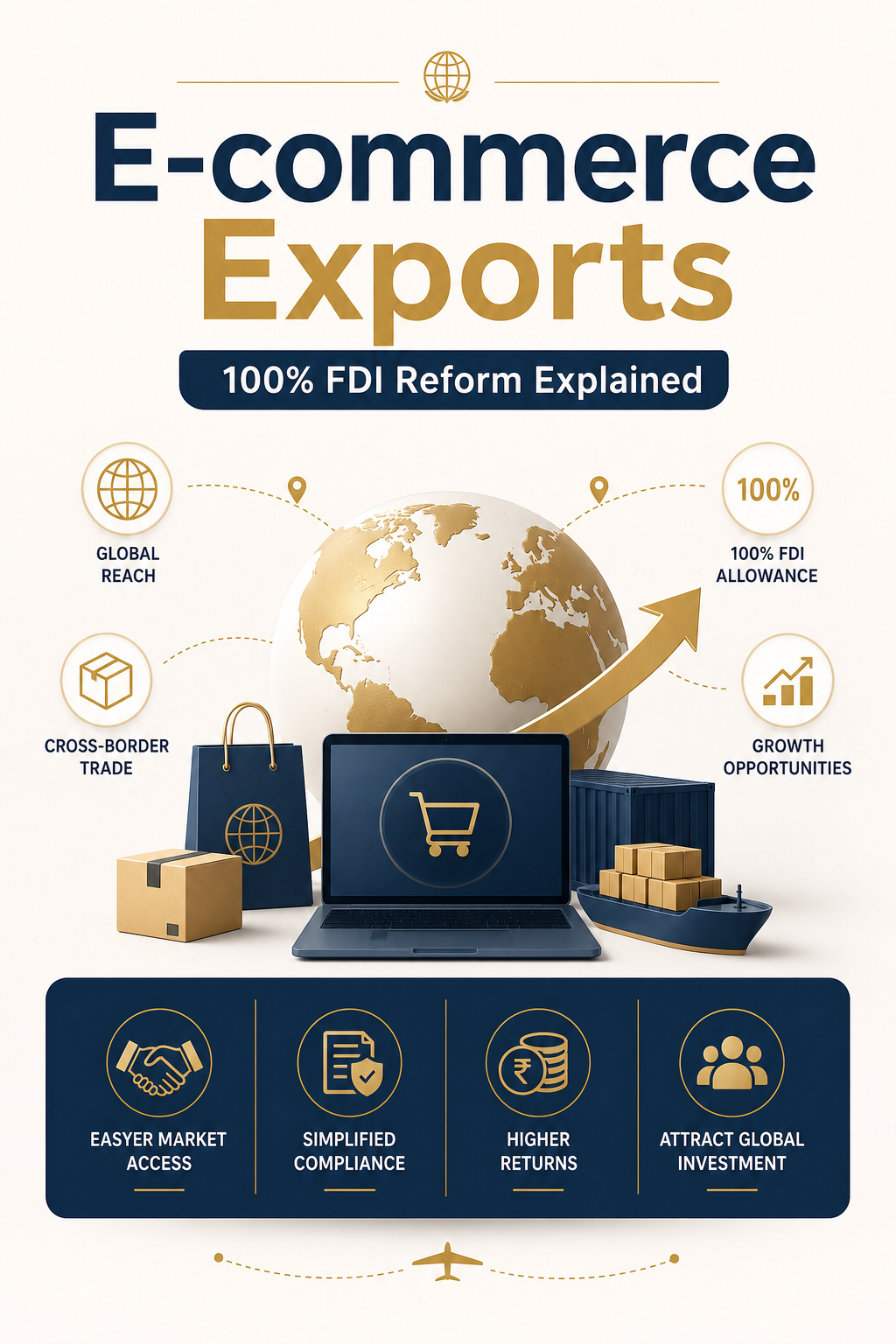
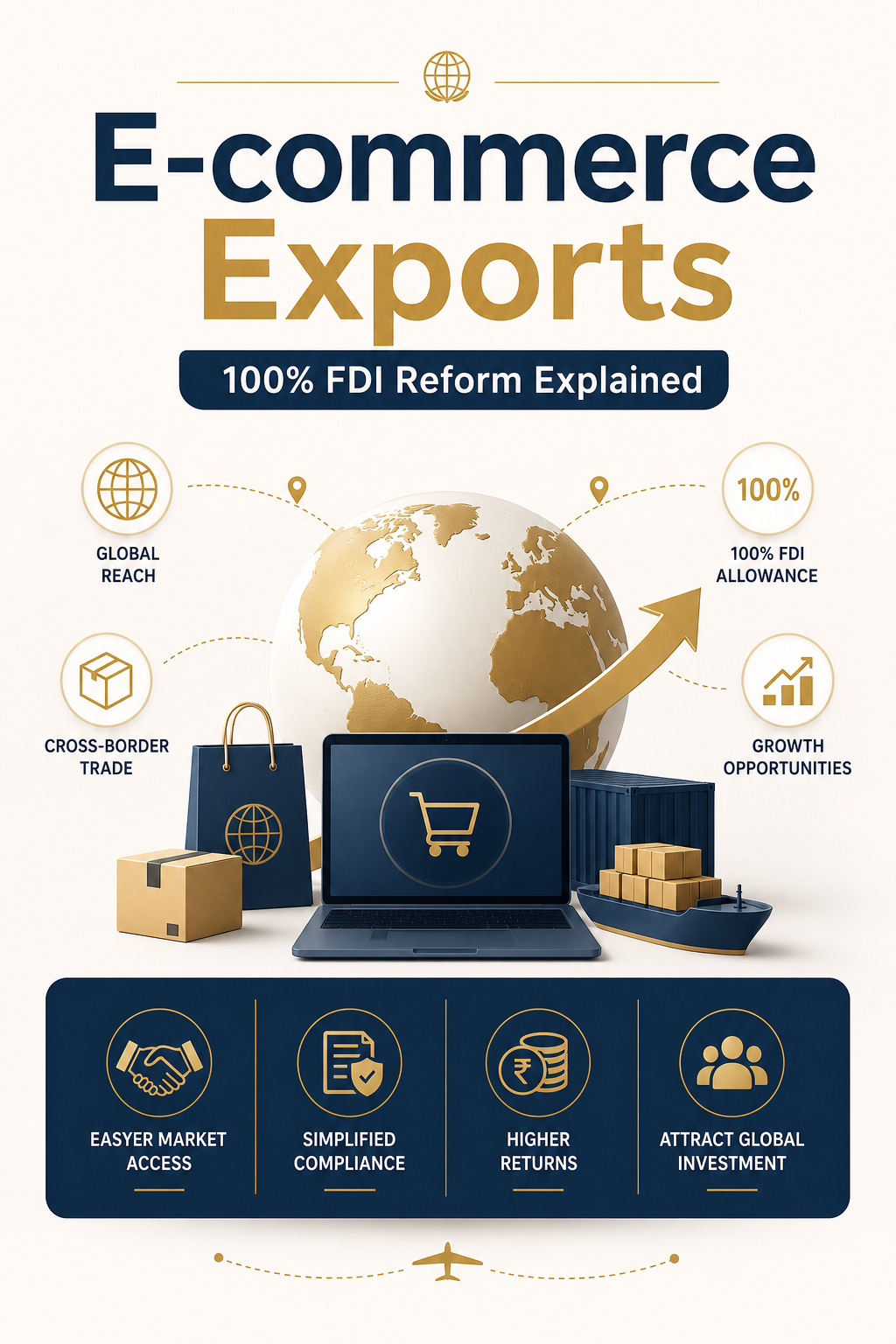
The Department for Promotion of Industry and Internal Trade has amended India’s FDI policy to permit 100% FDI under the automatic route in inventory-based e-commerce entities when their operations are exclusively directed towards exports. This means foreign-funded platforms can procure products in India, hold inventory and sell those products to customers abroad under the conditions of the revised framework.
The distinction between export and domestic operations is crucial. Restrictions on foreign investment in the inventory-based model for domestic retail continue. The reform therefore does not amount to unrestricted foreign investment in inventory-led online retail within India. Instead, it seeks to use global capital, technology, logistics and digital distribution to improve access to overseas markets.
Key Features of the New Export-Oriented FDI Model
The reform changes the investment framework without eliminating the regulatory distinction between domestic and export-oriented commerce. Foreign-invested entities operating under the permitted export model can potentially aggregate goods from Indian manufacturers, maintain inventories, manage fulfilment and use international digital networks to reach overseas customers. This can be particularly useful for producers that lack the scale to build independent global distribution systems.
- 100% FDI: foreign investment is permitted under the automatic route for the specified export-oriented inventory model.
- Export-only condition: the relaxation is directed at overseas sales rather than inventory-led domestic e-commerce.
- Inventory ownership: qualifying platforms can procure and hold Indian goods for subsequent export.
- Global market access: platforms can connect Indian manufacturers and MSMEs with international consumers.
- Domestic safeguards: the policy distinction protecting the regulated structure of domestic inventory-based e-commerce remains relevant.
Challenges Related to E-commerce Exports
Greater foreign participation can improve access to international markets, but regulatory safeguards remain necessary. Authorities must ensure that export-oriented inventory operations do not become an indirect route for circumventing restrictions governing domestic e-commerce. Clear separation of domestic and export activities, transparent records and effective compliance mechanisms will therefore be important for preserving the policy’s intended distinction.
MSMEs also face challenges beyond market access. International sales require consistent quality, appropriate packaging, reliable logistics, customs compliance, product standards and efficient returns management. Dependence on a small number of large platforms may create concerns over commissions, bargaining power and access to customer data. Digital export growth must therefore strengthen producers rather than merely transfer market concentration from traditional intermediaries to online platforms.
Way Forward for India’s Digital Export Economy
India can maximise the reform’s benefits by combining investment liberalisation with stronger export infrastructure. Faster customs processing, predictable documentation, efficient cross-border payments, affordable logistics and better warehousing can lower transaction costs for smaller exporters. Training programmes can help MSMEs understand overseas standards, intellectual property requirements, digital marketing and taxation in destination markets.
Policy implementation should also encourage competition among platforms so that exporters have multiple routes to global customers. Data transparency, fair contractual terms and efficient grievance mechanisms can strengthen trust. Integration with district-level export promotion and other objectives of the Foreign Trade Policy can widen participation beyond established industrial centres. If supported by logistics and regulatory reforms, digital commerce can help convert India’s large manufacturing and MSME base into a more globally connected export ecosystem.
Prelims Practice Corner
1. Consider the following statements regarding India’s e-commerce FDI framework:
1. Marketplace and inventory-based e-commerce models are conceptually different.
2. An inventory-based entity owns or controls inventory sold through its platform.
3. The recent export-oriented relaxation automatically removes all restrictions on inventory-based domestic e-commerce.
- (a) 1 and 2 only
- (b) 2 and 3 only
- (c) 1 and 3 only
- (d) 1, 2 and 3
Answer: (a) 1 and 2 only. The export-oriented relaxation does not amount to unrestricted FDI in inventory-based e-commerce for India’s domestic retail market.
2. The automatic route for FDI generally means that:
- (a) No Indian law applies to the investment
- (b) Prior government approval is not required for investment within the prescribed framework
- (c) Only public-sector companies can receive investment
- (d) Foreign investors receive automatic citizenship
Answer: (b) Under the automatic route, prior government approval is generally not required, subject to applicable sectoral rules and conditions.
3. Foreign Trade Policy 2023 is primarily associated with which Union Ministry?
- (a) Ministry of Finance
- (b) Ministry of Commerce and Industry
- (c) Ministry of Corporate Affairs
- (d) Ministry of Electronics and Information Technology
Answer: (b) Ministry of Commerce and Industry.
4. Which of the following can facilitate online exports by MSMEs?
1. Digital marketing
2. Cross-border logistics
3. Customs facilitation
4. Warehousing
- (a) 1 and 2 only
- (b) 1, 2 and 3 only
- (c) 2 and 4 only
- (d) 1, 2, 3 and 4
Answer: (d) All four can form part of the supporting ecosystem required for digital exports.
5. Which statement best distinguishes a marketplace model from an inventory-based model?
- (a) Marketplace entities necessarily manufacture all products themselves
- (b) Marketplace platforms primarily connect buyers and sellers, while inventory-based entities own or control goods sold to consumers
- (c) Inventory-based entities cannot use digital technology
- (d) There is no economic distinction between the two models
Answer: (b) Ownership or control of inventory is a key distinction between the two models.
Mains Practice Questions
-
1. Examine how liberalising FDI for export-oriented inventory-based e-commerce can improve the global competitiveness of Indian MSMEs. (10 marks)
Outline: Explain reform → global market access → logistics and warehousing → technology and marketing → lower entry barriers → MSME benefits → platform dependence and compliance concerns → balanced conclusion.
-
2. Digital platforms can democratise access to global markets, but policy support must extend beyond investment liberalisation. Discuss in the context of India’s export strategy. (15 marks)
Outline: Digital trade opportunity → FDI reform → Foreign Trade Policy 2023 → MSME participation → customs and logistics → payments and standards → platform competition → regulatory safeguards → capacity building → way forward.
FAQs on India’s Digital Export Reform
- What is an inventory-based e-commerce model?
- It is a model in which the e-commerce entity owns or controls the inventory of goods and sells those goods to consumers, unlike a marketplace that primarily connects independent buyers and sellers.
- Does the reform permit unrestricted foreign-funded inventory e-commerce for domestic Indian retail?
- No. The reported relaxation specifically concerns qualifying inventory-based operations exclusively intended for exports, while the regulatory position governing domestic retail remains distinct.
- How can the reform benefit Indian MSMEs?
- Export-oriented platforms can provide access to overseas customers while supporting functions such as warehousing, logistics, marketing, customs documentation and fulfilment, potentially reducing barriers faced by smaller producers entering international markets.
Related Current Affairs
Preparing for UPSC, PCS or HCS?
Talk to a mentor at Chetan Bharat Learning, Chandigarh. Free guidance on choosing the right exam and building a study plan.
Chat on WhatsAppCall 97793 53345UPSC / IAS / PCS coaching in Chandigarh · Trusted by aspirants across Punjab & Haryana
Leave a Reply
You must be logged in to post a comment.