
Important for:
UPSC, Haryana HCS, Punjab PCS
Prelims: Bail conditions, Fundamental Rights, Judiciary
Mains: GS Paper 2 — Judiciary, Social Justice, Tribal Rights
Why in News?
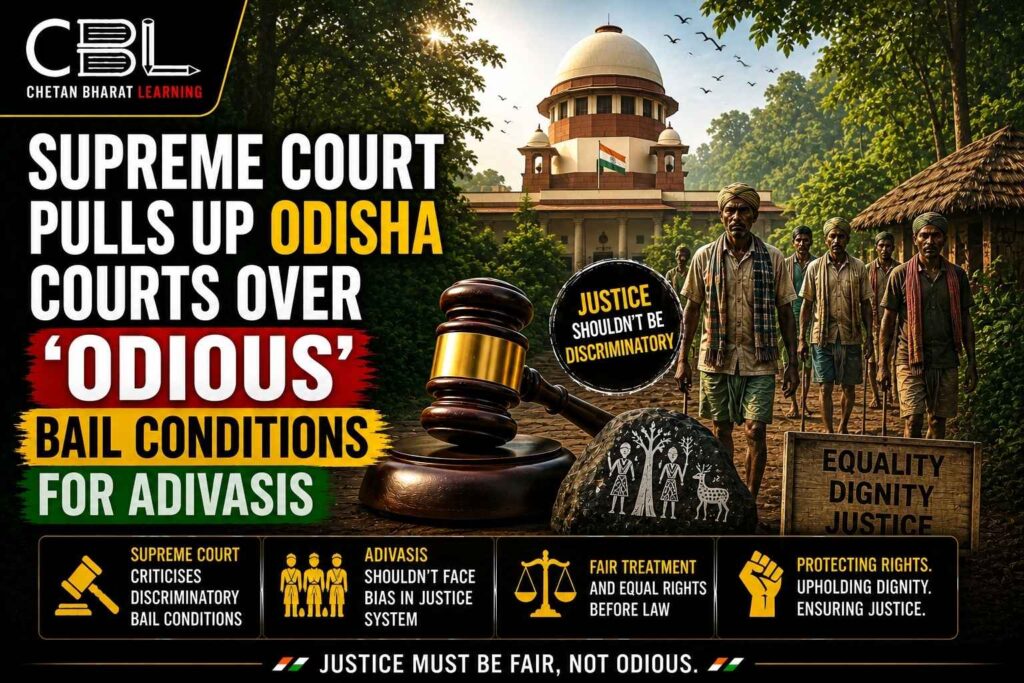
The Supreme Court strongly criticised the Odisha judiciary for imposing harsh and degrading bail conditions (like cleaning police stations), especially on Adivasi and Dalit individuals, calling them unconstitutional.
What Did the Supreme Court Say?
➤The Court observed:
✔ Bail conditions were degrading and discriminatory
✔ They violated personal liberty (Article 21)
✔ Reflected possible caste-based bias
What Were the Bail Conditions?
➤ Examples included:
- Cleaning police stations
- Performing tasks unrelated to legal requirements
➤ Court termed them:
⇢ “Obnoxious” and “unprecedented”
Key Constitutional Issues
1. Violation of Fundamental Rights
→ Article 21: Right to life & personal liberty
2. Equality Before Law
→ Discriminatory conditions violate Article 14
3. Judicial Bias Concerns
→ Targeting marginalised communities
Why This Case is Important
1. Protects Marginalised Groups
Adivasis & Dalits
2. Judicial Accountability
Courts must act within constitutional limits
3. Fair Bail System
Bail conditions must be:
✔ Reasonable
✔ Non-discriminatory
Supreme Court Directions
➤ SC ordered:
✔ Odisha High Court to submit compliance report
✔ All courts to avoid such conditions
✔ Circulation of guidelines across High Courts
➤ Key Issues Highlighted
- Caste bias in judiciary
- Misuse of discretionary powers
- Lack of uniform bail standards
Wider Governance Insight
➤ Important theme:
✔ Rule of law vs social bias
India-Specific Impact
- Reinforces constitutional morality
- Strengthens trust in judiciary
- Promotes fair legal process
Key Insight for UPSC
➤ Core idea:
✔ Justice must be fair, equal, and dignified
PRELIMS PRACTICE QUESTIONS
Q1. Article 21 deals with:
A. Equality
B. Liberty
C. Life and personal liberty
D. Freedom of speech
→ Answer: C
Q2. Bail conditions must be:
A. Punitive
B. Discriminatory
C. Reasonable
D. Arbitrary
→ Answer: C
Q3. Which article ensures equality before law?
A. Article 19
B. Article 21
C. Article 14
D. Article 32
→ Answer: C
Q4. Supreme Court protects:
A. Executive power
B. Fundamental rights
C. Trade
D. Finance
→ Answer: B
Q5. Bail conditions should NOT be:
A. Legal
B. Fair
C. Discriminatory
D. Reasonable
→ Answer: C
CBL Mains Practice Question
“Judicial discretion must align with constitutional morality.”
Discuss in the context of recent Supreme Court observations on bail conditions.
FAQs
1. What did SC say?
Bail conditions were unconstitutional.
2. Which rights were violated?
Article 14 and 21.
3. Why is it important?
Protects marginalised communities.
4. What is bail?
Temporary release of an accused person.
5. Which GS paper covers this?
GS2.
Related Current Affairs
Preparing for UPSC, PCS or HCS?
Talk to a mentor at Chetan Bharat Learning, Chandigarh. Free guidance on choosing the right exam and building a study plan.
Chat on WhatsAppCall 97793 53345UPSC / IAS / PCS coaching in Chandigarh · Trusted by aspirants across Punjab & Haryana
Leave a Reply
You must be logged in to post a comment.