
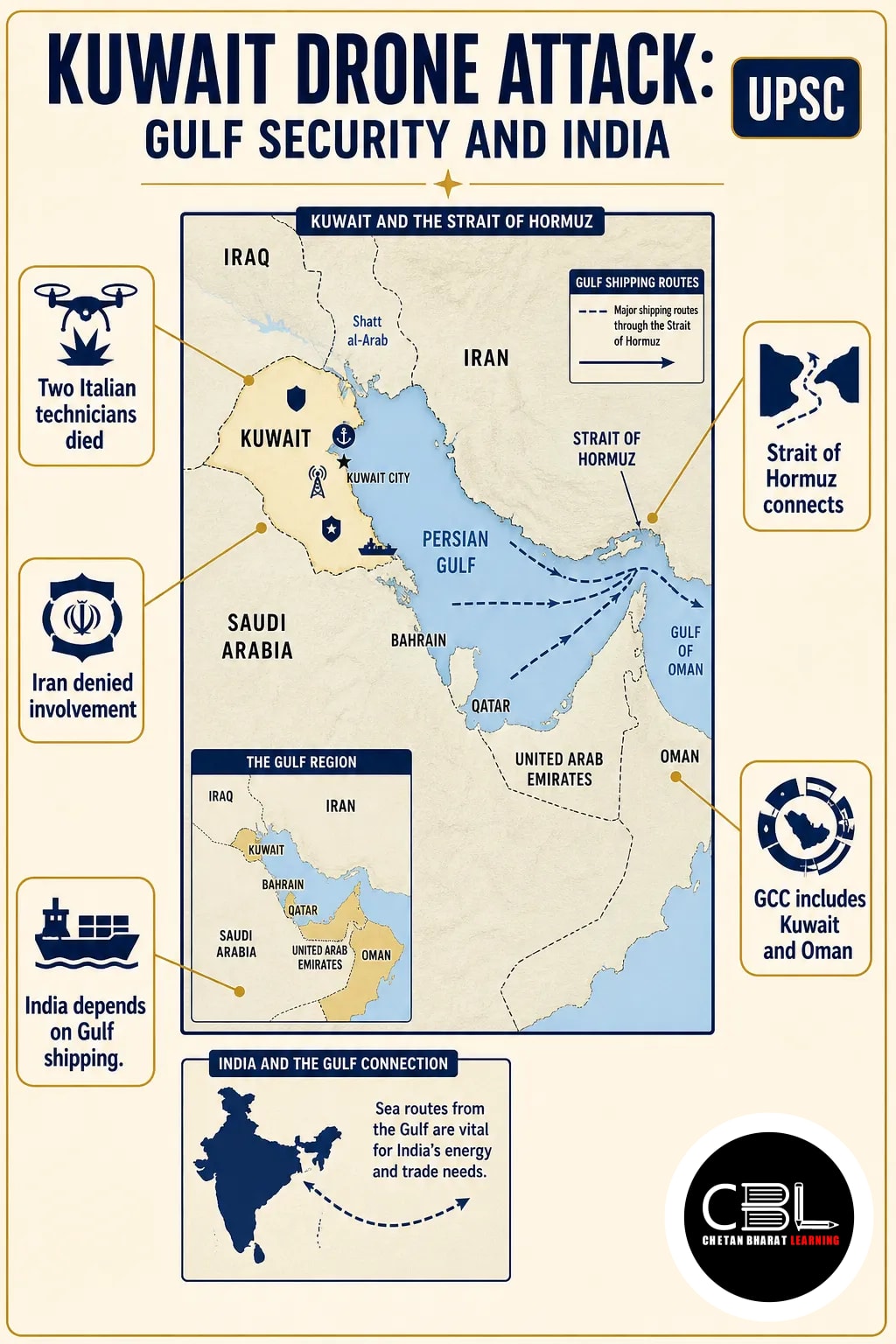
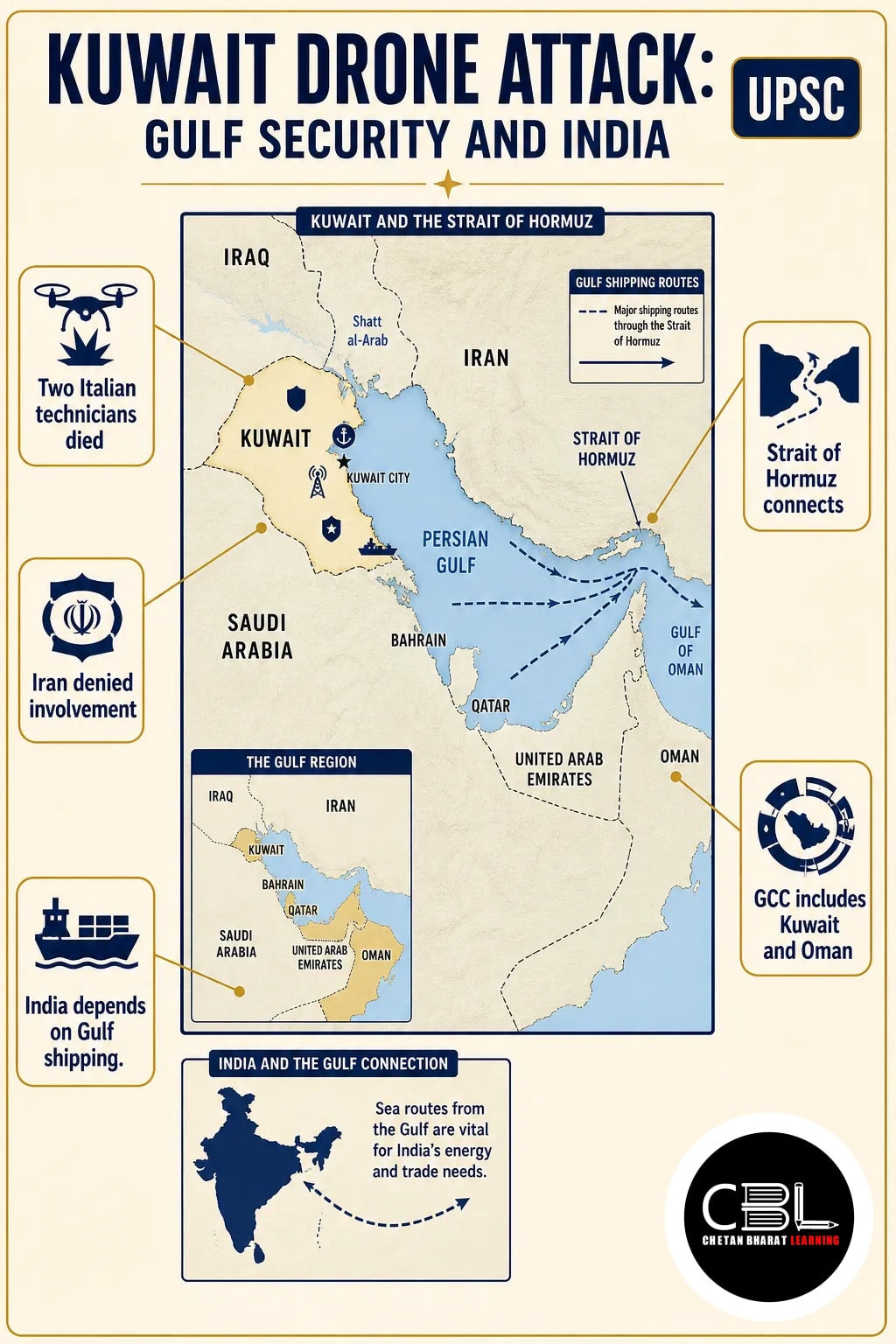
The Kuwait drone attack killed two Italian technicians at an air-defence detection station on 26 November 2026. The incident raises questions about Gulf security and international relations, although responsibility remains disputed.
Quick answer: The Kuwait drone attack struck military installations on 26 November 2026, killing two Italian technicians and injuring at least four people. Italy and Kuwait blamed Iran; Tehran denied involvement and offered a joint investigation. The strike adds to security concerns amid the United States–Iran confrontation over the Strait of Hormuz.
What happened in Kuwait?
Several drones targeted Kuwaiti military installations, including an air-defence detection station, according to Italian Foreign Minister Antonio Tajani. He told Italy’s Senate that the incident occurred at around 2 pm.
The two deceased technicians worked for Rheinmetall at the detection station. Kuwait’s Defence Ministry also said that at least four people were injured, although its earlier statement did not specify the location.
Both Italy and Kuwait confirmed the deaths and blamed Iran. However, Iran rejected the accusation; the available account does not establish an agreed conclusion about who launched the drones.
| Actor | Position or action |
|---|---|
| Italy | Tajani identified the drones as Iranian-made; Italy blamed Iran. |
| Kuwait | Confirmed the deaths and blamed Iran; its Defence Ministry reported at least four injured. |
| Iran | Denied involvement and offered cooperation to determine the incident’s origin. |
| European Union | European Commission President Ursula von der Leyen called for increased pressure on Iran. |
Why is attribution disputed?
The dispute centres on who launched the drones, rather than whether the attack caused deaths. Tajani described them as Iranian-made, but manufacture alone does not establish the identity of the operator.
Iranian Foreign Minister Abbas Araghchi spoke with Tajani and Kuwaiti Foreign Minister Jarrah Jaber Al-Ahmad Al-Sabah. In those calls, he denied Iranian involvement and offered a joint investigation.
Meanwhile, Iranian armed forces spokesperson Abolfazl Shekarchi blamed a false-flag operation by Israel and the United States. The source says he provided no evidence for that claim. Therefore, an examination of physical evidence and flight data would be important before drawing a definitive attribution.
Why is the Strait of Hormuz significant?
The Strait of Hormuz connects the Persian Gulf with the Gulf of Oman and provides a maritime route for Gulf energy exports. Iran lies to its north, while Oman and the United Arab Emirates lie to its south.
According to the source, the United States and Iran are confronting each other over the waterway. The United States military is escorting ships through it against Iranian attempts to close it. For background, see CBL’s analysis of Hormuz tensions and energy security.
The Gulf Cooperation Council (GCC) includes Kuwait, Bahrain, Oman, Qatar, Saudi Arabia and the United Arab Emirates. Kuwait’s location in the Gulf therefore connects its security to wider regional concerns, even though it does not border the strait itself.
What are the regional security implications?
The Kuwait drone attack illustrates how a regional confrontation can expose neighbouring states and foreign personnel to danger. The source also describes attacks on military facilities and energy installations across the Gulf.
- Escalation risk: Competing accusations can invite retaliation, especially before the attacker is identified.
- Infrastructure vulnerability: Detection stations and energy facilities require protection because disruption can have effects beyond the immediate site.
- Maritime insecurity: Threats near a strategic waterway can affect shipping decisions and supply reliability.
- Foreign personnel: The deaths also show the risks faced by technical staff at defence installations.
Meanwhile, the source describes separate Saudi–Houthi exchanges in Yemen and an attack on a refinery in Jazan, Saudi Arabia. The Saudi-led coalition attributed that attack to the Houthis; state media said one person died and some operations temporarily stopped. These developments underline multiple regional security pressures, but they do not establish a connection with the Kuwait strike.
Why does this matter for India?
India has an interest in secure Gulf shipping, dependable energy supplies and the safety of its nationals in the region. A prolonged disruption could raise transport or insurance costs and create uncertainty for energy imports, although this incident alone does not establish such an outcome.
Diplomatically, India must consider relations with Gulf partners alongside its ties with Iran. Therefore, encouraging restraint and protecting navigation can support its interests without prejudging responsibility for a specific attack.
Alternative routes and port partnerships can contribute to resilience, but they cannot eliminate every regional risk. For context, read about Oman’s Sohar port and India’s energy routes and the Hormuz crisis and Oman’s role.
What should the response priorities be?
A credible investigation and diplomatic communication are immediate priorities because the parties dispute responsibility. Any inquiry should preserve evidence and share its findings with the affected countries.
In addition, Gulf states and their partners can strengthen early warning, protect critical facilities and maintain emergency communication channels. India can review contingency plans for its nationals, shipping and energy supplies while engaging regional partners.
International humanitarian law requires parties to distinguish civilians from military objectives and follow proportionality and precaution rules. However, the technicians’ deaths alone do not establish whether a particular strike violated those rules; that assessment requires further facts.
Source: The Hindu International, 27 November 2026
- Sohar Port: Oman’s Strategic Offer to India (18 Sep 2026)
- Strait of Hormuz Crisis: US Sanctions, Oman Role (1 Sep 2026)
- Strait of Hormuz: Iran-US Tensions and Energy Security (11 Aug 2026)
Punjab PCS and Haryana HCS General Studies can test Gulf geography, the Strait of Hormuz and regional groupings. In addition, candidates should connect maritime security with India’s energy interests.
Prelims Practice Corner
Mains Practice Questions
Frequently Asked Questions
Who died in the Kuwait drone attack?
Two Italian technicians died. They worked for Rheinmetall at an air-defence detection station, according to Italy’s foreign minister.
Did Iran accept responsibility for the attack?
No, Iran denied involvement. It also offered to cooperate with Kuwait and Italy to determine the incident’s origin.
Why is the Strait of Hormuz important for India?
It is important because it provides a maritime route for Gulf energy exports. Therefore, insecurity there can affect shipping and India’s energy supply planning.
Is Kuwait a member of the Gulf Cooperation Council?
Yes, Kuwait is a member. The council also includes Bahrain, Oman, Qatar, Saudi Arabia and the United Arab Emirates.
Related Current Affairs
Preparing for UPSC, PCS or HCS?
Talk to a mentor at Chetan Bharat Learning, Chandigarh. Free guidance on choosing the right exam and building a study plan.
Chat on WhatsAppCall 97793 53345UPSC / IAS / PCS coaching in Chandigarh · Trusted by aspirants across Punjab & Haryana






Leave a Reply
You must be logged in to post a comment.