
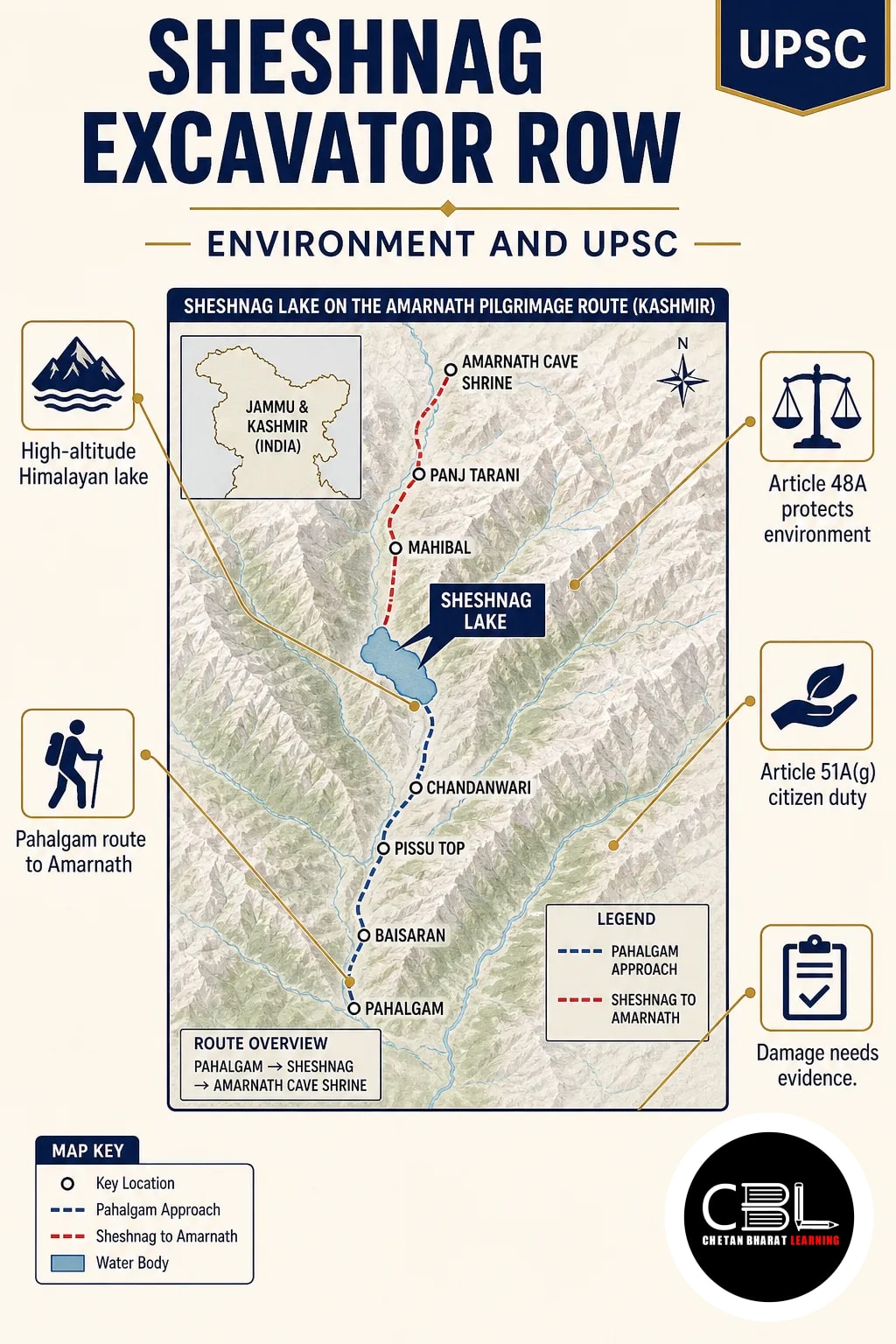
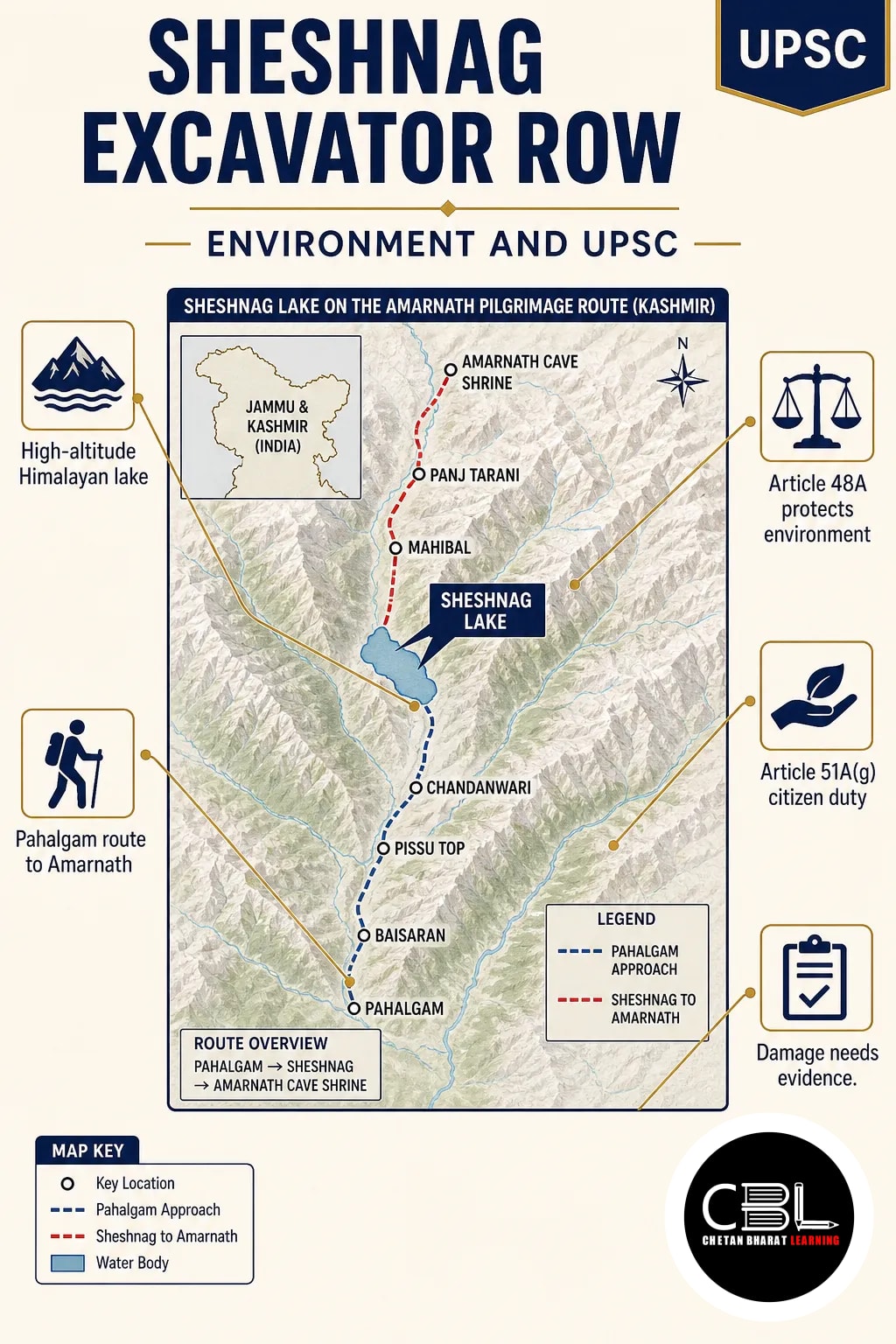
The Sheshnag excavator row concerns digging near a Himalayan lake on the Amarnath pilgrimage route. It offers a case study for environment and geography preparation, although the available source extract does not explain the work or identify those responsible.
Quick answer: The Sheshnag excavator row centres on excavation at Sheshnag Lake in Kashmir. The source describes the digging as controversial, but the supplied extract does not state who ordered it, its purpose, its date or the specific objections. Therefore, those details need verification before drawing conclusions about the work.
Where is Sheshnag Lake?
Sheshnag Lake is a high-altitude Himalayan lake in Kashmir, near the Pahalgam route to the Amarnath shrine. Its mountain setting and pilgrimage association make both ecological protection and visitor management relevant to decisions about nearby work.
| Feature | Key fact |
|---|---|
| Physical setting | High-altitude Himalayan lake |
| Region | Kashmir |
| Route association | Pahalgam route to Amarnath |
Why is the excavation in the news?
The source identifies digging involving excavators at Sheshnag Lake as the subject of a controversy. However, the supplied article text contains unrelated headlines rather than the explainer itself.
Consequently, it does not establish the project’s purpose, the authority involved, the scale of work or the grounds for objection. Aspirants should not treat possible environmental impacts as confirmed findings in this case.
Why can excavation near mountain lakes matter?
Excavation near a mountain lake warrants scrutiny because changes to slopes, drainage and sediment movement can affect the surrounding environment. The actual impact depends on the work’s location, design and execution.
- Slope stability: Cutting or disturbing a slope can increase instability under certain conditions; therefore, site-specific assessment matters.
- Water and sediment: Disturbed soil can enter water through runoff, potentially affecting water quality and aquatic habitats.
- Pilgrimage access: Work near a visitor route should also consider safety, access and waste management.
- Evidence: These are assessment questions, not established impacts of the Sheshnag work.
For related terrain concepts, revise the uses and limits of landslide susceptibility maps. Similarly, riverbed mining and its regulation illustrates why the location and scale of extraction matter, though it is a different activity.
Which constitutional principles are relevant?
The Constitution places environmental protection among both state policy objectives and citizens’ duties. These provisions provide a framework for discussion; they do not by themselves establish whether this excavation violated a law.
| Provision | Relevance |
|---|---|
| Article 48A | Directs the State to protect and improve the environment and safeguard forests and wildlife. |
| Article 51A(g) | Makes protecting and improving the natural environment a fundamental duty of citizens. |
| Article 21 | Protects life and personal liberty; judicial interpretation has linked environmental quality to the right to life. |
In addition, whether a particular clearance or environmental rule applies depends on the project’s characteristics and applicable law. The available extract does not provide enough information to determine that here.
What should environmental scrutiny examine?
A sound assessment should first establish what work took place and what authorisation it required. For the Sheshnag excavator row, the following are questions for verification rather than findings:
- Purpose and alternatives: Identify the stated need, project design and less disruptive options, if any.
- Site assessment: Examine terrain, drainage, lake proximity and potential sediment movement before evaluating risks.
- Permissions and oversight: Check the applicable approvals, responsible authority and conditions attached to the work.
- Public information: Publish relevant assessments and decisions so that affected communities and other stakeholders can scrutinise them.
- Monitoring and restoration: Set measurable safeguards where work is permitted; moreover, provide for corrective action if damage occurs.
Overall, the case illustrates how an examination answer can distinguish a confirmed event from an environmental risk that still requires evidence.
Source: Indian Express Explained, 25 November 2026
State PCS General Studies may test Himalayan geography, environmental duties and the assessment of work near water bodies. Moreover, the distinction between an alleged impact and an established finding is useful for administrative case studies.
Prelims Practice Corner
Mains Practice Questions
Frequently Asked Questions
Where is Sheshnag Lake?
Sheshnag Lake is a high-altitude lake in Kashmir. It is also associated with the Pahalgam route to the Amarnath shrine.
Why were excavators working at Sheshnag Lake?
The purpose is not established by the supplied source extract. Therefore, the project’s stated objective needs verification from the full report or relevant authorities.
Does the available information establish environmental damage?
No, the supplied extract does not establish damage. An assessment would also need evidence about the work’s location, scale and effects.
Which constitutional articles address environmental protection?
Articles 48A and 51A(g) address state policy and citizens’ duties respectively. In addition, courts have linked environmental quality to Article 21’s protection of life.
Related Current Affairs
Preparing for UPSC, PCS or HCS?
Talk to a mentor at Chetan Bharat Learning, Chandigarh. Free guidance on choosing the right exam and building a study plan.
Chat on WhatsAppCall 97793 53345UPSC / IAS / PCS coaching in Chandigarh · Trusted by aspirants across Punjab & Haryana






Leave a Reply
You must be logged in to post a comment.