
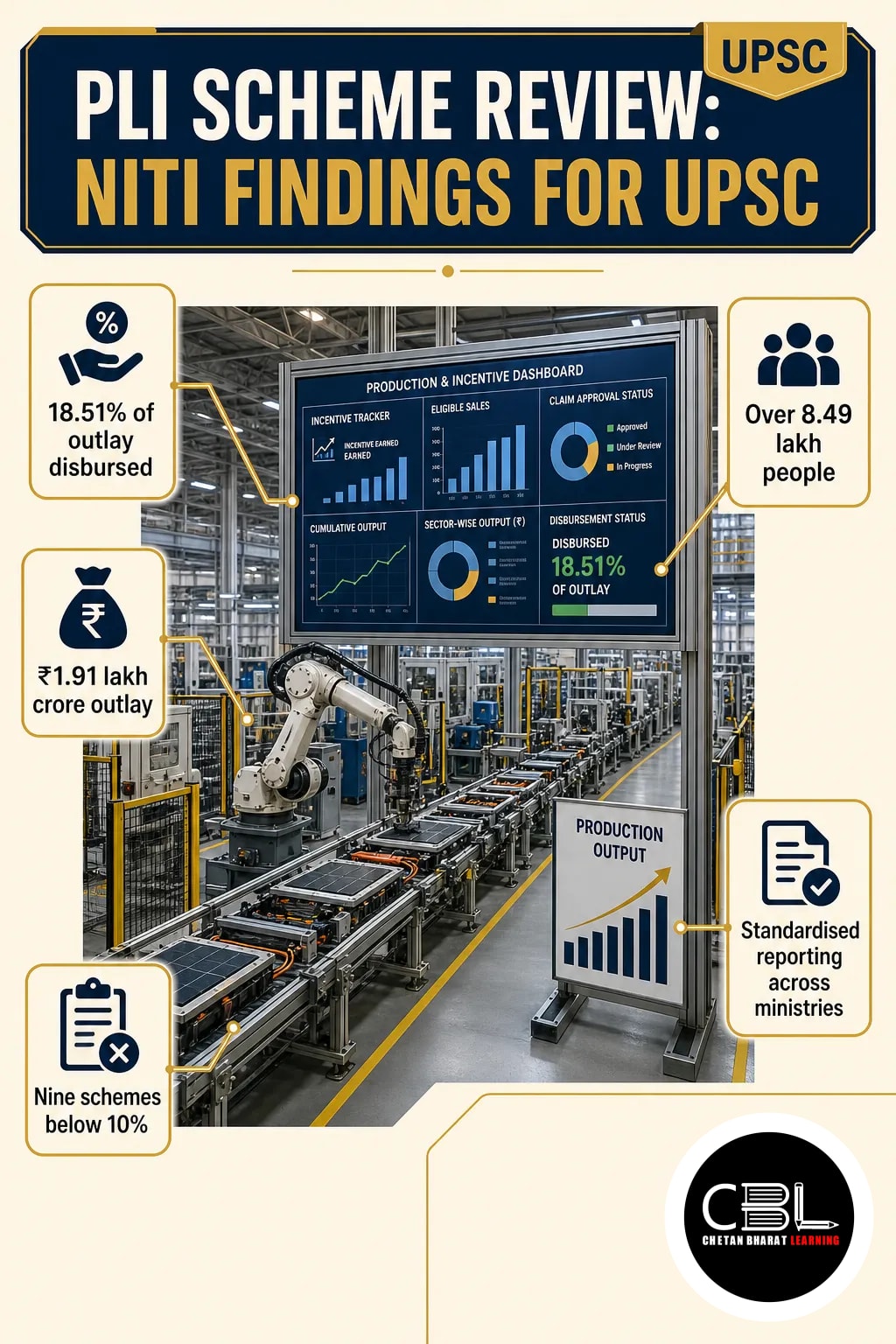
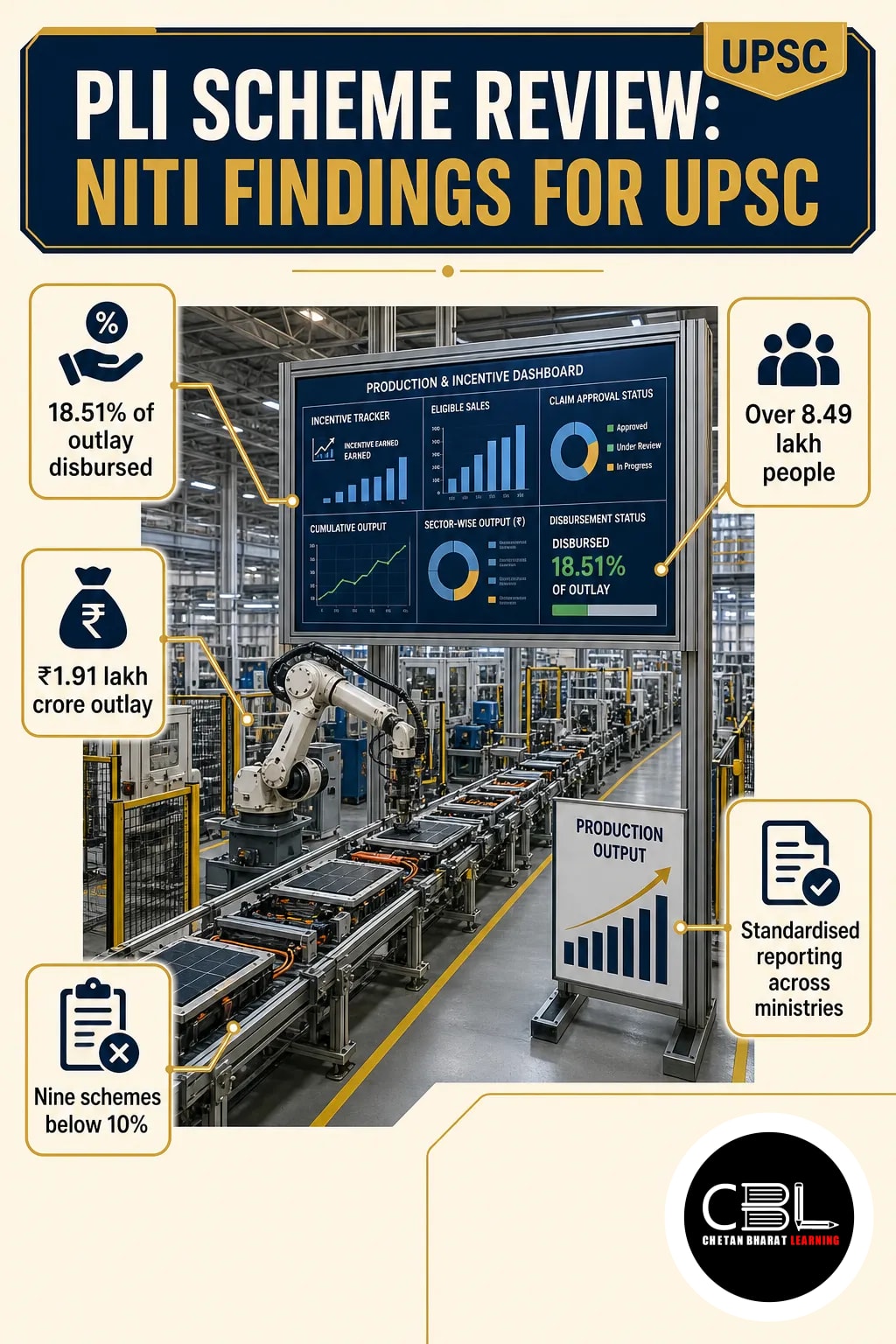
PLI scheme review findings show that incentive payments remain below one-fifth of the total outlay. The assessment of the Production Linked Incentive (PLI) schemes also raises questions about manufacturing depth and employment. Explore related policy issues in economy current affairs.
Quick answer: The PLI scheme review by NITI Aayog and the Indian Institute of Management (IIM) Ahmedabad found that 18.51% of the ₹1.91 lakh crore outlay had been disbursed by March 2026. The report links payments to performance conditions but also calls for sector-specific reforms and better reporting.
What is the PLI scheme?
PLI provides financial incentives to participating firms that meet specified performance and eligibility conditions. It encourages production and capacity creation rather than paying the entire incentive upfront.
India launched the PLI approach in 2020 across key manufacturing sectors. However, not all 14 schemes began operating that year, and some have longer gestation periods. These differences matter when comparing their spending and results.
Why is the PLI scheme review in the news?
NITI Aayog and IIM Ahmedabad assessed the schemes’ cumulative performance through March 2026. Their report provides an aggregate picture alongside substantial differences across sectors.
| Indicator | Finding as of March 2026 |
|---|---|
| Incentive disbursement | 18.51% of the ₹1.91 lakh crore outlay |
| Investment attracted | ₹2.40 lakh crore |
| Production generated | ₹22.66 lakh crore |
| Employment created | Over 8.49 lakh people |
| Targeted segments broadly on track | Nearly 70% |
The report identified particularly strong outcomes in electronics, telecom and pharmaceutical drugs. However, aggregate production and investment figures do not by themselves show domestic value addition or establish what would have occurred without the incentives.
Why are disbursals uneven across sectors?
Different performance thresholds, start dates and production cycles contribute to uneven disbursals. The report also identifies technology adoption, global competition and capital requirements as sector-specific constraints.
- Lower disbursals: Nine schemes spent less than 10% of their respective outlays, including bulk drugs, automobiles and textiles.
- Higher disbursals: Drones and drone components, large-scale electronics and food products ranged from 25% to 77% of their respective outlays.
- Performance conditions: Incentives follow the achievement of specified investment, production and other eligibility criteria; therefore, low early payments do not automatically prove failure.
Nevertheless, a low disbursal share warrants scrutiny when firms do not meet targets over time. Evaluators should distinguish normal gestation from persistent barriers to investment or production.
What are the economic implications?
The schemes can support manufacturing capacity, but their long-term value depends on the quality and durability of the resulting growth.
Investment, production and fiscal accountability
Performance-linked payments tie public support to specified outcomes. Consequently, the approach can limit upfront spending before firms fulfil the conditions.
However, production value is not the same as domestic value added: imported components may account for part of the final product’s value. A sound assessment should therefore examine both output and the depth of domestic production.
Employment and industrial capabilities
The report records employment for over 8.49 lakh people. However, critics argue that mobile phone manufacturing growth has relied substantially on assembly rather than employment generation.
Criticism also links some programmes, including electronics manufacturing, to a sharp rise in imports. Thus, policymakers need to examine whether increased output also builds domestic capabilities and creates durable jobs.
Workforce readiness is a related consideration for industrial growth. For context, see the CBL explainer on industrial training institute transformation under PM-SETU.
What challenges does the report identify?
The PLI scheme review identifies uneven sectoral outcomes, a supply-side emphasis and inconsistent reporting as key challenges.
- Uniform policy risks: Sectors face different capital needs and production timelines; therefore, one standard approach may miss binding constraints.
- Demand-side weakness: Incentives encourage capacity and output, but the report says long-term sustainability also requires demand-pull support.
- Data gaps: Ministries report additional revenue, employment, production and exports inconsistently, making comparisons and evaluation difficult.
- Outcome measurement: In addition to total output, assessment must consider import dependence and employment outcomes.
What reforms can improve PLI outcomes?
The report recommends sector-specific assessment, demand-side support and standardised reporting across ministries.
- Tailor assessment: Compare each sector against its technology, capital and gestation constraints rather than relying on a single spending measure.
- Add demand-pull mechanisms: Future schemes of this kind should support demand alongside production incentives, as the report recommends.
- Standardise data: Set clear rules on what firms report, when they report it and how ministries monitor annual progress.
- Enable course correction: Use comparable data on production, employment, exports and additional revenue to identify problems during implementation.
Overall, the test is not simply how quickly incentives are paid. Rather, public support should translate into sustained, competitive manufacturing and measurable economic benefits.
Source: Indian Express Business, 12 November 2026
- PM-SETU Scheme: ITI Transformation for UPSC (3 Nov 2026)
Asked in UPSC: Previous Year Questions
- UPSC CSE Mains 2025 (GS Paper III): Discuss the rationale and achievements of the Production Linked Incentive scheme. How can its functioning and outcomes be improved?
UPSC tests the rationale and outcomes of the scheme; therefore, revise both its design and reform options.
State PCS questions can test how central industrial incentives relate to investment, manufacturing and employment. In addition, candidates should distinguish national scheme outcomes from state-specific results unless reliable state data are available.
Prelims Practice Corner
Mains Practice Questions
Frequently Asked Questions
How much of the PLI outlay was disbursed by March 2026?
18.51% of the ₹1.91 lakh crore outlay was disbursed. The figure covers 14 schemes, although their start dates and gestation periods differ.
Does low PLI disbursal necessarily mean the scheme has failed?
No, because payments depend on firms meeting specified performance conditions. However, persistent shortfalls still require sector-specific examination.
What reforms did the PLI assessment recommend?
It recommended sector-specific assessment, demand-pull support and standardised reporting. Better data would also support comparisons and mid-course corrections.
Related Current Affairs
Preparing for UPSC, PCS or HCS?
Talk to a mentor at Chetan Bharat Learning, Chandigarh. Free guidance on choosing the right exam and building a study plan.
Chat on WhatsAppCall 97793 53345UPSC / IAS / PCS coaching in Chandigarh · Trusted by aspirants across Punjab & Haryana









Leave a Reply
You must be logged in to post a comment.