
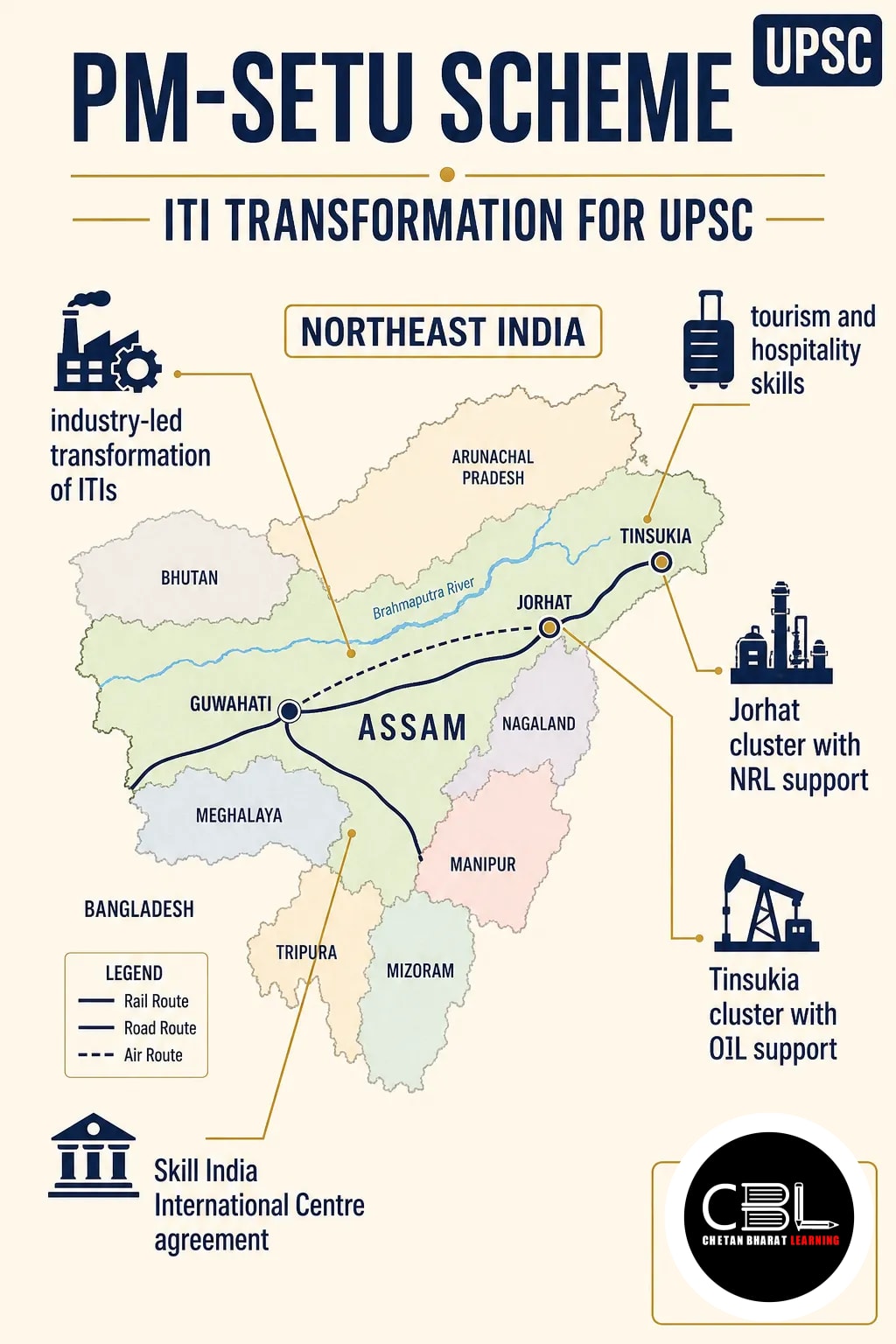
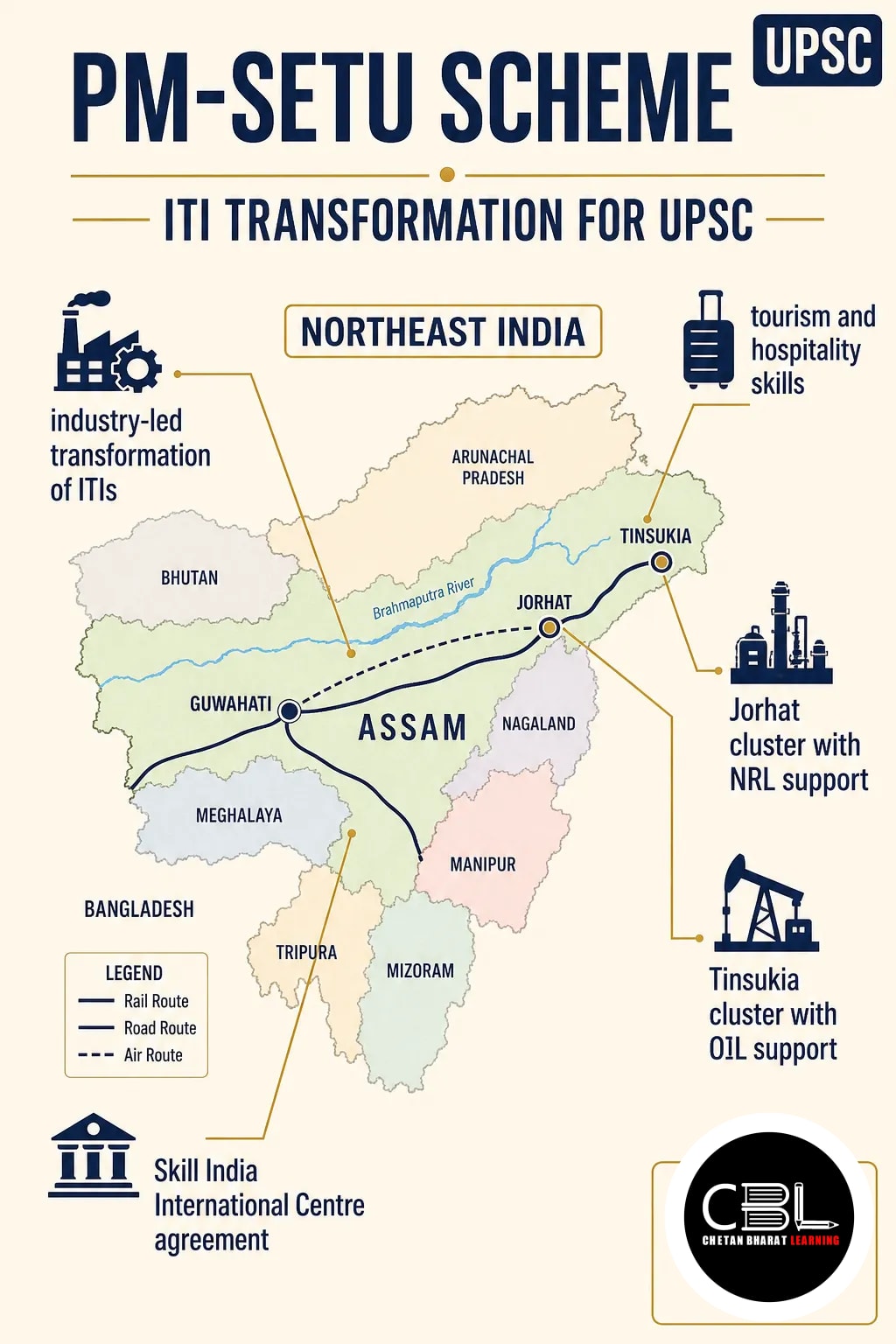
The PM-SETU scheme featured at a Guwahati conclave on training and employment opportunities for Northeast India. The event linked industrial training institute reform with tourism, hospitality and international mobility. For broader context, explore CBL’s national current affairs coverage.
Quick answer: The PM-SETU scheme seeks industry-led transformation of industrial training institutes. At a 2026 Guwahati conclave, stakeholders discussed tourism and hospitality skills for Northeast youth. Letters of intent covered two Assam clusters: Jorhat, supported by Numaligarh Refinery Limited, and Tinsukia, supported by Oil India Limited.
What is the PM-SETU scheme?
PM-SETU seeks to make industrial training institutes (ITIs) more responsive to industry and employment needs. It brings industry closer to training and institutional development; consequently, the emphasis is on skills relevant to emerging work opportunities.
The Guwahati discussion connected this institutional transformation with the Northeast’s domestic and overseas employment prospects. However, the source does not specify a scheme budget, national coverage target or implementation timeline.
Why was it discussed in Guwahati?
The Ministry of Skill Development and Entrepreneurship (MSDE) organised the Northeast Tourism and Hospitality Skill Conclave 2026 in Guwahati. It brought together central and Assam government representatives, industry stakeholders and skill ecosystem leaders.
Minister of State for Skill Development and Entrepreneurship Jayant Chaudhary delivered the keynote. Assam minister Biswajit Daimary also emphasised industry-relevant skills and pathways to employment and entrepreneurship.
Participants discussed aligning training with industry requirements and international standards. In addition, Assam presented its Chief Minister’s Flight scheme and its vision for a global skill centre; the source does not provide their operational details.
Key partnerships and institutional roles
The conclave recorded two cluster partnerships and an agreement to establish an international skills centre. Their purposes are related, but the source identifies them as distinct developments.
| Development | What the source says |
|---|---|
| Jorhat ITI cluster | A letter of intent covers a cluster supported by Numaligarh Refinery Limited. |
| Tinsukia ITI cluster | A letter of intent covers a cluster supported by Oil India Limited. |
| Skill India International Centre | MSDE and the Assam government exchanged a memorandum of understanding to establish the centre. |
| Tourism and Hospitality Skill Council | Its representative discussed industry-relevant competencies and global hospitality opportunities. |
The letters signal proposed industry support; they do not, by themselves, establish that training upgrades or placements have already occurred. Similarly, the centre remains an establishment commitment in the source, not evidence of an operational facility.
Why do tourism and hospitality matter?
Tourism and hospitality offer potential domestic and international employment pathways for Northeast youth. The conclave therefore focused on competencies that match employer needs and international expectations.
For aspirants, the policy connection is broader than tourism alone: training must translate into recognisable skills and access to actual jobs. Meanwhile, the region’s visitor economy also depends on regulatory conditions; see the explainer on tourist permits in the Northeast for a separate governance dimension.
What are the policy implications and challenges?
The initiative links human resource development with employment, regional opportunity and Centre–state cooperation. Its results, however, will depend on how well institutions convert partnerships into training and work.
- Industry alignment: Employers can help identify relevant competencies; however, training should remain transferable across employers.
- Institutional capacity: Updated equipment and capable instructors matter because an industry partnership alone cannot ensure effective instruction.
- Access and inclusion: Outreach and accessible training can help different groups participate; otherwise, opportunities may not reach all eligible youth.
- International mobility: Overseas readiness requires attention to destination standards and worker protections; therefore, course completion should not be treated as a job guarantee.
- Accountability: Agreements indicate intent, whereas completed upgrades, placements and job retention reveal implementation outcomes.
These are implementation considerations for analysis, not findings that the source establishes as existing failures. The source also provides no placement figures or assessment of cluster performance.
What should the way forward prioritise?
The way forward is to connect institutional upgrades with measurable and inclusive employment outcomes. First, governments and industry could define responsibilities for equipment, instruction and practical exposure.
Second, training providers could map courses to relevant domestic and destination-country requirements. In addition, transparent information on recruitment terms and grievance channels would help prospective overseas workers make informed choices.
Finally, monitoring should track course completion, placement quality and retention alongside access across locations and social groups. Thus, policymakers can distinguish signed partnerships from sustained employment gains.
Source: Press Information Bureau, 3 November 2026
Punjab PCS and Haryana HCS may test industry partnerships in vocational training and the role of states in employment policy. Moreover, candidates can use the Assam example to discuss how state governments coordinate with the Centre and employers.
Prelims Practice Corner
Mains Practice Questions
Frequently Asked Questions
What does PM-SETU aim to do?
It aims to transform ITIs through closer industry participation. Consequently, training should become more responsive to emerging employment needs.
Which Assam ITI clusters were covered by letters of intent?
Jorhat and Tinsukia were the two clusters. They have support from Numaligarh Refinery Limited and Oil India Limited, respectively.
Is the Skill India International Centre already operational?
The source does not establish that it is operational. Instead, MSDE and Assam exchanged an agreement to establish it.
Why did the conclave focus on tourism and hospitality?
The sectors offer potential employment opportunities for Northeast youth. Moreover, the discussion connected relevant skills with domestic and international markets.
Related Current Affairs
Preparing for UPSC, PCS or HCS?
Talk to a mentor at Chetan Bharat Learning, Chandigarh. Free guidance on choosing the right exam and building a study plan.
Chat on WhatsAppCall 97793 53345UPSC / IAS / PCS coaching in Chandigarh · Trusted by aspirants across Punjab & Haryana

 Ananya RanaIAS · AIR 60
 Aditya SharmaIAS · AIR 70
 Ria Kaur SethiIPS · AIR 89
 Aman AloonIRS · AIR 295
 Sumer Singh VirkIRS · AIR 335
 Shivani PanchalIAS

Leave a Reply
You must be logged in to post a comment.