
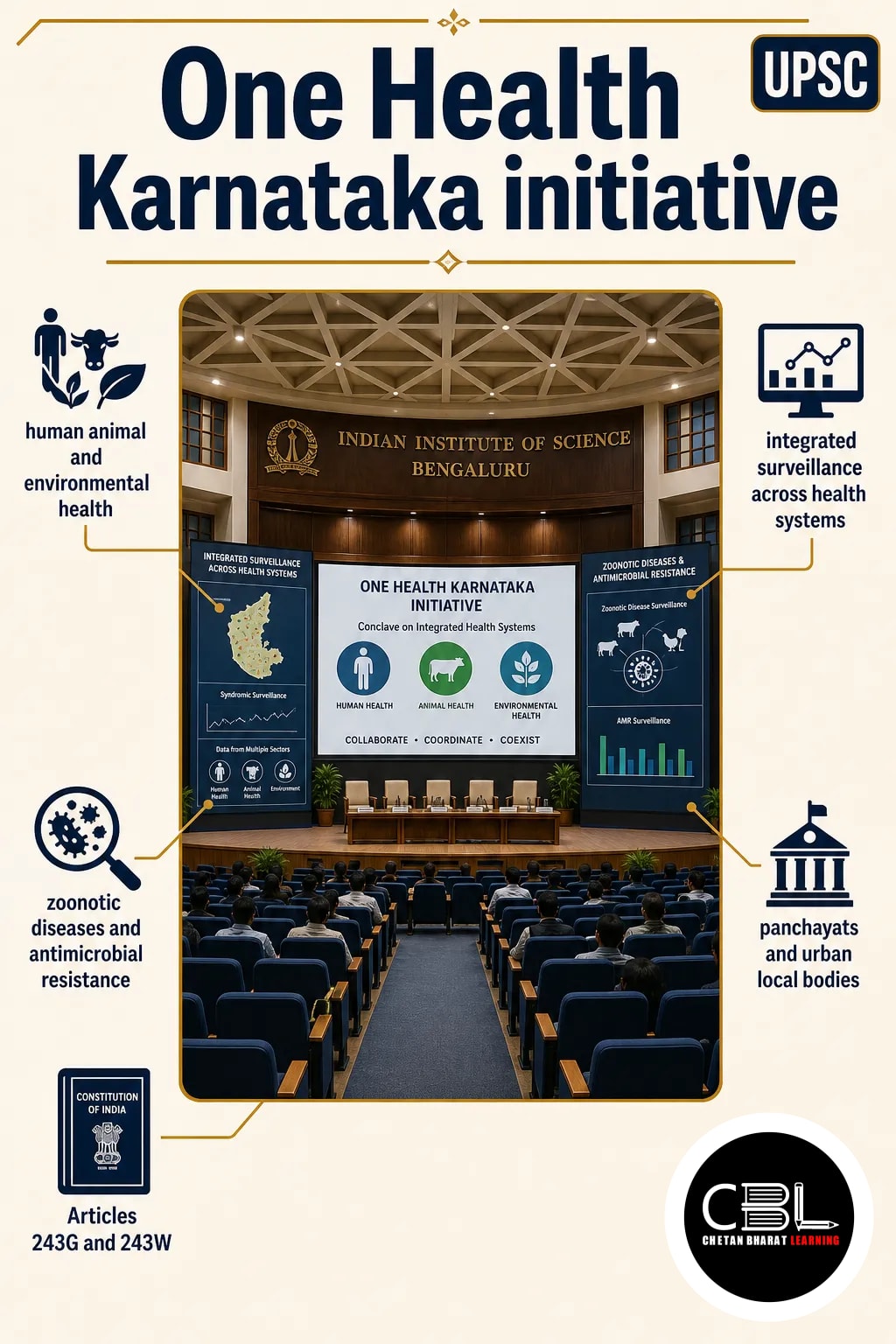
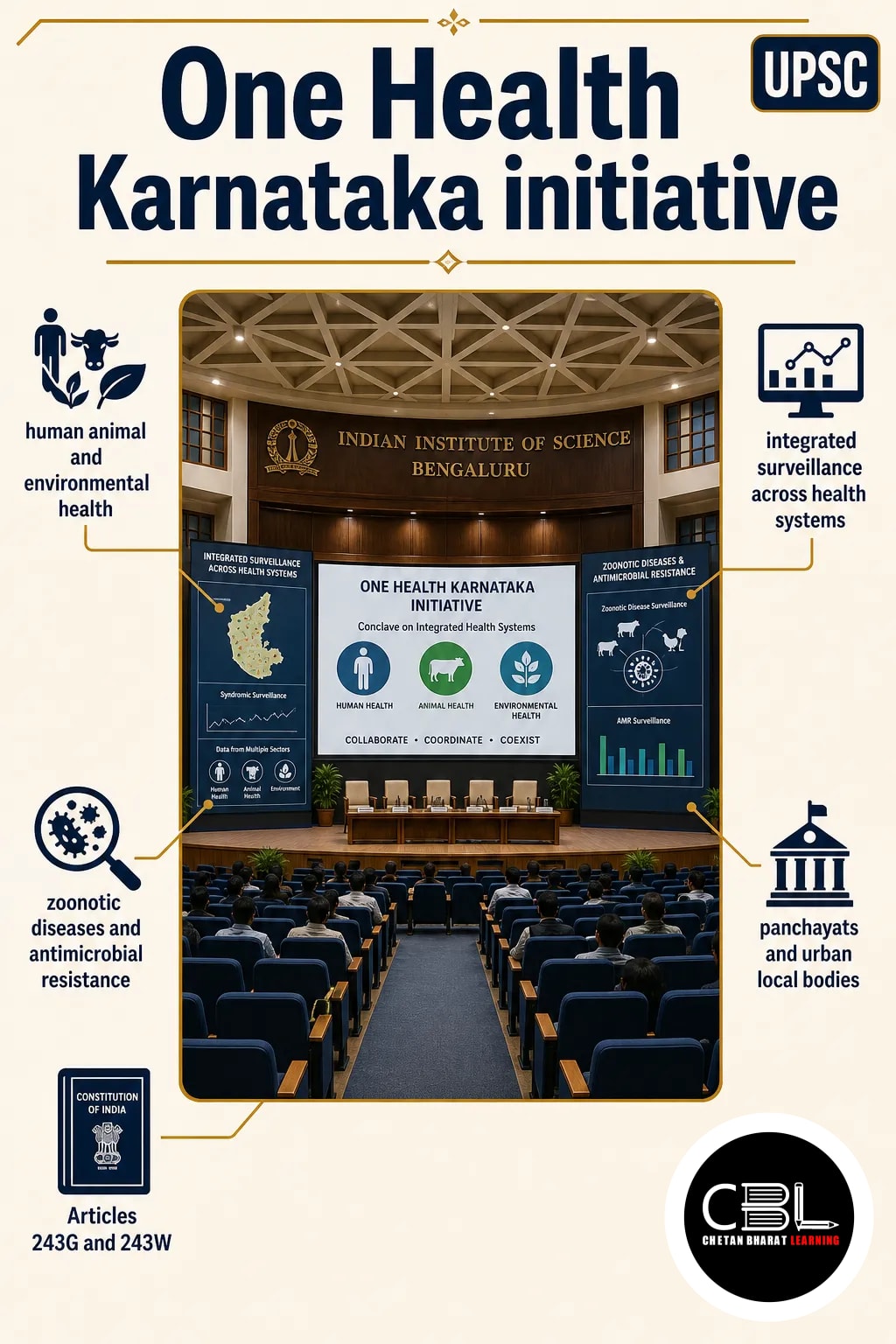
The One Health Karnataka initiative entered focus at a Bengaluru conclave where experts called for coordinated action across health sectors. The discussion offers a useful lens for public health and governance topics in the civil services examination.
Quick answer: At the One Health Conclave 2026 in Bengaluru, experts urged Karnataka to connect human, animal and environmental health systems. They emphasised integrated surveillance, scientific cooperation and local participation. Zoonotic diseases and antimicrobial resistance were among the concerns, while panchayats and urban local bodies were identified as potential coordinating institutions.
What is the One Health approach?
One Health treats human, animal and environmental health as interconnected rather than separate areas of action. Therefore, it brings medical professionals, veterinarians, environmental experts and communities together to prevent and respond to shared risks.
For example, a disease that passes between animals and humans may require both human and veterinary surveillance. Similarly, environmental conditions can affect exposure to health risks. The approach is thus a framework for cooperation, not a substitute for individual health services.
Why was One Health discussed in Karnataka?
The Bengaluru conclave examined how to translate the approach into practical, cross-sector solutions. The Karnataka Health Promotion Trust and HCL Foundation organised it with the National Institute of Mental Health and Neurosciences and The Association of People With Disability.
Participants included government representatives, scientists, public health professionals, community practitioners and civil society organisations. In her video address, Soumya Swaminathan called for stronger public health systems, integrated surveillance and coordinated prevention before risks become crises.
Meanwhile, Karnataka Additional Chief Secretary and Development Commissioner Uma Mahadevan highlighted decentralised governance. She identified panchayats and urban local bodies as potential meeting points for departments, frontline workers and communities. The event discussed implementation; the source does not establish a newly approved scheme, budget or timeline.
Key features and risks of the approach
The approach connects surveillance, prevention and local action across three health domains.
| Dimension | Relevance |
|---|---|
| Human health | Detect illness and connect public health responses with other sectors. |
| Animal health | Monitor animal health and identify risks at the human–animal interface. |
| Environmental health | Consider environmental conditions alongside human and animal health information. |
| Community participation | Use local knowledge to identify priorities and make responses accessible. |
Zoonotic diseases are infections that can pass between animals and humans. Antimicrobial resistance occurs when microorganisms develop resistance to medicines used against them. Both featured in the conclave because effective responses can require coordination beyond a single sector.
How can surveillance support prevention?
Integrated surveillance can help officials identify linked risks and act earlier. It involves sharing and interpreting relevant information across human, animal and environmental health systems rather than treating each dataset in isolation.
At the conclave, Vijay Chandru pointed to genomic surveillance, epidemiological data and computational science as lessons from the coronavirus disease 2019 pandemic. He emphasised connecting data and converting it into intelligence about emerging threats. However, collecting more data alone is insufficient unless responsible agencies can interpret it and respond.
For instance, a local alert about unusual animal illness could prompt veterinary assessment and communication with health officials. This is an illustrative response, not a measure announced at the conclave. Environmental exposures also matter to health; for related context, see the analysis of Delhi air pollution.
What are the governance challenges?
The central challenge is turning cooperation across sectors into routine, accountable action. A One Health Karnataka initiative would need to address the following implementation questions:
- Fragmented responsibilities: Health, animal husbandry and environmental functions involve different institutions; therefore, an alert may not reach every relevant agency promptly.
- Data coordination: Different systems may collect information for different purposes. Consequently, shared definitions and clear reporting channels matter.
- Community access: The conclave considered farming communities, livestock keepers, tribal populations and informal urban settlement residents. Their priorities and access to services can differ.
- Local capacity: Panchayats and urban bodies can convene actors; however, effective coordination also requires personnel, expertise and resources.
- Accountability: Joint work can blur responsibility. Therefore, participating agencies need clear roles for verification, communication and follow-up.
What role can local governments play?
Local governments can connect community knowledge with departmental expertise and frontline services. Panchayats can bring rural concerns to the table, while urban local bodies can coordinate responses to settlement-level needs.
Articles 243G and 243W of the Constitution allow state legislatures to endow panchayats and municipalities, respectively, with powers and responsibilities. The Eleventh and Twelfth Schedules list subjects relevant to local governance, including public health and sanitation. However, the extent of devolution depends on state law; the constitutional provisions do not automatically assign every One Health function to local bodies.
What is the way forward?
A practical approach would give institutions clear responsibilities while keeping communities involved in decisions.
- Joint protocols: First, departments could agree on when to share alerts, who verifies them and who communicates the response.
- Usable intelligence: Next, common reporting formats and trained personnel could help turn surveillance data into action.
- Local participation: In addition, local bodies could consult livestock keepers, farmers and other affected groups while setting priorities.
- Review and resources: Finally, periodic joint reviews could track response time, coordination gaps and resource needs without assuming that a new scheme already exists.
Overall, the One Health Karnataka initiative is best understood as a call to connect existing expertise and institutions. Its effectiveness would depend on sustained coordination, local capacity and meaningful community participation.
Source: The Hindu, 2 November 2026
- Delhi Air Pollution: AQI at 310, UPSC Facts (2 Nov 2026)
Punjab PCS and Haryana HCS can test One Health through public health, animal husbandry and local governance questions. In addition, candidates should examine how panchayats and urban bodies can coordinate departments and communities without assuming identical powers across states.
Prelims Practice Corner
Mains Practice Questions
Frequently Asked Questions
What is One Health?
One Health is an approach linking human, animal and environmental health. Therefore, it calls for cooperation across disciplines and communities.
Where was the Karnataka One Health conclave held?
It took place at the Indian Institute of Science, Bengaluru. The 2026 conclave brought together government representatives, scientists and community practitioners, among others.
Why are zoonotic diseases relevant to One Health?
They can pass between animals and humans, so prevention may require cooperation across health systems. In addition, environmental conditions can influence exposure to health risks.
Can panchayats support One Health implementation?
Yes, because they can bring departments, frontline workers and communities together. However, their statutory powers and resources depend on state-level arrangements.
Related Current Affairs
Preparing for UPSC, PCS or HCS?
Talk to a mentor at Chetan Bharat Learning, Chandigarh. Free guidance on choosing the right exam and building a study plan.
Chat on WhatsAppCall 97793 53345UPSC / IAS / PCS coaching in Chandigarh · Trusted by aspirants across Punjab & Haryana

 Ananya RanaIAS · AIR 60
 Aditya SharmaIAS · AIR 70
 Ria Kaur SethiIPS · AIR 89
 Aman AloonIRS · AIR 295
 Sumer Singh VirkIRS · AIR 335
 Shivani PanchalIAS

Leave a Reply
You must be logged in to post a comment.