
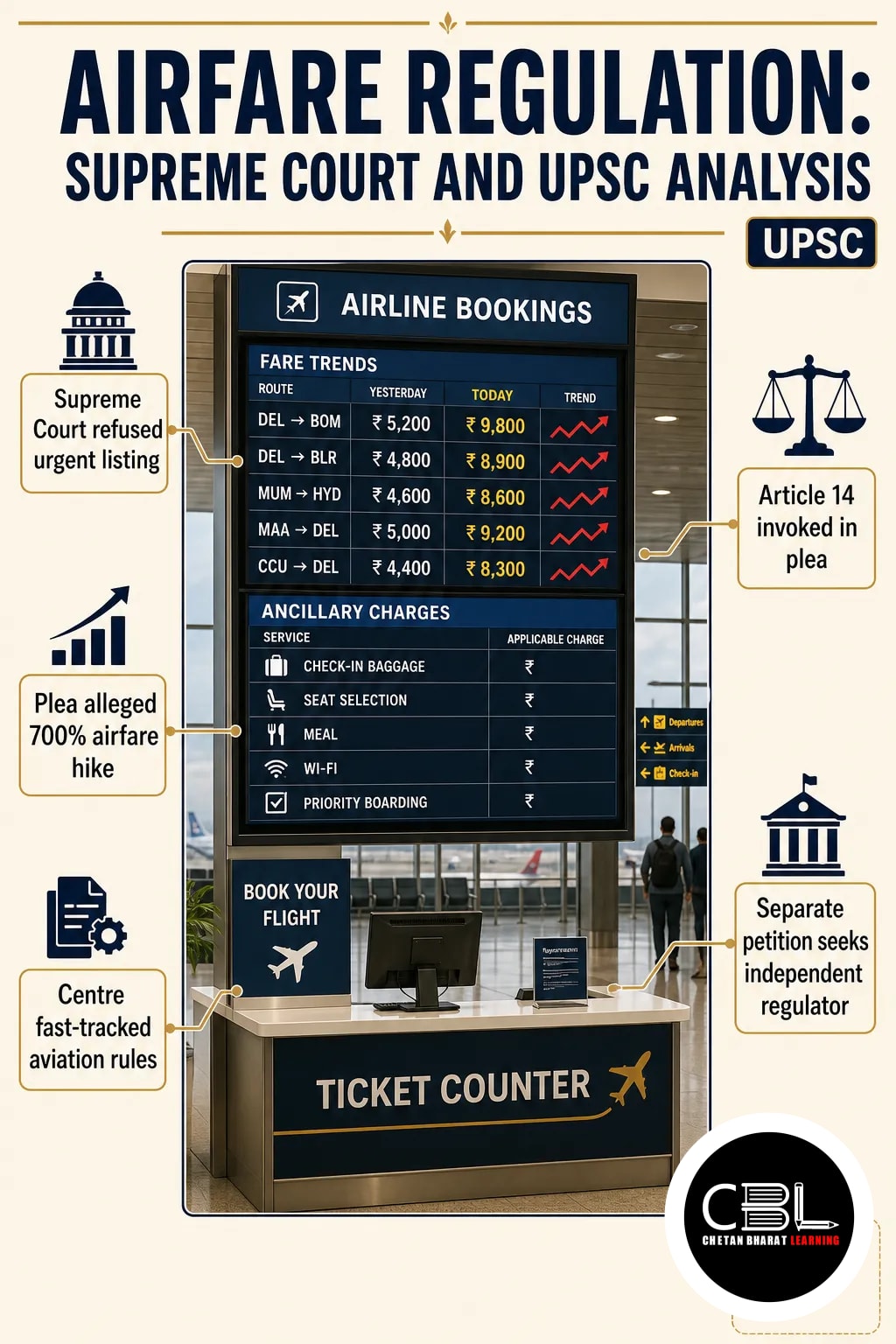

Airfare regulation returned to the Supreme Court on 2 November 2026, when it declined to urgently list a plea alleging a 700% fare increase. The case raises questions about economic regulation and consumer protection.
Quick answer: On 2 November 2026, the Supreme Court refused urgent listing of a plea alleging a 700% airfare hike in India. A separate petition seeks stronger airfare regulation and passenger protection. The Centre has informed the Court that rules under the Bharatiya Vayuyan Adhiniyam, 2024, are being fast-tracked.
What did the Supreme Court decide?
The Supreme Court declined urgent listing of the plea alleging a 700% increase in airfares. A Bench of Justices Vikram Nath, Sandeep Mehta and Aparesh Kumar Singh heard the request for urgent listing.
The advocate described air travel as an essential service and invoked Article 14. However, refusal of urgent listing is not a final judgment on the allegation or the constitutional argument. The 700% figure remains an allegation, not a Court-verified nationwide increase.
What is the background to the separate petition?
Social activist S. Laxminarayanan has filed a separate petition seeking an independent regulator and controls on unpredictable fares and ancillary charges. The Supreme Court is already hearing that matter.
| Date | Development |
|---|---|
| January 2026 | The Court flagged sharp festival-period fare rises and sought responses from the Centre and the Directorate General of Civil Aviation (DGCA). |
| 17 August 2026 | The Centre said it had fast-tracked rules under the 2024 aviation law. |
| 16 October 2026 | The Centre said the rules had administrative approval and were likely to be published within two weeks. |
| 16 November 2026 | The next hearing in the separate case is scheduled; the Court asked for the published rules to be placed before it. |
The source does not confirm that the rules have been published. Therefore, their final contents and any fare-control mechanism cannot be assumed.
Which constitutional and legal provisions matter?
Article 14 and the 2024 aviation law provide distinct starting points for examining the dispute.
| Provision or instrument | Relevance |
|---|---|
| Article 14 | Guarantees equality before the law and equal protection of the laws; the advocate invoked it in the urgent-listing plea. |
| Bharatiya Vayuyan Adhiniyam, 2024 | The aviation legislation under which the Centre is framing rules. |
| Rules under the Adhiniyam | The Centre told the Court that administrative approval had been granted; publication was expected. |
For UPSC: An advocate’s Article 14 claim does not establish a violation. Similarly, rules made under legislation are subordinate to the parent Act; their precise effect depends on their published text.
Why is airfare regulation difficult?
Regulators must balance passenger protection against the operational and commercial realities of airlines.
- Changing demand: Festival peaks can increase demand for a limited number of seats; consequently, booking time and availability may affect fares.
- Cost variation: Fuel and other operating expenses can influence airline pricing. For related context, see CBL’s coverage of jet fuel pricing.
- Price visibility: Ancillary charges may make comparison difficult; therefore, the total payable amount matters alongside the base fare.
- Regulatory capacity: A regulator needs comparable fare data and clear criteria to distinguish unusual pricing from ordinary variation.
- Access and connectivity: High fares can constrain necessary travel, while overly rigid controls may affect service viability. The UDAN 5.0 overview provides related context on regional connectivity.
What are the implications for governance?
The cases illustrate the interaction between judicial scrutiny, executive rule-making and sectoral regulation.
First, courts can examine legal challenges, but declining urgent listing does not settle the underlying policy question. Meanwhile, the Centre’s rule-making process remains significant because enforceable duties depend on the final rules.
Second, the separate petition seeks an independent regulator; the Court has not granted that request in the reported proceedings. Moreover, passenger protection requires attention to both ticket prices and additional charges, not just a headline fare.
What policy options could improve passenger protection?
Transparent pricing and evidence-based oversight offer possible options without assuming that a fixed fare cap is already in force.
- Full-price disclosure: Require a clear breakdown of the final payable fare and ancillary charges before booking.
- Fare monitoring: Collect route-wise and time-wise data; consequently, authorities can assess exceptional spikes against normal variation.
- Targeted intervention: Examine proportionate responses to extreme spikes rather than assuming one ceiling suits every route.
- Accountability: Define complaint channels, enforcement responsibilities and review mechanisms in the published framework.
- Regulatory balance: Assess effects on affordability, competition and connectivity before adopting price controls.
Ultimately, the published rules and the Court’s subsequent proceedings will determine the legal framework. Until then, proposed reforms should be distinguished from decisions already taken.
Source: The Hindu, 2 November 2026
- ATF Price Stabilisation Scheme: Government Fixes Jet Fuel Prices to Support Airlines (8 Jun 2026)
- UDAAN 5.0 (17 Apr 2023)
State PCS General Studies may test Article 14, delegated legislation and the role of regulators through this case. In addition, aspirants can analyse how affordable transport supports regional connectivity without assuming specific state fare data.
Prelims Practice Corner
Mains Practice Questions
Frequently Asked Questions
Did the Supreme Court confirm a 700% airfare increase?
No, the figure was an allegation made while seeking urgent listing. The Court declined that request; therefore, it did not confirm the figure in a final judgment.
What did the separate airfare petition seek?
It sought an independent regulator and guidelines on unpredictable fares and ancillary charges. In addition, it called for transparency and passenger protection across civil aviation.
Have the aviation rules been published?
The source does not confirm their publication. On 16 October 2026, the Centre said administrative approval had been granted and publication was expected within two weeks.
Which constitutional provision did the advocate invoke?
The advocate invoked Article 14, which concerns equality before the law and equal protection of the laws. However, the reported proceedings did not establish that an Article 14 violation had occurred.
Related Current Affairs
Preparing for UPSC, PCS or HCS?
Talk to a mentor at Chetan Bharat Learning, Chandigarh. Free guidance on choosing the right exam and building a study plan.
Chat on WhatsAppCall 97793 53345UPSC / IAS / PCS coaching in Chandigarh · Trusted by aspirants across Punjab & Haryana

 Ananya RanaIAS · AIR 60
 Aditya SharmaIAS · AIR 70
 Ria Kaur SethiIPS · AIR 89
 Aman AloonIRS · AIR 295
 Sumer Singh VirkIRS · AIR 335
 Shivani PanchalIAS

Leave a Reply
You must be logged in to post a comment.