
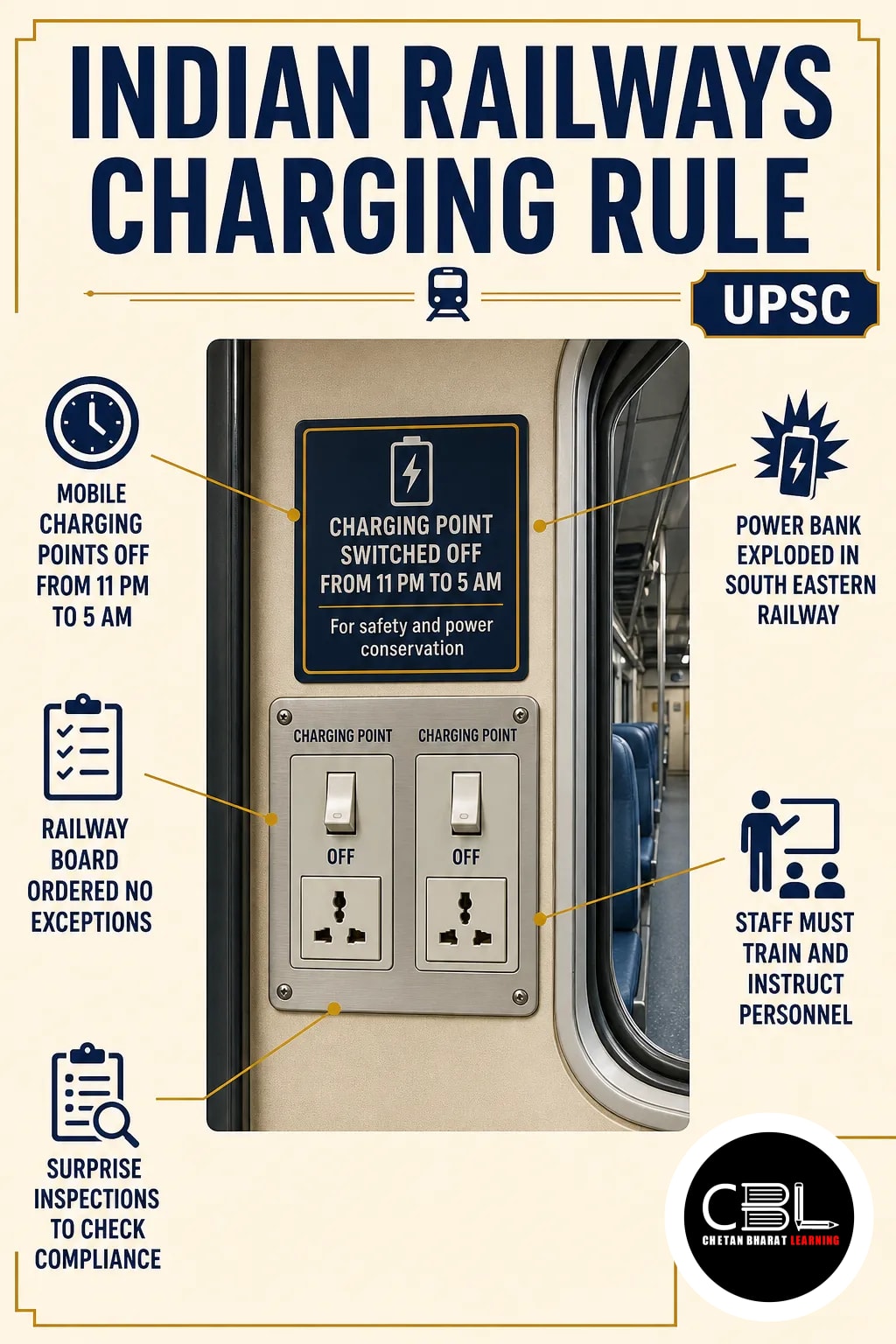

Indian Railways charging rule requires coach mobile charging points to remain switched off at night. The Railway Board has reinforced this national passenger safety measure after a power bank incident.
Quick answer: The Indian Railways charging rule requires mobile charging points in train coaches to remain off from 11 PM to 5 AM. On 26 October 2026, the Railway Board instructed all zones to enforce it without exceptions, after a power bank exploded while charging in the South Eastern Railway zone.
What is the Indian Railways charging rule?
The rule requires mobile charging points in train coaches to stay off for six hours overnight. Moreover, the Railway Board has directed zones to allow no exceptions during this period.
The instruction concerns coach charging points; it does not describe a general ban on carrying phones or power banks. For earlier coverage, see the train charging point safety explainer.
| Feature | Key fact |
|---|---|
| Restricted hours | 11 PM to 5 AM |
| Purpose | Prevent fire hazards and protect passengers |
| Board communication | Letter dated 26 October 2026 |
| Recipients | Principal Chief Mechanical Engineers of all railway zones |
Why was the instruction reinforced?
A power bank exploded and produced smoke while charging in the South Eastern Railway zone. According to the Board, onboard staff had not switched off the charging points during the prescribed period.
Separately, a fire occurred on 24 October 2025 in a general coach of the Amritsar–Purnia Court Jan Sewa Express. It occurred near Sonbarsa Kachahari station in Bihar’s Saharsa district at around 6:10 PM. A phone explosion during charging was reported as its cause; the fire was extinguished and no casualties were reported.
How will railway zones ensure compliance?
The Railway Board asked all zones to instruct their staff and check compliance with the overnight restriction.
- Staff preparation: Zones must counsel, instruct and train concerned personnel for effective implementation.
- Surprise inspections: Officers and supervisors must check compliance through unannounced inspections.
- Uniform enforcement: Moreover, the Board’s letter says staff should permit no exceptions.
Why does the rule matter?
The Indian Railways charging rule addresses fire risks associated with charging devices in coaches. Therefore, it connects passenger safety with routine staff action and supervisory checks.
For prelims, distinguish the night-time switch-off from an all-day prohibition. Also remember that the 2025 incident occurred before the restricted hours and its reported cause is not proof of the cause of every charging-related fire.
Source: Indian Express, 2 November 2026
- Train Charging Point Rule: UPSC Safety Facts (2 Nov 2026)
State PCS General Studies questions can test the restricted hours, the issuing authority and the reason for the instruction. Also note that the 2025 fire involved a train travelling from Amritsar to Purnia Court.
Prelims Practice Corner
Mains Practice Questions
Frequently Asked Questions
When are train mobile charging points switched off?
From 11 PM to 5 AM, because the rule requires a six-hour overnight switch-off. The Railway Board has directed zones to permit no exceptions.
Why did the Railway Board reinforce the charging rule?
Because a power bank exploded while charging in the South Eastern Railway zone. The Board said staff had not switched off the points during the prescribed hours.
Does the instruction ban passengers from carrying power banks?
No, since the stated instruction concerns switching off coach mobile charging points overnight. It does not describe a general ban on carrying power banks.
Related Current Affairs
Preparing for UPSC, PCS or HCS?
Talk to a mentor at Chetan Bharat Learning, Chandigarh. Free guidance on choosing the right exam and building a study plan.
Chat on WhatsAppCall 97793 53345UPSC / IAS / PCS coaching in Chandigarh · Trusted by aspirants across Punjab & Haryana

 Ananya RanaIAS · AIR 60
 Aditya SharmaIAS · AIR 70
 Ria Kaur SethiIPS · AIR 89
 Aman AloonIRS · AIR 295
 Sumer Singh VirkIRS · AIR 335
 Shivani PanchalIAS

Leave a Reply
You must be logged in to post a comment.