
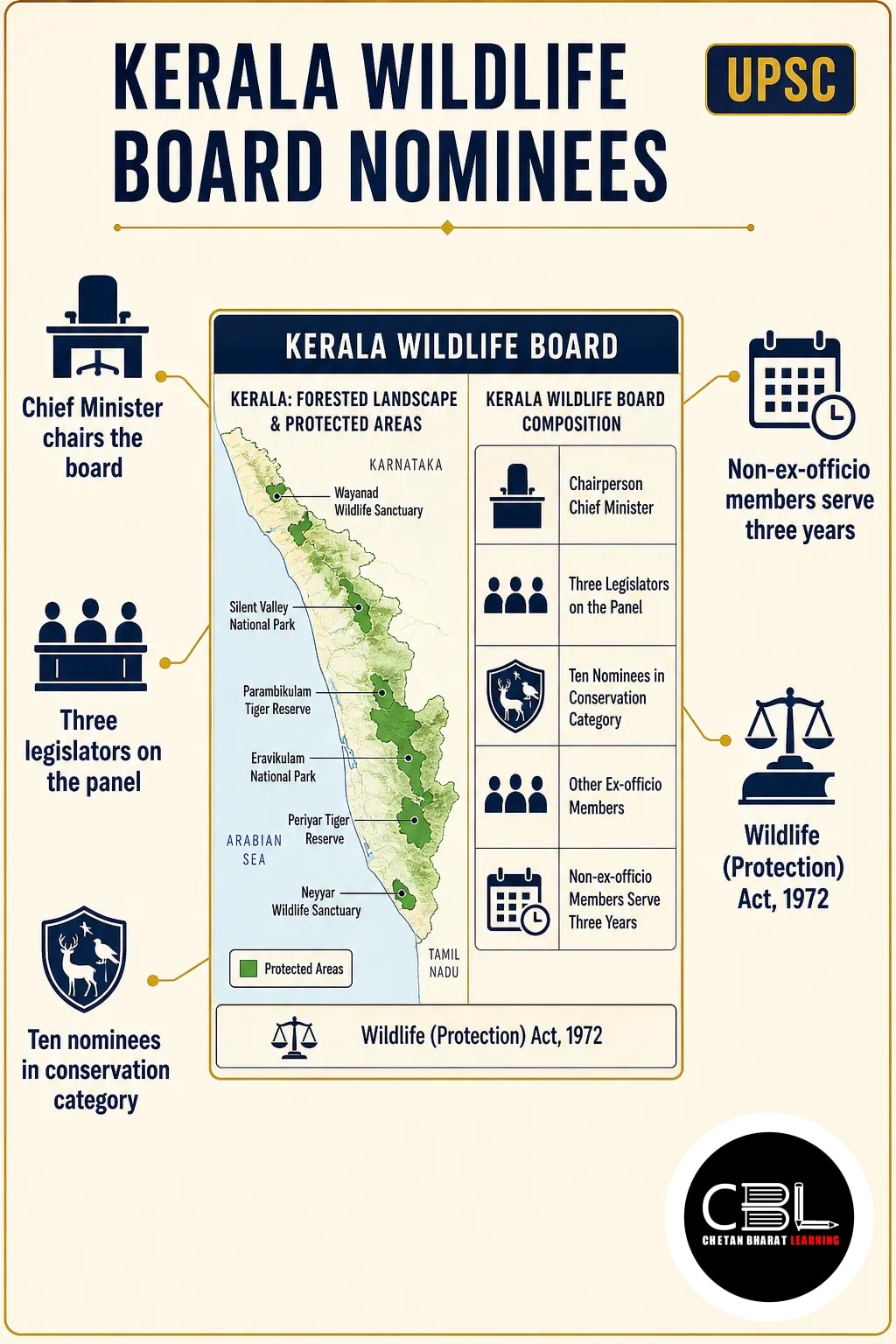

Kerala Wildlife Board nominees have drawn criticism from conservation activists after the state reconstituted the panel. The dispute raises questions about representation and expertise in environmental governance.
Quick answer: Kerala Wildlife Board nominees came under scrutiny after the state reconstituted its wildlife board, as reported on 2 November 2026. The Chief Minister chairs the panel, which includes three legislators and ten conservation-category nominees. Activists questioned certain selections; non-ex-officio members serve for three years from nomination.
What is the State Board for Wildlife?
A State Board for Wildlife is a statutory body that advises the state government on wildlife conservation. Section 6 of the Wildlife (Protection) Act, 1972 provides for its constitution.
Under Section 8, the board advises on matters including protected areas, wildlife protection and conservation policy. Therefore, its composition matters because members contribute different forms of knowledge to environmental advice.
The board has an advisory role; it should not be confused with an authority that independently grants every environmental approval. For related context, see the analysis of post-facto environmental clearance.
Why are the Kerala Wildlife Board nominees in the news?
Environmental activists have challenged the choice of certain nominees after Kerala reconstituted the board. In particular, they questioned whether some selections reflect the panel’s conservation objectives.
N. Badusha, president of the Wayanad Prakrithi Samrakshana Samithi, criticised the nomination of Wayanad-based activist K.P. Elias. Badusha alleged that Elias advocated hunting wild animals for population control and questioned forests’ role in addressing global warming.
Badusha also referred to Elias’ reported support for a tunnel road through the Wayanad hills and an airport involving paddy-field reclamation. However, these are allegations and reported positions, not established findings; Elias was unavailable to respond to the allegations.
In addition, the Co-existence Collective, a coalition of environmental groups, researchers, scientists and civil society members, protested against the panel’s constitution. The source does not establish that the board has taken a decision on either project.
Who sits on the reconstituted board?
The board brings together political representatives, conservation nominees, officials and scientific institutions. The Chief Minister is chairperson, while the Forest Minister is vice-chairperson.
| Category | Members or details |
|---|---|
| Legislators | Ullas Kovoor of Kunnathur, Sebastian M.J. of Poonjar and C.K. Kasim of Thiruvambady |
| Non-governmental organisations | Renjan Mathew Varghese, Jose Louise and M.K. Ranjit Singh |
| Conservation category | Ten nominees, including Chandanam N. and Raman Rajamannan from the Scheduled Tribe community |
| Member secretary | Chief Wildlife Warden |
| Tenure | Three years from nomination for members other than ex-officio members |
The three legislators represent the Revolutionary Socialist Party, Indian National Congress and Indian Union Muslim League, respectively. Among the organisational representatives, Varghese is the state director of World Wide Fund for Nature (WWF)-India; Louise and Singh are associated with the Wildlife Trust of India.
Furthermore, official members include forest, tourism, police, animal husbandry and fisheries representatives. The Botanical Survey of India and Zoological Survey of India also have representatives, alongside the Director of the Wildlife Institute of India.
Which legal and constitutional provisions matter?
The wildlife board operates within a statutory framework supported by constitutional environmental duties. These provisions connect state-level advice with broader conservation responsibilities.
| Provision | Relevance |
|---|---|
| Sections 6 and 8, Wildlife (Protection) Act, 1972 | Provide for the state board and its advisory functions |
| Article 48A | Directs the state to endeavour to protect the environment and safeguard forests and wildlife |
| Article 51A(g) | Makes environmental protection and compassion for living creatures a fundamental duty of citizens |
| Concurrent List, Entry 17B | Covers protection of wild animals and birds |
Articles 48A and 51A(g) provide constitutional context; however, they do not prescribe a particular nominee. For protected-area context, also revise wildlife sanctuaries and eco-sensitive zone rules.
Why does board composition matter?
Board composition affects the range and credibility of advice available to the state. It also determines whether ecological evidence, community experience and administrative concerns receive attention.
- Scientific expertise: Ecologists and wildlife specialists can assess habitat impacts and conservation choices.
- Community representation: Scheduled Tribe representatives can bring knowledge and perspectives from forest-dependent communities.
- Development trade-offs: Roads and other projects may generate competing claims, so advice should assess ecological consequences alongside public needs.
- Public trust: Transparent appointments and reasoned advice can help citizens evaluate whether conservation concerns received due consideration.
However, representation alone does not establish the quality of deliberation. The board must also consider evidence and record how it evaluates competing views.
What are the concerns and the way forward?
The central governance challenge is to combine diverse representation with demonstrable conservation competence. Criticism of an appointment should therefore be examined against clear criteria rather than treated as proof of misconduct.
- Selection criteria: Publish the expertise and conservation experience sought for nominated positions, along with reasons for selection.
- Evidence-led advice: Place ecological assessments and relevant scientific views before the board when it considers proposals.
- Accountability: Record substantive recommendations and disclose them where legally permissible; also document differing views.
- Inclusive deliberation: Give community representatives a meaningful opportunity to contribute, rather than limiting participation to formal membership.
Overall, transparent selection and reasoned recommendations can strengthen an advisory board without excluding legitimate debate about conservation and development.
Source: The Hindu, 2 November 2026
- Kappatagudda Wildlife Sanctuary: Location and ESZ Rules (28 Oct 2026)
- Kolamarka Wildlife Sanctuary & Tansa Expansion (28 Oct 2026)
- Post-Facto Environmental Clearance: 2026 SC Ruling (28 Oct 2026)
State PCS General Studies may test the statutory basis and advisory role of state wildlife boards. In addition, candidates can link conservation administration to protected areas and state-level environmental decision-making.
Prelims Practice Corner
Mains Practice Questions
Frequently Asked Questions
Who chairs Kerala’s State Board for Wildlife?
The Chief Minister chairs the board. In addition, the Forest Minister serves as vice-chairperson.
Why have the board’s nominations drawn criticism?
Activists have questioned whether certain nominees support conservation objectives. However, the allegations against K.P. Elias remain attributed to critics, and he was unavailable to respond.
What is the tenure of nominated members?
Non-ex-officio members serve for three years from their nomination. Therefore, the reported tenure does not apply to ex-officio members in the same way.
Which law provides for state wildlife boards?
The Wildlife (Protection) Act, 1972 provides for them under Section 6. In addition, Section 8 sets out their advisory functions.
Related Current Affairs
Preparing for UPSC, PCS or HCS?
Talk to a mentor at Chetan Bharat Learning, Chandigarh. Free guidance on choosing the right exam and building a study plan.
Chat on WhatsAppCall 97793 53345UPSC / IAS / PCS coaching in Chandigarh · Trusted by aspirants across Punjab & Haryana

 Ananya RanaIAS · AIR 60
 Aditya SharmaIAS · AIR 70
 Ria Kaur SethiIPS · AIR 89
 Aman AloonIRS · AIR 295
 Sumer Singh VirkIRS · AIR 335
 Shivani PanchalIAS

Leave a Reply
You must be logged in to post a comment.