

UPSC Mapping
| Aspect | Details |
|---|---|
| Relevant law | Bharatiya Nagarik Suraksha Sanhita (BNSS) |
| Chapter | Chapter IX: Threats to peace and good behaviour |
| Key sections | Section 126, Sections 127–129, Section 130, Sections 135–136, Section 140, Section 163, Section 414, Sections 438–442, Section 491 |
| UPSC relevance | Prelims and GS Paper II: Governance, Constitution and rights |
Article
BNSS security bonds allow executive magistrates to address a risk of violence before an offence occurs. Their use also raises questions about liberty and safeguards, discussed alongside protections against arbitrary arrest.
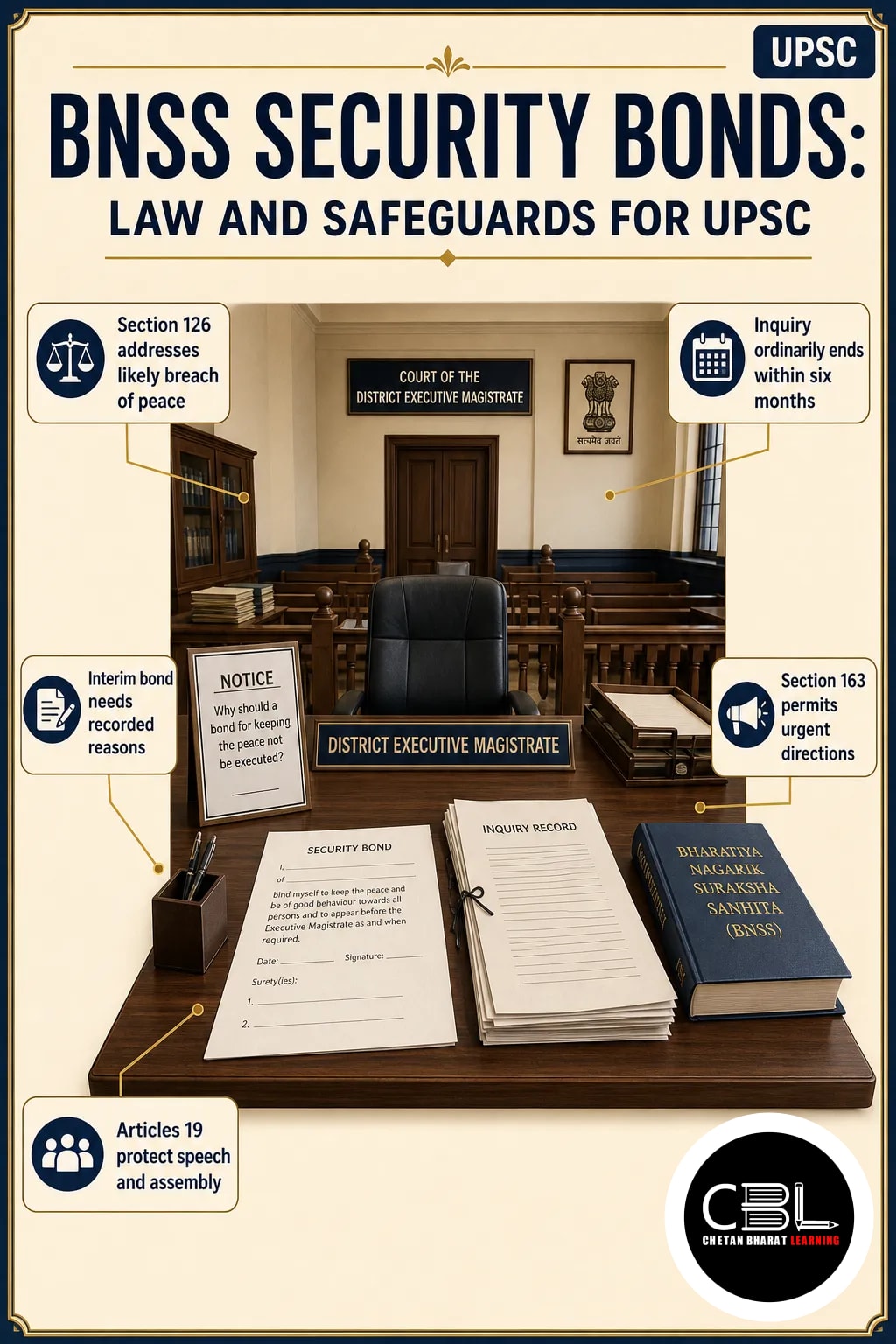
Quick answer: BNSS security bonds are preventive undertakings sought through proceedings before executive magistrates. Chapter IX of the Bharatiya Nagarik Suraksha Sanhita (BNSS) covers threats to peace and certain good-behaviour cases. An inquiry ordinarily ends within six months; meanwhile, a magistrate may require an interim bond for recorded reasons.
What do BNSS security bonds seek to prevent?
Security proceedings seek to prevent a breach of peace or ensure good behaviour by an identified person. The BNSS, which succeeded the Code of Criminal Procedure (CrPC), places these measures in Chapter IX.
Under Section 126, proceedings address a person likely to breach peace, disturb public tranquillity or commit a wrongful act that may cause such disturbance. Sections 127–129, meanwhile, address good behaviour in cases involving certain prohibited material, suspected persons and habitual offenders.
A bond is an undertaking to comply with specified conditions; a bail bond involves a surety. For example, a ₹20,000 peace bond does not require payment upfront. However, a breach can trigger forfeiture proceedings and recovery.
How do preventive proceedings work?
An executive magistrate must assess the information independently before asking an identified person to show cause. In most districts, an Executive Magistrate or Sub-Divisional Magistrate conducts the proceedings.
Police usually submit a report and relevant evidence. However, the magistrate is not bound by the recommendation and must form a reasoned opinion on the available material. In commissionerate systems, eligible police officers may exercise executive magistrate powers under the applicable provisions.
From notice to decision
- Written preliminary order: Section 130 requires an order stating reasons and the substance of the information; it calls upon the person to explain why security should not be furnished.
- Inquiry: The magistrate examines the truth of the information and gives the person an opportunity to present evidence. Ordinarily, proceedings end automatically if the inquiry is not completed within six months.
- Interim bond: During the inquiry, the magistrate may require one after a preliminary assessment. However, reasons must be recorded in writing and an imminent breach must justify the measure.
- Final decision: After the inquiry, the magistrate decides whether a bond is necessary. Sections 135 and 136 provide for inquiry and a reasoned decision.
A surety undertakes an obligation and provides an additional source of recovery if forfeiture lawfully follows. Moreover, Section 140 provides for rejection of an unfit surety.
What happens if a person fails to furnish or breaches a bond?
Failure to furnish a bond after the inquiry can lead to imprisonment; a later breach can lead to detention and forfeiture proceedings. These consequences address distinct situations.
For proceedings under Sections 126–128, imprisonment for failure to furnish security can extend to one year. Under Section 129, it can extend to three years.
If a breach is proved after a bond is furnished, the magistrate may record the grounds and order detention for the remaining bond period. In addition, Section 491 provides the forfeiture procedure through which the penalty may be recovered.
How do bonds differ from an FIR and Section 163?
Security proceedings target a future risk, whereas a First Information Report (FIR) starts investigation of a cognizable offence. Section 163, by contrast, enables urgent directions to avert danger or disturbance.
| Procedure | Purpose and reach |
|---|---|
| Security proceedings | Prevent a future breach through proceedings against identified persons. |
| FIR | Initiates investigation of a cognizable offence, for which police can arrest without a warrant. |
| Section 163 | Permits urgent directions to an individual or the public; emergency orders may be ex parte, without a prior hearing. |
The processes can operate together. For example, after a clash, an FIR addresses the suspected offence; meanwhile, security proceedings may address a risk of further violence. Section 163 can also restrict specified activities to avert an urgent confrontation.
What constitutional safeguards apply?
The Constitution protects speech and peaceful assembly while permitting reasonable restrictions on specified grounds, including public order. In Madhu Limaye v. Sub-Divisional Magistrate, Monghyr (1970), the Supreme Court upheld the constitutional validity of the relevant preventive provisions.
| Article or provision | What it provides |
|---|---|
| Articles 19(1)(a) and 19(1)(b) | Protect speech and expression, and peaceful assembly without arms. |
| Articles 19(2) and 19(3) | Permit reasonable restrictions on specified grounds, including public order. |
| BNSS Sections 130, 135 and 136 | Provide for a written preliminary order, inquiry and reasoned decision. |
| BNSS Section 414 and Sections 438–442 | Provide avenues of appeal and criminal revision, respectively. |
Why do safeguards matter for public order?
Preventive powers can address credible threats, but their use can also affect liberty and expression. Therefore, the quality of the evidence and the magistrate’s independent assessment matter.
- Risk-based action: Proceedings can help prevent escalation during communal tensions, rallies or threats of retaliation. However, a mere allegation of tension should not replace sufficient material.
- Freedom of expression: Critical reporting may create controversy. Nevertheless, the magistrate must independently assess whether the statutory basis for proceedings exists.
- Meaningful hearing: A written notice and opportunity to present evidence help the affected person contest the alleged risk. Moreover, recorded reasons enable scrutiny.
- Proportionate administration: Authorities should assess the need for security and interim measures case by case. In addition, accessible appeal and revision mechanisms support accountability.
The National Crime Records Bureau’s Crime in India 2022 recorded 57,082 cases of offences against public tranquillity, including 37,816 rioting cases. These figures show the scale of recorded offences; however, they do not by themselves establish the effectiveness of bonds.
Source: Indian Express Explained, 29 October 2026
District magistrates in Punjab and Haryana use these preventive powers during farm protests, religious processions and elections. Therefore, state PCS papers can ask how BNSS security proceedings balance public order with the right to protest.
Prelims Practice Corner
Mains Practice Questions
Frequently Asked Questions
What is the purpose of a security bond under the BNSS?
It prevents a breach of peace or secures good behaviour. Therefore, proceedings can begin before any offence occurs.
Must the bond amount be paid immediately?
No, because signing the undertaking needs no upfront payment. However, a breach may lead to forfeiture and recovery.
How long does the inquiry ordinarily take?
Six months, ordinarily. Otherwise, the proceedings end automatically.
Can security proceedings and an FIR operate together?
Yes, because they serve different purposes. An FIR addresses a suspected offence, while security proceedings address a future risk.
Related Current Affairs
Preparing for UPSC, PCS or HCS?
Talk to a mentor at Chetan Bharat Learning, Chandigarh. Free guidance on choosing the right exam and building a study plan.
Chat on WhatsAppCall 97793 53345UPSC / IAS / PCS coaching in Chandigarh · Trusted by aspirants across Punjab & Haryana
Leave a Reply
You must be logged in to post a comment.