
UPSC Syllabus Mapping
- GS Paper: GS-II
- Subject: International Relations, International Institutions and India’s Trade Policy
What is Plurilateral Agreements?
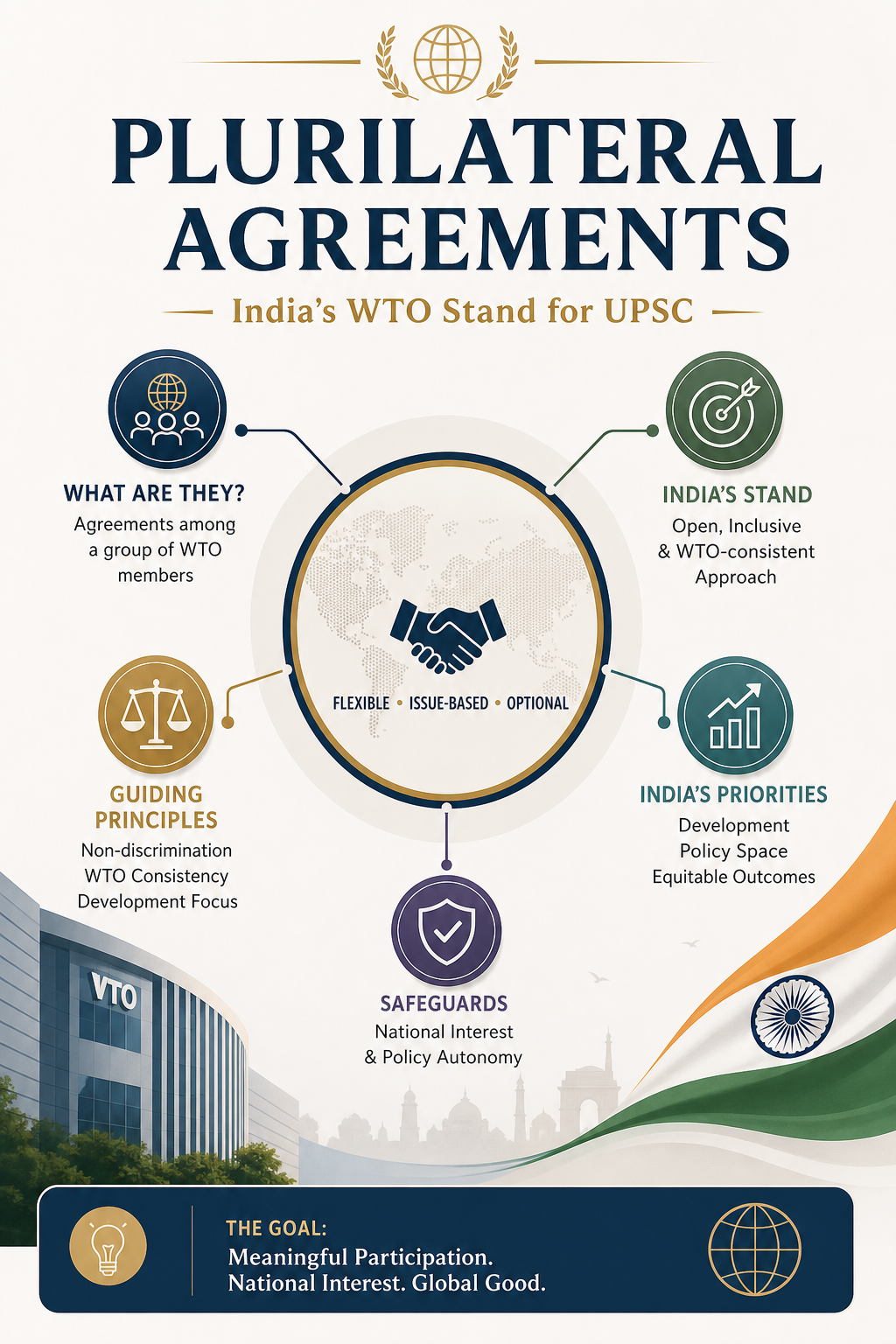
Plurilateral Agreements are trade agreements negotiated among a limited number of willing WTO members instead of all members. Only participating countries are legally bound by their commitments, unlike multilateral agreements that apply to the entire WTO membership.
These agreements generally focus on emerging issues such as e-commerce, digital trade, investment facilitation and environmental goods. Supporters argue that they enable faster negotiations where consensus among all members is difficult.
Why is Plurilateral Agreements in News?
During India’s Trade Policy Review at the WTO, India opposed attempts to incorporate Plurilateral Agreements into the WTO framework without consensus. India emphasized that the Marrakesh Agreement establishing the WTO was founded on collective decision-making and equal participation of all members.
India argued that Annex 4 agreements require consensus for inclusion within the WTO legal architecture and warned that permitting rule-making by only a few members could undermine the multilateral trading system.
Key Features of Plurilateral Agreements
- Negotiated only among interested WTO members.
- Binding only on participating countries.
- Often address new-generation trade issues such as digital trade and investment facilitation.
- Allow faster negotiations compared to full multilateral consensus.
- Can coexist with multilateral agreements if adopted according to WTO procedures.
- Closely linked to Annex 4 of the Marrakesh Agreement.
Challenges Related to Plurilateral Agreements
India fears that small groups of countries may gradually create global trade rules that later become compulsory for others, thereby weakening the WTO’s consensus-based governance model. Developing countries may also face capacity constraints in participating effectively in multiple negotiations.
For related topics on global governance and trade, visit the UPSC current affairs library.
Way Forward for Plurilateral Agreements
The WTO should continue reform efforts while preserving inclusiveness, transparency and consensus wherever required. Negotiations on emerging trade issues should balance flexibility with the interests of developing economies, ensuring that multilateralism remains credible and effective.
For further policy analysis, refer to PRS Legislative Research.
Prelims Practice Corner
- Where is the headquarters of the WTO located?
- The Marrakesh Agreement established which international organisation?
- Which WTO Annex contains Plurilateral Agreements?
- What is the primary decision-making principle of the WTO?
- Which of the following is commonly discussed under plurilateral negotiations? (a) Digital Trade (b) E-commerce (c) Investment Facilitation (d) All of the above
Answers
- 1. Geneva
- 2. WTO
- 3. Annex 4
- 4. Consensus
- 5. (d) All of the above.
Mains Practice Questions
Q1. Discuss India’s objections to Plurilateral Agreements within the WTO framework.
Answer Outline: Consensus principle, inclusiveness, developing country concerns, WTO reforms, India’s trade interests.
Q2. Evaluate whether plurilateral trade negotiations strengthen or weaken the multilateral trading system.
Answer Outline: Advantages, limitations, WTO governance, future reforms, balanced conclusion.
FAQs on Plurilateral Agreements
What are Plurilateral Agreements?
They are agreements negotiated among a limited number of WTO members rather than the full membership.
Why does India oppose some Plurilateral Agreements?
India believes WTO rules should emerge through consensus-based multilateral negotiations to preserve equality among members.
Why is this topic important for UPSC?
It is relevant for GS-II, international organisations, India’s trade policy and WTO reforms.
Related Current Affairs
Preparing for UPSC, PCS or HCS?
Talk to a mentor at Chetan Bharat Learning, Chandigarh. Free guidance on choosing the right exam and building a study plan.
Chat on WhatsAppCall 97793 53345UPSC / IAS / PCS coaching in Chandigarh · Trusted by aspirants across Punjab & Haryana
Leave a Reply
You must be logged in to post a comment.