
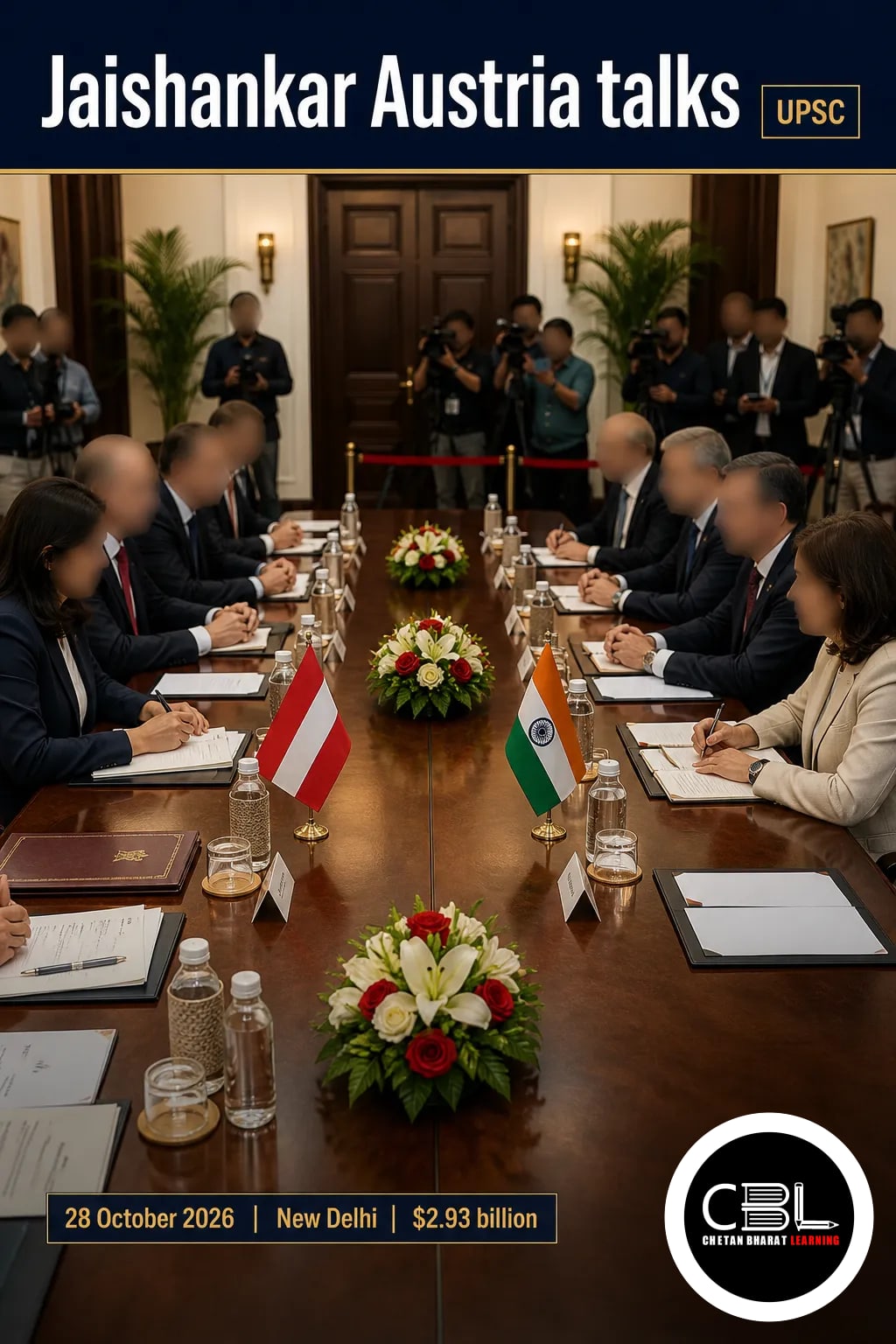
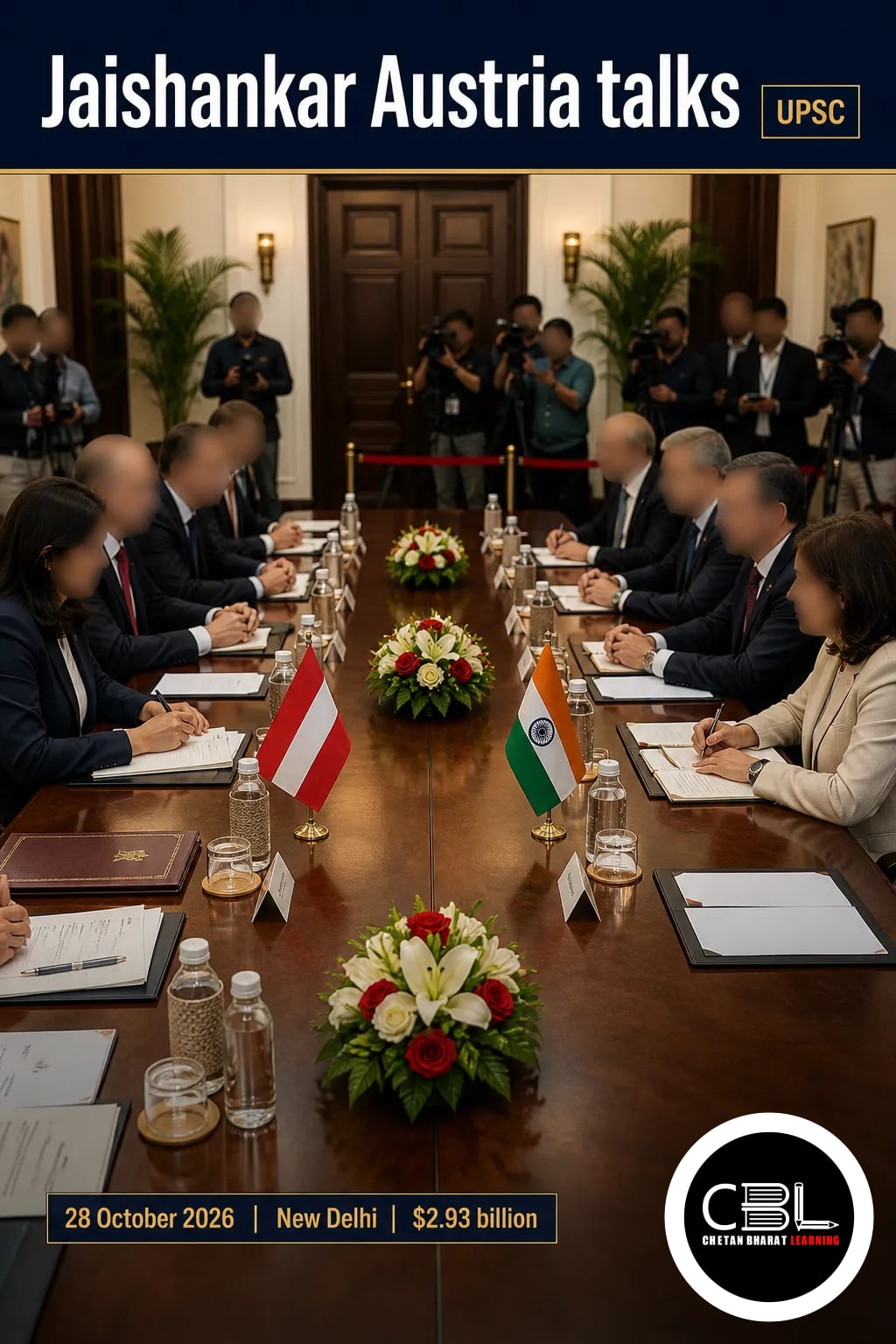
Jaishankar Austria talks in New Delhi brought trade, technology and mobility into focus on 28 October 2026. The meeting also adds to the context for studying India’s outreach to Central Europe.
Quick answer: On 28 October 2026, External Affairs Minister S. Jaishankar met Austrian Foreign Minister Beate Meinl-Reisinger in New Delhi. They discussed trade, investment, infrastructure, technology, education and culture, as well as opportunities in startups, space, skilling and mobility. They also exchanged views on global developments and multilateral cooperation.
What happened at the Jaishankar Austria talks?
The foreign ministers discussed bilateral cooperation and exchanged views on global developments and their impacts. They also addressed cooperation in multilateral forums.
Jaishankar identified trade, investment, infrastructure, technology, education and culture as areas of the partnership. In addition, the ministers discussed potential avenues in startups, space, skilling and mobility.
The account identifies discussion areas rather than specific commitments. Therefore, the meeting is best assessed as an opportunity to develop cooperation, not as evidence of a concluded agreement.
What were the key outcomes and discussion areas?
The reported outcome was a broad exchange on existing and potential areas of cooperation. The source does not specify an agreement, funding commitment or implementation schedule.
- Economic ties: The ministers discussed trade and investment alongside infrastructure and technology.
- Knowledge links: They included education and culture in their bilateral agenda.
- New avenues: They also discussed startups, space, skilling and mobility.
- Global issues: They exchanged views on international developments, their impacts and multilateral cooperation.
India–Austria trade snapshot
The reported figures show Indian exports exceeding imports from Austria. However, the source does not specify the period covered by these figures.
| Indicator | Reported value |
|---|---|
| Total bilateral trade | $2.93 billion |
| Indian exports to Austria | $1.52 billion |
| Indian imports from Austria | $1.41 billion |
| India’s trade surplus, calculated | $0.11 billion |
The surplus is the difference between the reported export and import figures. However, this snapshot alone cannot establish a trend or identify the goods driving trade.
Why do India–Austria ties matter for India?
The discussions connect India’s economic diplomacy with education, skills and international cooperation. For Mains answers, their significance lies in how these areas can reinforce one another.
Economic and technology cooperation
Trade and investment provide a basis for sustained engagement. Moreover, cooperation on technology and infrastructure could connect commercial relationships with innovation and project capabilities.
Startups and space offer additional areas for exploration. However, their contribution will depend on specific projects and institutional partnerships, neither of which the source details.
People and multilateral engagement
Education, skilling and mobility can complement economic links by connecting institutions and people. Similarly, cultural engagement can support broader mutual understanding.
Discussion of global developments also gives both countries an opportunity to compare assessments. In addition, multilateral cooperation can help them engage on shared concerns beyond the bilateral relationship.
What are the concerns and limits?
The principal analytical limit is the gap between a wide agenda and documented implementation. Aspirants should distinguish stated discussion areas from measurable results.
- Unspecified commitments: The source lists topics, but it does not identify agreed projects or deadlines.
- Limited trade context: The trade figures lack a stated period and sectoral breakdown; therefore, they cannot demonstrate growth.
- Implementation: Cooperation in skills and mobility would require practical arrangements; however, the report does not describe any.
- Global differences: An exchange of views does not necessarily imply identical positions on every international issue.
What is the way forward for India–Austria cooperation?
Both sides could translate the discussion areas into identifiable projects and regular follow-up. For example, institutions could explore education and skilling partnerships alongside commercial engagement.
They could also identify mutually agreed opportunities in technology, startups and space. Meanwhile, clearer trade data and project milestones would help assess progress without treating an initial dialogue as a completed outcome.
Source: The Hindu, 28 October 2026
- Visegrad Group (V4): India’s Central Europe Outreach (24 Sep 2026)
- Reformed Multilateralism: India’s 81st UNGA Push (24 Sep 2026)
Punjab PCS and Haryana HCS General Studies can test Austria’s location and the reported areas of India–Austria cooperation. In addition, Mains answers can use the meeting to explain links between trade, skills and mobility.
Prelims Practice Corner
Mains Practice Questions
Frequently Asked Questions
Who represented Austria in the talks with India?
Foreign Minister Beate Meinl-Reisinger represented Austria. She met S. Jaishankar in New Delhi on 28 October 2026.
What was the reported India–Austria bilateral trade volume?
The reported bilateral trade volume was $2.93 billion. However, the source does not specify the period covered.
Did the ministers discuss space and mobility?
Yes, both were discussed as potential avenues of cooperation. The ministers also discussed startups and skilling.
Was a specific agreement announced in the source?
No specific agreement is identified in the source. Instead, it describes the ministers’ discussion areas and exchange of views.
Related Current Affairs
Preparing for UPSC, PCS or HCS?
Talk to a mentor at Chetan Bharat Learning, Chandigarh. Free guidance on choosing the right exam and building a study plan.
Chat on WhatsAppCall 97793 53345UPSC / IAS / PCS coaching in Chandigarh · Trusted by aspirants across Punjab & Haryana
Leave a Reply
You must be logged in to post a comment.