
UPSC Mapping
| Prelims | United Nations, UNSC and Visegrád Group |
|---|---|
| Mains | GS Paper II – International Relations |
| Session | 81st UNGA |
|---|---|
| Venue | New York |
| Indian Representative | External Affairs Minister |
| Diplomatic Format | P4M Summit |
Article
What is Reformed Multilateralism?
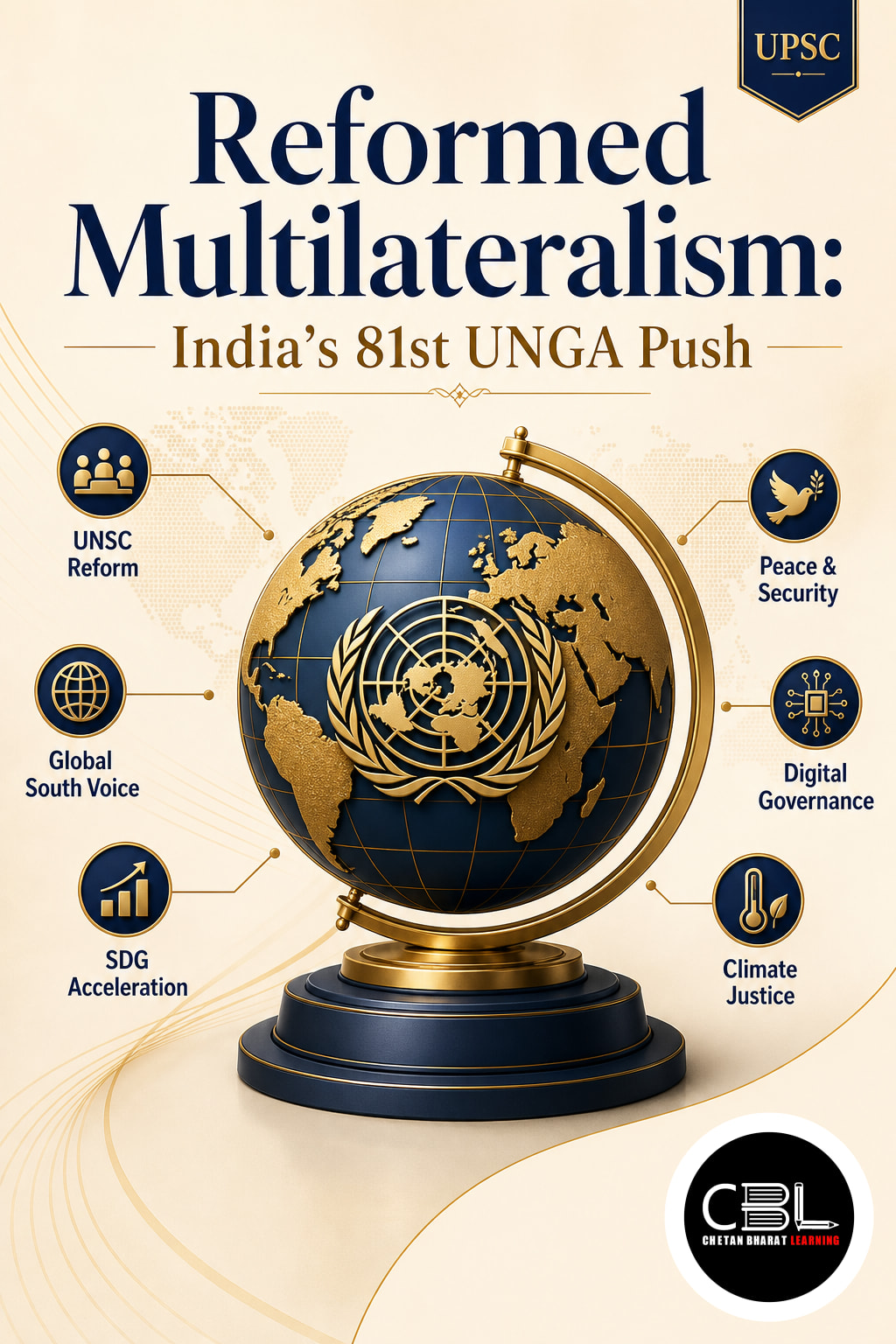
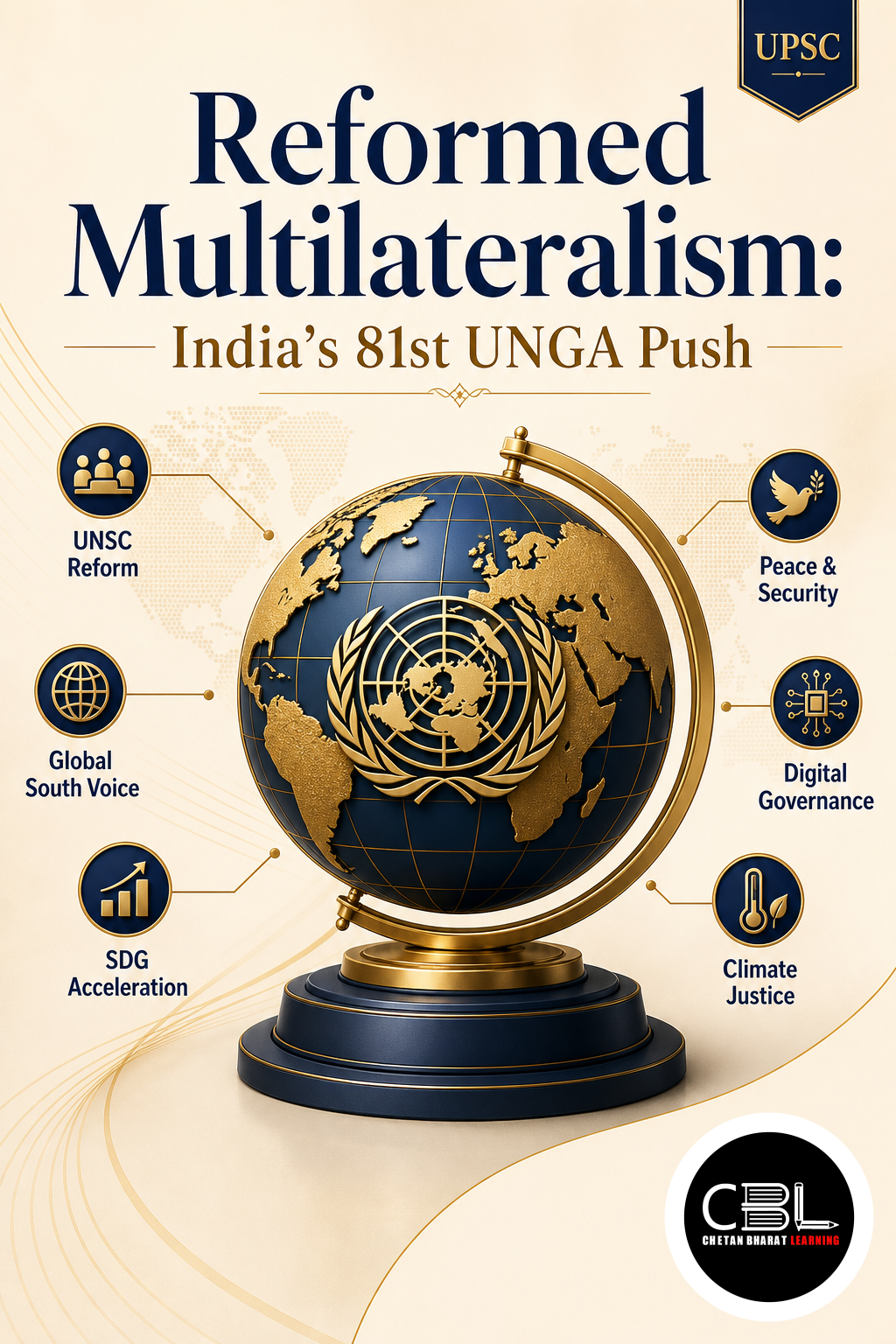
Reformed Multilateralism seeks to update global institutions according to contemporary political, economic and demographic realities. It supports a more representative United Nations system where developing countries participate meaningfully in deliberations. The approach also demands transparent decision-making instead of arrangements dominated by a few established powers.
India argues that institutions designed after the Second World War no longer reflect today’s distribution of power. Asia, Africa and Latin America have gained economic weight, yet their formal influence remains limited. India consequently links institutional reform with stronger representation for the Global South and expanded membership of the UN Security Council.
Why is Reformed Multilateralism in News?
Reformed Multilateralism entered the spotlight when S. Jaishankar addressed growing pressures on international cooperation during the 81st UNGA. He co-chaired the inaugural P4M Summit with European Council President Antonio Costa. The meeting examined how multilateral cooperation, international law and peace could withstand intensifying geopolitical competition.
India highlighted conflicts, strategic rivalries and disruptions affecting food, fuel, fertiliser and finance. This 4F crisis demonstrates how distant geopolitical events can create economic and humanitarian consequences worldwide. The Ministry of External Affairs provides official updates on India’s diplomatic engagements and multilateral priorities.
Key Features
- Representative global institutions: Greater participation for developing countries in decision-making bodies, particularly the UN Security Council.
- Participatory and transparent decisions: Open deliberations, accountable procedures and wider consultation to improve legitimacy.
- Respect for international law: Emphasis on established rules, peaceful dispute resolution and sovereign equality.
- Resilient global supply chains: Diversified suppliers, markets and transport routes to reduce strategic chokepoint risks.
- Cooperation on emerging challenges: Shared frameworks for climate action, terrorism, pandemics, disaster resilience and emerging technologies.
Challenges
- Resistance from established powers: Possible pushback from those with permanent seats, veto rights or disproportionate influence.
- Absence of reform consensus: Disagreement over additional seats, regional representation and veto powers.
- Growing geopolitical divisions: Rivalries that block collective action on conflicts, sanctions and humanitarian emergencies.
- Dependence on strategic chokepoints: Vulnerabilities in concentrated supply chains requiring investment and infrastructure.
- Gap between commitments and delivery: Need for measurable outcomes, regular reviews and public accountability.
Way Forward
Reformed Multilateralism requires negotiations that connect institutional legitimacy with effective responses to present challenges. Member states should pursue UNSC reform, improve working methods and expand meaningful Global South participation. They should also strengthen early-warning mechanisms and coordinate responses to supply, health and climate disruptions.
India can advance this agenda through the UN, G20, BRICS and partnerships such as V4+India. Its diplomacy should continue balancing strategic autonomy with issue-based cooperation across competing blocs. Official UN General Assembly resources can support transparent engagement, while sustained dialogue can translate institutional reform into collective global action.
Prelims Practice Corner
Q1. The 4F crisis discussed at the 81st UNGA refers to which combination?
- (a) Food, fuel, fertiliser and finance
- (b) Food, forests, fisheries and finance
- (c) Fuel, freedom, federalism and finance
- (d) Food, fuel, factories and federalism
Answer: (a) The 4F crisis covers disruptions involving food, fuel, fertiliser and finance.
Q2. Which country supported India’s bid for permanent membership of the UN Security Council during the reported engagements?
- (a) Czechia
- (b) Slovakia
- (c) Hungary
- (d) Moldova
Answer: (b) Slovakia expressed support for India’s permanent membership of the UNSC.
Q3. Which countries constitute the Visegrád Group?
- (a) Austria, Hungary, Poland and Slovakia
- (b) Czechia, Hungary, Poland and Slovakia
- (c) Czechia, Romania, Poland and Slovenia
- (d) Croatia, Hungary, Serbia and Slovakia
Answer: (b) The Visegrád Group comprises Czechia, Hungary, Poland and Slovakia.
Q4. Consider the following statements about India’s multilateral reform agenda: 1. It supports greater representation of contemporary global realities. 2. It favours transparent decision-making. 3. It rejects international law in favour of unilateral action. Which statements are correct?
- (a) 1 only
- (b) 1 and 2 only
- (c) 2 and 3 only
- (d) 1, 2 and 3
Answer: (b) India supports representation and transparency while emphasising respect for international law.
Q5. P4M primarily concerns cooperation related to which broad themes?
- (a) Migration, minerals and maritime trade
- (b) Multilateralism, international law, peace and prosperity
- (c) Monetary policy and private markets
- (d) Military alliances and regional expansion
Answer: (b) P4M focuses on multilateralism, international law, peace and prosperity.
Mains Practice Questions
Q1. Why does India consider reform of multilateral institutions essential for an equitable and effective global order? (250 words, 15 marks)
Answer Structure:
- Intro: Explain how post-war institutions inadequately reflect contemporary geopolitical realities.
- Body: Discuss Global South representation, UNSC reform, transparent decisions, institutional legitimacy and India’s strategic interests.
- Conclusion: Link inclusive institutions with effective cooperation on shared transnational challenges.
Q2. Examine how de-risking and diversification can strengthen India’s strategic autonomy and supply-chain resilience. (150 words, 10 marks)
Answer Structure:
- Intro: Introduce the risks created by concentrated supply chains and geopolitical chokepoints.
- Body: Cover supplier diversification, trusted partnerships, domestic capacity, infrastructure and cooperation across competing blocs.
- Conclusion: Present resilience as a foundation for independent and stable foreign-policy choices.
FAQs on Reformed Multilateralism
Why does India seek reform of the UN Security Council?
India argues that the UNSC does not adequately represent current political and economic realities. Expanded membership could strengthen its legitimacy and give developing countries a greater voice.
What is the significance of the V4+India format?
The format connects India with Czechia, Hungary, Poland and Slovakia. It supports cooperation in diplomacy, trade, defence, technology, connectivity and people-to-people relations.
How does the 4F crisis affect international cooperation?
Disruptions involving food, fuel, fertiliser and finance can affect inflation, development and human security across borders. Coordinated policies and diversified supply chains can reduce these vulnerabilities.
Related Current Affairs
Preparing for UPSC, PCS or HCS?
Talk to a mentor at Chetan Bharat Learning, Chandigarh. Free guidance on choosing the right exam and building a study plan.
Chat on WhatsAppCall 97793 53345UPSC / IAS / PCS coaching in Chandigarh · Trusted by aspirants across Punjab & Haryana
Leave a Reply
You must be logged in to post a comment.