
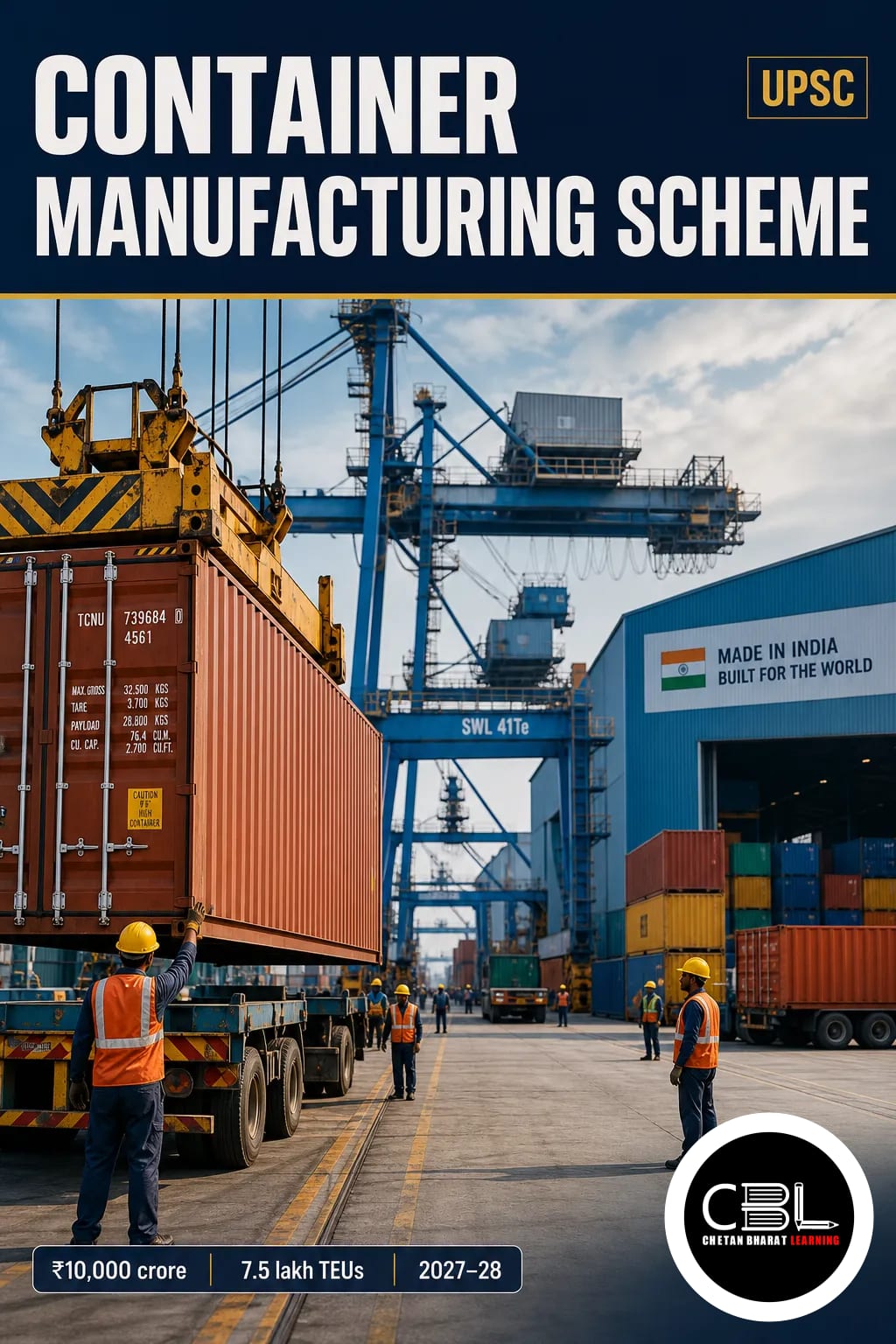

The container manufacturing scheme has received Cabinet approval with an outlay of ₹10,000 crore. It adds a manufacturing dimension to India’s freight and logistics network.
Quick answer: The Union Cabinet approved the container manufacturing scheme to build a competitive production ecosystem in India. Announced in the 2026–27 Budget, the ₹10,000 crore scheme runs from 2027–28 to 2039–40. It targets annual capacity of 7.5 lakh twenty-foot equivalent units, compared with roughly 70,000 currently.
What is the container manufacturing scheme?
The Container Manufacturing Promotion Scheme (CMPS) supports new container manufacturing units and the expansion of existing ones in India. It seeks to develop a globally competitive ecosystem and reduce reliance on containers made abroad.
A twenty-foot equivalent unit (TEU) is a standard measure based on the capacity of a 20-foot container. The annual manufacturing capacity target measures production capability, not the volume of containers moving through ports.
Why is the scheme in the news?
The Union Cabinet approved the scheme after its announcement in the Union Budget 2026–27. According to the government, almost all containers used for India’s container-dependent trade are manufactured overseas.
Meanwhile, the Maritime Amrit Kaal Vision projects Indian container traffic rising from about 2.4 crore TEUs in 2024 to 17.5 crore TEUs by 2047. This is a traffic projection, not a forecast of annual container production.
Key features and targets
The scheme combines a three-year period for establishing manufacturing units with ten years of production support.
| Feature | Provision or estimate |
|---|---|
| Financial outlay | ₹10,000 crore |
| Operating period | Financial years 2027–28 to 2039–40 |
| Eligible expansion | New manufacturing units and expansion of existing units |
| Annual capacity | Target of 7.5 lakh TEUs, against approximately 70,000 TEUs currently |
| Expected employment | About 3,000 direct and over 50,000 indirect jobs |
| Estimated economic output | About ₹75,000 crore by 2039–40 |
An inter-ministerial steering committee, chaired by the Secretary of the Ministry of Ports, Shipping and Waterways, will approve guidelines and sanction assistance. The source does not specify eligibility thresholds or the formula for production support; these require clarification in the guidelines.
Why does domestic container production matter?
Domestic production can strengthen a supply chain that connects manufacturers, ports, exporters and shipping lines.
Trade resilience and industrial linkages
Local capacity can give buyers an additional sourcing option when overseas supply faces disruption. However, capacity alone will not guarantee timely supply or internationally competitive prices.
The scheme could also support ancillary industries, including corner castings, specialised steel, wooden frames and paints. Consequently, its benefits depend partly on whether these suppliers can scale alongside container plants.
Demand and economic returns
The government identifies global fleet replacement, the Bharat Container Shipping Line and the Vadhavan and Galathea Bay mega ports as potential demand drivers. Therefore, demand planning must consider both Indian and overseas buyers.
The projected ₹75,000 crore economic output is more than seven times the assistance amount, according to the government. However, economic output is not the same as fiscal revenue or profit; it is an estimate of activity, not an assured return to the exchequer.
What are the implementation challenges?
The principal challenge is converting supported capacity into competitive, sustained production.
- Cost competitiveness: Producers must match international suppliers on price, quality and delivery, even after support ends.
- Supplier readiness: Shortages or high costs of specialised inputs could constrain output; therefore, the wider component ecosystem matters.
- Demand uncertainty: Traffic growth does not translate directly into new-container demand because containers circulate and can be reused.
- Public expenditure: The government must assess whether assistance creates additional capacity and jobs rather than subsidising investment that would happen anyway.
- Execution details: Eligibility, support rates and monitoring arrangements remain important matters for the scheme guidelines.
What should the way forward include?
Implementation should link support to verifiable production while building a competitive supplier base.
- Clear guidelines: Specify eligibility, disbursement conditions and verification procedures so firms can plan investment.
- Performance monitoring: Track operational capacity, actual output, employment and public support separately; moreover, publish progress against targets.
- Supply-chain coordination: Engage steel, component and logistics suppliers alongside manufacturers to identify bottlenecks early.
- Market discipline: Assess costs, quality and buyer demand throughout the support period; consequently, policy can focus on lasting competitiveness.
For the container manufacturing scheme, success will depend on sustained production and reliable demand, not installed capacity alone.
Source: Press Information Bureau, 28 October 2026
- Dedicated Freight Corridors: India’s Logistics Backbone (18 September 2026)
- RELIEF Initiative Extended to March 2027 | UPSC (28 October 2026)
Punjab PCS and Haryana HCS General Studies may test the scheme’s outlay, duration and capacity target. The topic also connects industrial policy with logistics and export competitiveness.
Prelims Practice Corner
Mains Practice Questions
Frequently Asked Questions
What is the outlay of the container manufacturing scheme?
The outlay is ₹10,000 crore. The Cabinet approved the scheme after its announcement in the Union Budget 2026–27.
What is India’s container manufacturing capacity target?
The target is 7.5 lakh TEUs annually. This compares with current annual capacity of approximately 70,000 TEUs.
When will the scheme operate?
The scheme will operate from financial year 2027–28 to 2039–40. It includes three years for establishing units and ten years of production support.
Does the scheme support existing manufacturers?
Yes, it supports expansion of existing units as well as new units. However, detailed eligibility conditions require clarification in the guidelines.
Related Current Affairs
Preparing for UPSC, PCS or HCS?
Talk to a mentor at Chetan Bharat Learning, Chandigarh. Free guidance on choosing the right exam and building a study plan.
Chat on WhatsAppCall 97793 53345UPSC / IAS / PCS coaching in Chandigarh · Trusted by aspirants across Punjab & Haryana
Leave a Reply
You must be logged in to post a comment.