
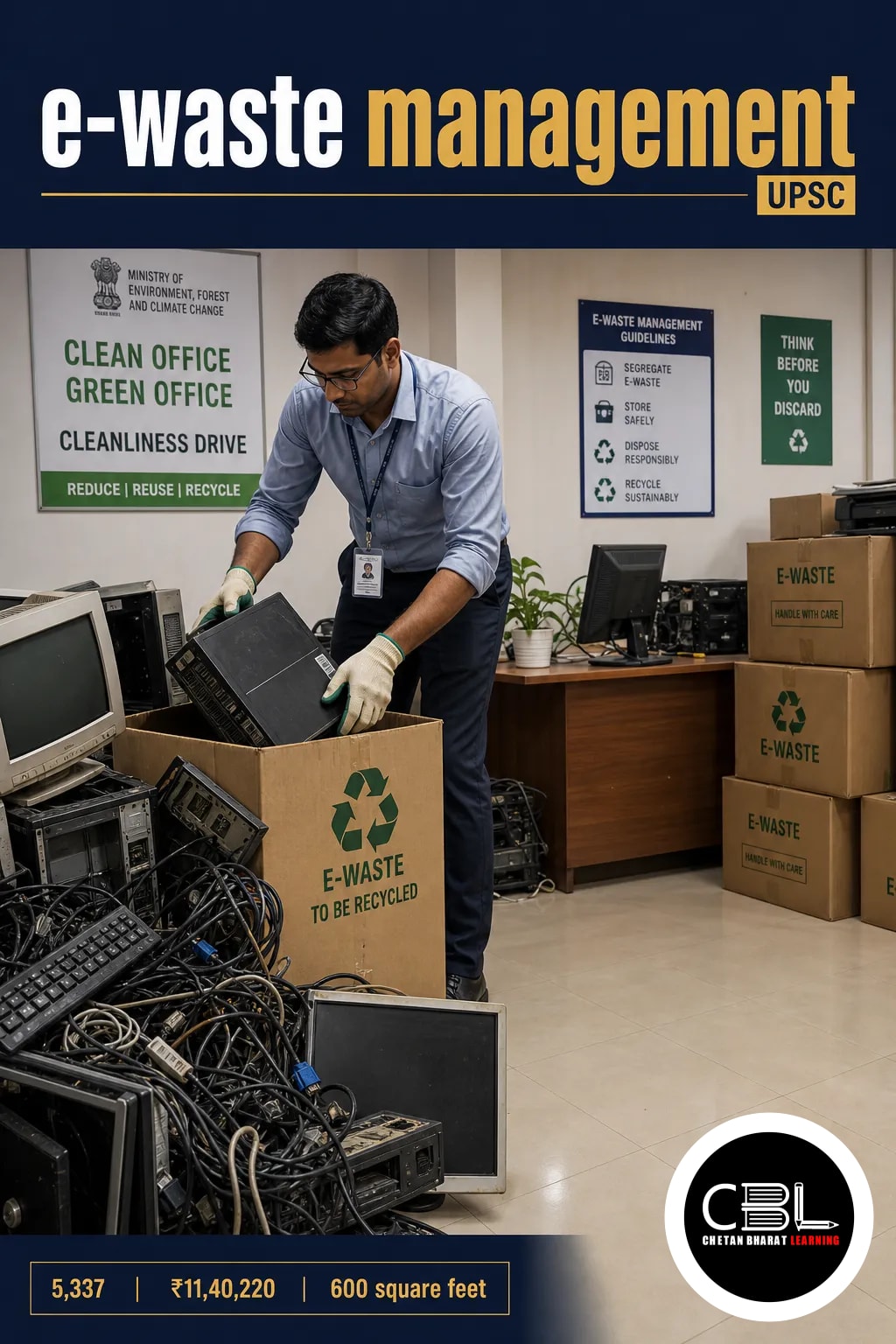

E-waste management at the Ministry of New and Renewable Energy (MNRE) has received a push under Special Campaign 6.0. The drive also connects office waste disposal with the wider idea of a circular economy.
Quick answer: MNRE has intensified e-waste management under Special Campaign 6.0 to improve cleanliness and resource use in its offices. It identified 5,337 old and e-waste items for disposal. Auction-based disposal has generated ₹11,40,220 and freed approximately 600 square feet of space so far.
What is e-waste management?
E-waste management covers the collection, segregation and responsible handling of discarded electrical and electronic equipment. It seeks to recover usable materials while reducing harm from improper disposal.
For example, keeping electronic waste separate from mixed office waste makes it easier to direct it towards appropriate processing. In addition, reuse and recycling support a circular economy by retaining materials in use.
Why is the ministry’s drive in the news?
MNRE has intensified its collection, segregation and disposal efforts as part of Special Campaign 6.0. The campaign addresses pending matters and seeks to make cleanliness a regular administrative practice.
The ministry identified 5,337 old and e-waste items for disposal. However, this is a combined identification figure; it does not establish how many items were electronic waste or how many had already been disposed of.
Key features of the drive
The drive combines identification and segregation with auction-based disposal and better use of office space.
| Feature | Details |
|---|---|
| Items | 5,337 old and e-waste items identified for disposal |
| Disposal method | Auction of identified old and e-waste items |
| Revenue so far | ₹11,40,220 from the disposal process |
| Office space | Approximately 600 square feet freed |
Thus, the reported outcomes cover both revenue and workspace. They do not specify the quantity of material recycled.
What challenges require attention?
Responsible disposal requires attention beyond removing old equipment from offices.
- Segregation: Electronic items must be distinguished from other old materials to enable suitable handling.
- Downstream processing: An auction alone does not establish how electronic waste is subsequently processed.
- Tracking: Separate records of items identified, disposed of and recycled would clarify outcomes.
What is the way forward?
Regular inventories and segregation can make e-waste management a continuing office practice. In addition, tracking the destination of discarded equipment can support responsible processing and clearer reporting.
The E-Waste (Management) Rules, 2022 provide the broader regulatory context. They include extended producer responsibility, under which producers have obligations concerning the recycling of e-waste.
Source: Press Information Bureau, 28 October 2026
- Circular Economy Forum 2026: India Leads Transition (15 Sep 2026)
- Circular Economy (9 Feb 2023)
Punjab PCS and Haryana HCS questions can link e-waste segregation to waste management in state offices and local bodies. They may also test the circular economy and producer responsibility concepts.
Prelims Practice Corner
Mains Practice Questions
Frequently Asked Questions
Which ministry launched the reported e-waste drive?
The Ministry of New and Renewable Energy conducted the drive. It forms part of Special Campaign 6.0.
How many items did the ministry identify for disposal?
It identified 5,337 old and e-waste items. However, the source does not give a separate count for electronic items.
How much revenue did the disposal process generate?
The process generated ₹11,40,220 so far. In addition, it freed approximately 600 square feet of office space.
What is extended producer responsibility for e-waste?
It places obligations on producers concerning e-waste recycling. The E-Waste (Management) Rules, 2022 include this principle.
Related Current Affairs
Preparing for UPSC, PCS or HCS?
Talk to a mentor at Chetan Bharat Learning, Chandigarh. Free guidance on choosing the right exam and building a study plan.
Chat on WhatsAppCall 97793 53345UPSC / IAS / PCS coaching in Chandigarh · Trusted by aspirants across Punjab & Haryana
Leave a Reply
You must be logged in to post a comment.