
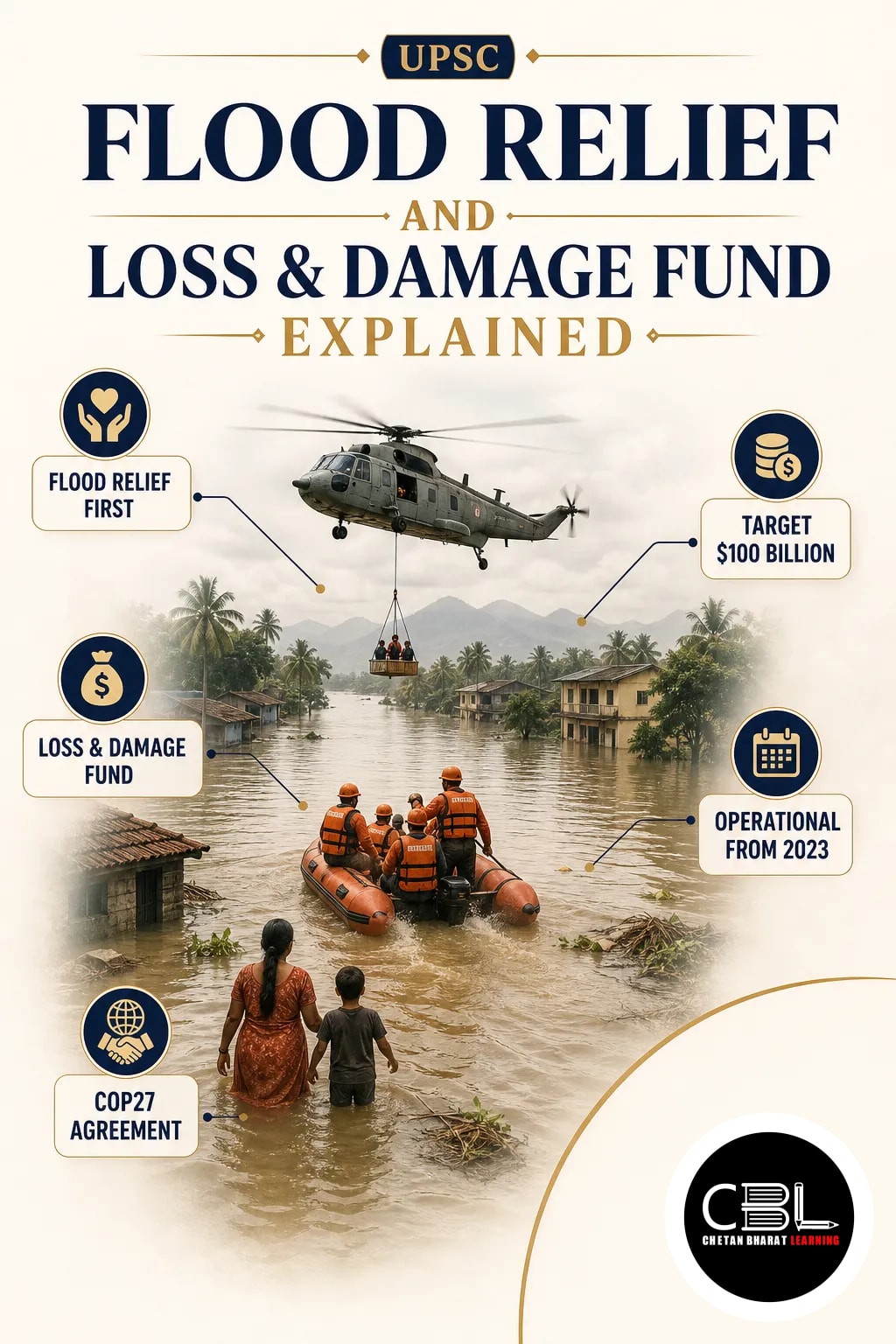

Flood relief has moved into the centre of climate finance after Nepal received the latest global payout from the loss and damage fund. The development matters because it shows how climate impacts beyond adaptation can now receive dedicated support.
What is flood relief?
Flood relief refers to immediate and short-term assistance after flooding disrupts lives, infrastructure, and livelihoods. It usually includes emergency aid, temporary shelter, food, drinking water, health support, and early recovery measures.
In climate discussions, flood relief now sits alongside wider ideas such as adaptation and loss and damage. This shift matters because some impacts are too severe for communities to handle through prevention alone.
Why in News?
Nepal has received the first payout from the global loss and damage fund, and the money is meant for flood-related recovery. The Indian Express explained that this is the fund’s first such disbursement, making it a milestone for climate justice negotiations.
The development is significant for countries that face repeated climate shocks despite contributing little to global emissions. It also brings the financing debate closer to the needs of vulnerable Himalayan and monsoon-affected states.
Key Features
- Dedicated climate solidarity: The fund is designed to support countries hit by climate-driven losses that exceed normal coping capacity.
- First payout precedent: Nepal’s assistance shows that the fund can move from negotiation to actual disbursement.
- Focus on disaster recovery: The support is linked to flood damage, which makes it relevant to emergency response and rebuilding.
- Separate from mitigation: It addresses harm already caused, unlike emissions reduction or long-term prevention.
- International burden sharing: The mechanism reflects the principle that climate costs should not fall only on vulnerable states.
Challenges
- Funding adequacy: Early payouts may be small compared with the scale of destruction caused by floods and extreme weather.
- Access and speed: Vulnerable countries need fast procedures, or relief will arrive after the worst damage has already deepened.
- Defining eligibility: Countries can face disputes over what qualifies as loss and damage rather than ordinary disaster loss.
- Predictable financing: A one-time payment does not solve the larger problem of stable and regular contributions.
- Equity concerns: Negotiations remain sensitive because states differ on historical responsibility and contribution formulas.
Way Forward
The fund will matter only if contributors expand resources and simplify delivery. For countries facing recurring floods, the priority is fast, transparent, and predictable support.
India can follow this issue closely because it combines climate finance, regional resilience, and disaster governance. Stronger domestic flood management, early warning systems, and climate-resilient infrastructure will remain essential even when international aid improves.
Source: Indian Express Explained, 2026-10-26
- Climate Equity: India’s Case for Fair Climate Action (21 Sep 2026)
- Climate Overshoot: 1.5°C Threshold, Impacts & Way Forward (5 Sep 2026)
This topic fits state PCS preparation through disaster management, climate governance, and international environmental negotiations. Punjab and Haryana frequently face flood, drought, and heat stress concerns, so the idea of compensating climate losses is highly relevant.
FAQ
Why does the first payout from the fund matter?
It shows that the loss and damage mechanism is no longer only a negotiating idea. It has begun financing real climate recovery needs.
How is flood relief different from adaptation?
Flood relief responds after damage occurs, while adaptation aims to reduce future risk. Both are important, but they serve different stages of climate response.
Why should UPSC aspirants track loss and damage finance?
It connects environment, international relations, and disaster management. Questions can appear in Prelims as well as GS Paper 3 answers on climate policy.
Related Current Affairs
Preparing for UPSC, PCS or HCS?
Talk to a mentor at Chetan Bharat Learning, Chandigarh. Free guidance on choosing the right exam and building a study plan.
Chat on WhatsAppCall 97793 53345UPSC / IAS / PCS coaching in Chandigarh · Trusted by aspirants across Punjab & Haryana
Leave a Reply
You must be logged in to post a comment.