

UPSC Mapping
| Exam | Topic |
|---|---|
| Prelims | Environment and Ecology |
| Mains | GS Paper 3 (Environment) |
Quick Facts
| Temperature Threshold | 1.5°C above pre-industrial levels |
|---|---|
| Key Agency | UNEP |
| Core Concept | Temporary exceedance followed by decline |
What is climate overshoot?
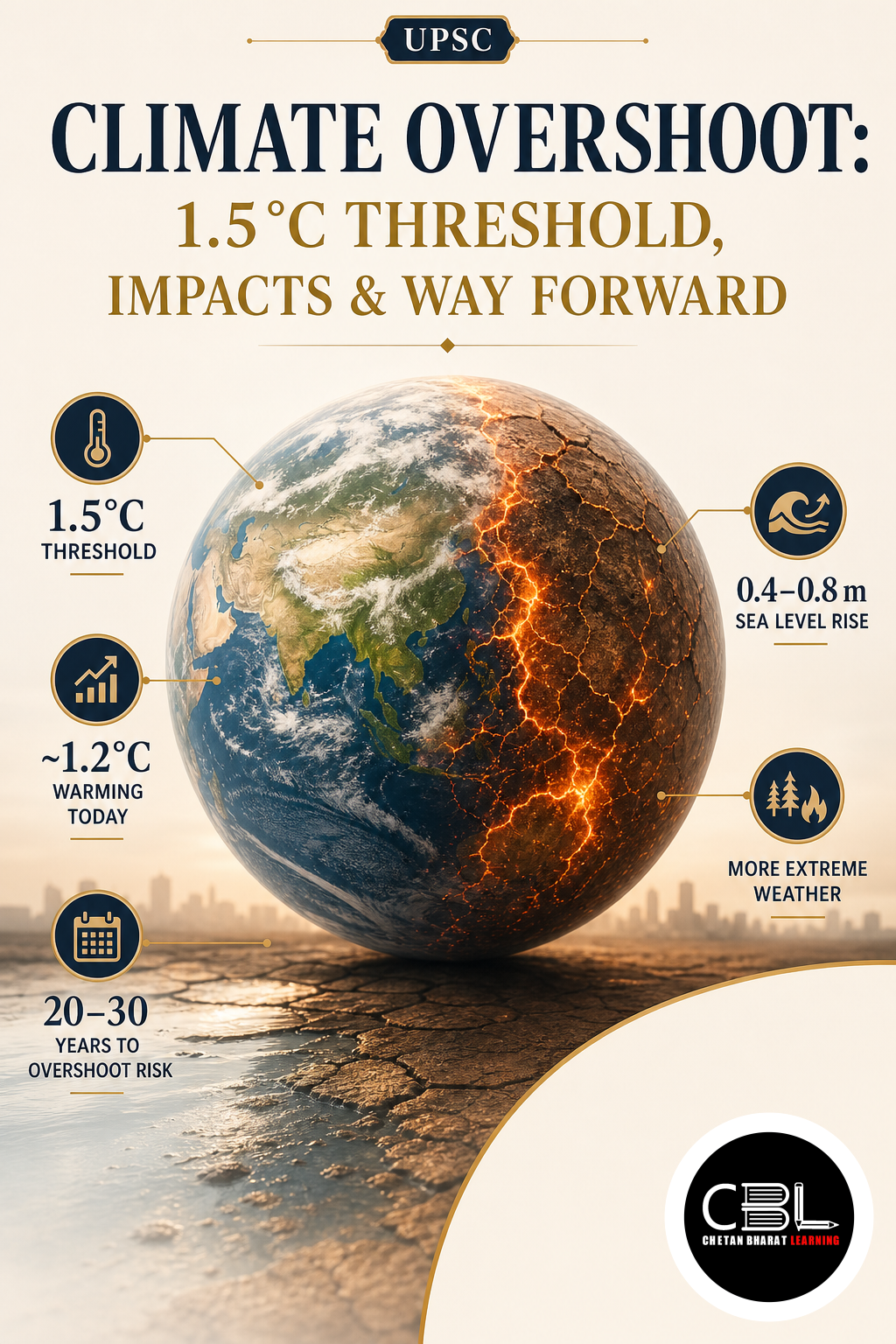
The term climate overshoot refers to a scenario where global average temperatures exceed a specific target, peak, and subsequently decline. The 1.5°C threshold specifically measures warming relative to pre-industrial baseline levels. A temporary crossing of this limit differs fundamentally from permanently stabilizing global temperatures above it. Scientists emphasize that the duration and magnitude of this exceedance dictate the severity of ecological impacts. This distinction is crucial for formulating realistic climate policies.
Historically, climate models focused primarily on avoiding the threshold altogether. The emerging reality of climate overshoot forces a recalibration of these models. It acknowledges that current emission trajectories make a temporary breach highly probable. The focus thus shifts toward minimizing the duration of the exceedance. Rapid deployment of carbon-removal technologies becomes essential to bring temperatures back down safely.
Why is climate overshoot in News?
The climate overshoot narrative recently gained prominence following a stark UNEP assessment. The report warns that the world is rapidly approaching an era where temporarily breaching the 1.5°C limit becomes inevitable. You can verify the latest scientific findings on the UNEP portal. This development forces policymakers to reframe the climate task beyond mere emission cuts. It highlights the urgent need for scalable carbon-removal measures.
Furthermore, recent extreme weather events underscore the non-linear increase in climate risks. Higher temperatures intensify heatwaves, extreme rainfall, droughts, and biodiversity loss. Prolonged warming also increases the probability of crossing irreversible climate tipping points. Policymakers now recognize that adaptation alone is insufficient. Some climate impacts will exceed adaptation limits and create unavoidable loss and damage.
Key Features
The framework for addressing this phenomenon incorporates several critical scientific and policy dimensions.
- Duration and Magnitude: The severity of ecological damage depends directly on how high temperatures peak and how long they remain elevated.
- Tipping Point Risks: Prolonged warming significantly increases the probability of triggering irreversible ecological thresholds, such as ice sheet collapse.
- Carbon Removal Necessity: Bringing temperatures down requires rapid emissions reduction alongside carefully designed carbon-removal measures.
- Adaptation Limits: The framework acknowledges that some climate impacts will inevitably exceed human and ecological adaptation capacities.
- Climate Justice Focus: Vulnerable nations bear the brunt of overshoot impacts despite contributing minimally to historical emissions.
This comprehensive structure ensures that climate policy addresses both mitigation and unavoidable damages. The emphasis on carbon removal distinguishes it from traditional conservation strategies. By integrating climate justice, the policy fosters a sense of global equity. The institutional framework relies heavily on international cooperation. Nations must share technology and finance to manage the overshoot period effectively. This collaborative approach is vital for global ecological stability.
Challenges
Despite clear scientific warnings, managing climate overshoot faces several structural and operational hurdles.
- Technological Immaturity: Large-scale carbon dioxide removal technologies remain expensive and unproven at the gigaton scale required.
- Moral Hazard: The prospect of future temperature reduction might encourage governments to delay immediate emission cuts.
- Loss and Damage Funding: Mobilizing adequate financial resources for unavoidable climate impacts remains a major geopolitical sticking point.
- Ecological Irreversibility: Certain ecosystems, once degraded by temporary warming, may not recover even if temperatures subsequently decline.
- Equity Disputes: Developing nations rightfully demand compensation for bearing the disproportionate burden of global temperature exceedance.
Addressing these bottlenecks is crucial for the credibility of global climate commitments. Policymakers must remain vigilant against using overshoot scenarios as an excuse for inaction. The verification of carbon removal claims requires robust international auditing mechanisms. Introducing strict regulatory frameworks will prevent greenwashing in the carbon credit market.
Way Forward
To maximize the effectiveness of global climate policy, nations must integrate mitigation, adaptation, carbon removal, and climate justice. Treating the 1.5°C mark as a simple pass-fail threshold is no longer scientifically viable. Governments must aggressively scale up investments in nature-based solutions and direct air capture technologies. Strengthening the technical capabilities of early warning systems will also protect vulnerable populations from extreme weather.
Additionally, international climate finance must prioritize loss and damage funds for developing nations. Policymakers should establish clear guidelines to mandate transparent reporting of carbon removal activities. For detailed policy frameworks, refer to the PRS Legislative Research database. A robust, transparent, and equitable system will ultimately drive global climate resilience forward.
Continuous academic research and independent audits will further refine operational guidelines over time. The success of this initiative depends entirely on maintaining strict ecological integrity and political will. The global community has the opportunity to set a benchmark for managing complex environmental transitions. Future iterations of climate policy must remain adaptable to emerging scientific consensus.
Prelims Practice Corner
Q1
With reference to climate overshoot, consider the following statements:
- It refers to temperatures exceeding a target, peaking, and subsequently declining.
- The 1.5°C threshold measures warming relative to pre-industrial levels.
- A temporary crossing of 1.5°C is identical to permanent stabilization above it.
Which of the statements given above is/are correct?
Answer: (b) Statement 3 is incorrect because a temporary crossing differs fundamentally from permanent stabilization.
Q2
Which of the following is a major risk associated with prolonged climate overshoot?
- (a) Decreased frequency of extreme rainfall
- (b) Increased probability of crossing climate tipping points
- (c) Stabilization of global biodiversity
- (d) Reduction in ocean acidification
Answer: (b) Prolonged warming significantly increases the probability of triggering irreversible climate tipping points.
Q3
Bringing global temperatures down after an overshoot primarily requires:
- (a) Sole reliance on adaptation measures
- (b) Rapid emissions reduction and carbon-removal measures
- (c) Halting all industrial activity globally
- (d) Ignoring the 1.5°C threshold entirely
Answer: (b) It requires rapid emissions reduction alongside carefully designed carbon-removal measures.
Q4
Which international organization recently highlighted the world entering a possible 1.5°C overshoot era?
- (a) World Meteorological Organization
- (b) United Nations Environment Programme (UNEP)
- (c) Intergovernmental Panel on Climate Change (IPCC)
- (d) World Bank
Answer: (b) The UNEP assessment specifically described the world entering a possible 1.5°C overshoot era.
Q5
Consider the following components essential for addressing climate overshoot: 1. Mitigation 2. Adaptation 3. Carbon removal 4. Climate justice. Which of the above are required?
- (a) 1 and 2 only
- (b) 1, 2 and 3 only
- (c) 2, 3 and 4 only
- (d) 1, 2, 3 and 4
Answer: (d) Effective climate policy must combine all four elements rather than treating the threshold as a simple pass-fail metric.
Mains Practice Questions
Q1
Discuss the concept of climate overshoot and its implications for global climate policy. (150 words, 10 marks)
Intro: Define climate overshoot as a temporary exceedance of the 1.5°C threshold followed by a decline.
Body: Discuss implications (non-linear risk increase, tipping points, adaptation limits, necessity of carbon removal, and climate justice).
Conclusion: Emphasize that overshoot scenarios must not become an excuse for delaying immediate emission reductions.
Q2
In a warming world, climate policy must combine mitigation, adaptation, carbon removal, and climate justice. Critically analyze this statement. (250 words, 15 marks)
Intro: Contextualize the shift from viewing 1.5°C as a strict pass-fail threshold to managing a probable overshoot era.
Body: Analyze the four pillars: Mitigation (rapid cuts), Adaptation (managing unavoidable impacts), Carbon Removal (bringing temperatures down), and Climate Justice (addressing loss and damage for vulnerable nations). Discuss challenges like technological immaturity and moral hazard.
Conclusion: Conclude that a holistic, multi-pronged approach is the only viable path to ensure global ecological stability and equity.
FAQs on climate overshoot
What is the difference between climate overshoot and permanent warming?
Climate overshoot refers to temperatures exceeding a target, peaking, and subsequently declining. Permanent warming implies that global temperatures stabilize and remain above the threshold indefinitely without a decline.
Why is the duration of climate overshoot important?
The duration and magnitude of the overshoot matter because climate risks increase non-linearly with warming. Prolonged exposure to higher temperatures significantly raises the probability of crossing irreversible climate tipping points.
How does climate justice relate to climate overshoot?
Vulnerable nations bear the brunt of overshoot impacts, such as loss and damage, despite contributing minimally to historical emissions. Climate justice demands that these nations receive adequate financial and technological support.
Related Current Affairs
Preparing for UPSC, PCS or HCS?
Talk to a mentor at Chetan Bharat Learning, Chandigarh. Free guidance on choosing the right exam and building a study plan.
Chat on WhatsAppCall 97793 53345UPSC / IAS / PCS coaching in Chandigarh · Trusted by aspirants across Punjab & Haryana
Leave a Reply
You must be logged in to post a comment.