
UPSC Mapping
| Exam | Topics |
|---|---|
| Prelims | Health programmes, tuberculosis and diagnostic technologies |
| Mains | GS Paper II: Health and Governance; GS Paper III: Science and Technology |
Quick Facts
| Nodal Ministry | National Programme | Global Framework |
|---|---|---|
| Health and Family Welfare | NTEP | SDG 3.3: End the TB epidemic by 2030 |
What is TB-Free India?
The national effort seeks to reduce tuberculosis transmission, prevent avoidable deaths and ensure access to comprehensive care. The National Tuberculosis Elimination Programme (NTEP) brings together diagnosis, treatment, prevention and patient support. Its strategic framework rests on four pillars: Detect, Treat, Prevent and Build.
Tuberculosis results from infection with Mycobacterium tuberculosis. It usually affects the lungs, although it can also involve the brain, kidneys, spine and other organs. Infectious pulmonary or laryngeal disease can spread through the air, particularly in crowded, poorly ventilated spaces.
People with latent TB infection do not transmit the infection, but some subsequently develop active disease. Undernutrition, HIV, diabetes and weakened immunity increase vulnerability. The disease is preventable and curable with appropriate care, while the BCG vaccine helps protect children against severe forms.
Why in News?
The government launched JOSH Teams on 8 October 2026 to strengthen youth participation in tuberculosis elimination. The first phase covers 55 districts across 11 States and Union Territories. The initiative links community outreach with timely diagnosis, treatment completion and efforts against discrimination.
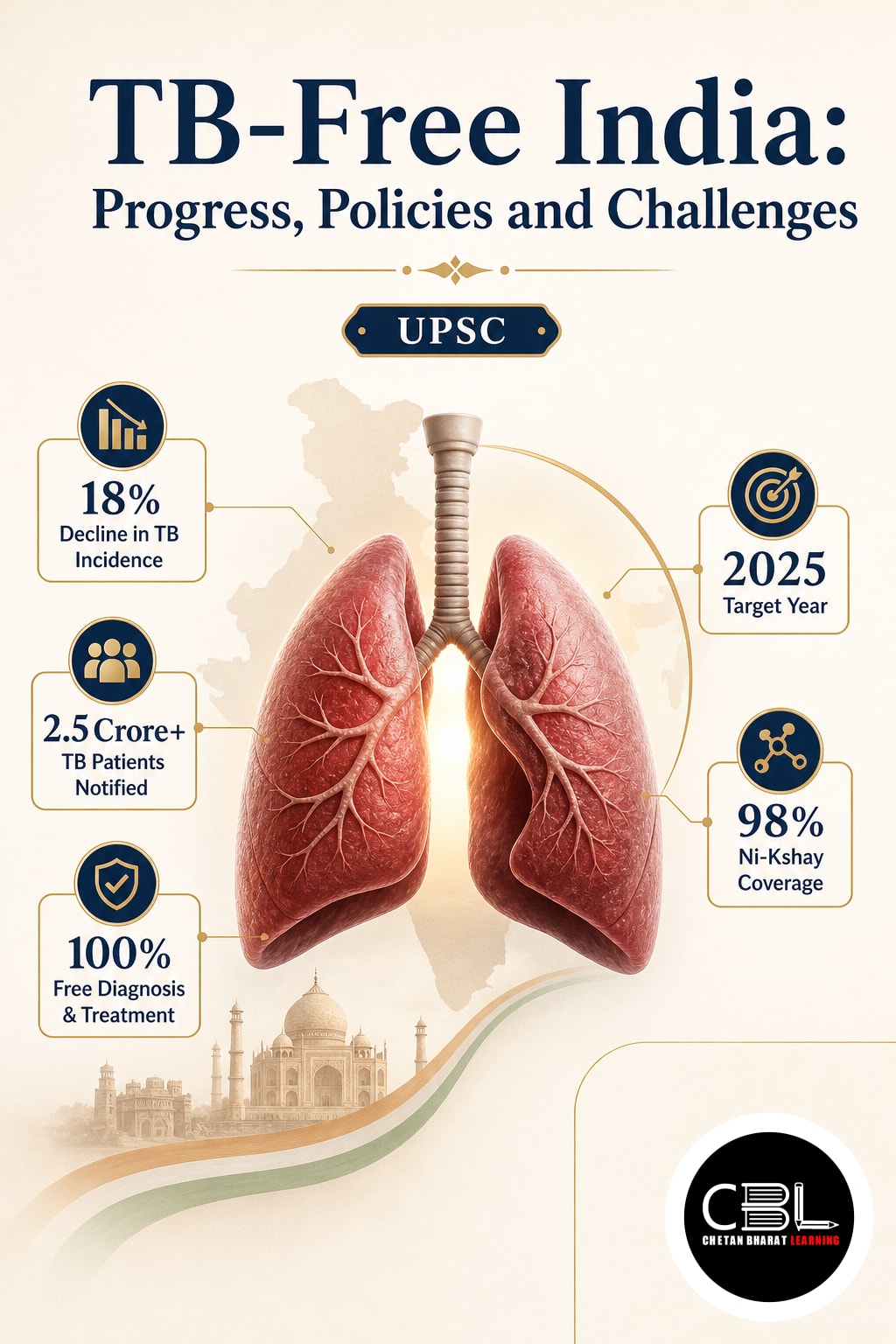
Official reporting, citing the WHO Global Tuberculosis Report 2025, records a 21% decline in India’s TB incidence during 2015–2024, compared with 12% globally. It also reports treatment coverage of 92%, against a global figure of 78%. These indicators demonstrate progress but do not establish that India has eliminated the disease.
India had earlier set a 2025 elimination ambition, ahead of the global 2030 timeline. That date should now appear as a historical policy target rather than a future deadline. WHO’s 2025 global assessment provides the relevant framework for examining disease burden and progress.
Key Features
- Programme integration: NTEP coordinates early diagnosis, quality-assured medicines, notification, private-provider engagement and continuity of care.
- Community partnership: The Pradhan Mantri TB Mukt Bharat Abhiyaan, launched in September 2022, encourages citizens and organisations to support patients.
- Nutritional assistance: Ni-kshay Poshan Yojana provides notified patients ₹1,000 monthly through direct benefit transfer during treatment.
- Voluntary support: Ni-kshay Mitras supplement public services through food baskets, psychosocial assistance and other patient-centred support.
- Active case finding: The 100-day campaign launched in December 2024 prioritised vulnerable populations and high-burden districts before wider expansion.
- Preventive treatment: Eligible contacts receive treatment after clinical assessment to reduce progression to active disease.
- Shorter resistant-TB treatment: BPaLM combines bedaquiline, pretomanid, linezolid and moxifloxacin in a six-month regimen for eligible patients.
- Digital coordination: Ni-kshay supports notification, patient monitoring and benefit delivery, while digital outreach tools help communicate service information.
Technology and Community Participation
Rapid molecular tests help detect tuberculosis and identify resistance earlier. Portable chest X-ray equipment and AI-assisted interpretation can expand screening where specialists are limited.
The TB-Free India approach uses primary healthcare facilities to connect outreach with testing and referral. Ayushman Arogya Mandirs bring screening and follow-up closer to communities. Effective referral arrangements matter because identifying a person at risk does not automatically secure treatment.
Each JOSH team comprises five My Bharat volunteers and five NCC cadets, under a designated Class-I officer. Volunteers explain symptoms, counter misconceptions and encourage care-seeking, complementing trained health workers while respecting patient confidentiality.
Challenges
- Delayed diagnosis: Mild symptoms, limited awareness and difficult access can postpone testing and prolong transmission.
- Social vulnerability: Undernutrition, insecure housing and income loss can undermine recovery even when medicines are free.
- Drug resistance: Resistant disease requires reliable testing, appropriate regimens and uninterrupted medicine access.
- Treatment continuity: Long care pathways, migration and side effects can interrupt follow-up without active support.
- Stigma and privacy: Fear of discrimination can discourage disclosure and care-seeking.
- Uneven implementation: Laboratory access, staffing and private-sector coordination vary by district.
- Technology limitations: AI tools need local validation, quality assurance and human oversight.
Way Forward
District administrations should link screening, confirmatory testing and treatment initiation through accountable referral systems. Reviews should examine diagnostic delays, treatment completion and patient outcomes alongside outreach totals.
Health departments should combine nutritional support with counselling, timely benefit transfers and assistance for mobile populations. Coordination with private providers can improve notification and prevent drop-outs. Community volunteers should facilitate access without public identification.
Technology investments should strengthen routine services through trained staff, equipment maintenance and reliable medicine supplies. AI tools require transparent evaluation and secure data handling.
Prelims Practice Corner
Q1. Which organism causes tuberculosis?
- (a) A virus
- (b) Mycobacterium tuberculosis
- (c) A protozoan
- (d) A fungus
Answer: (b) Mycobacterium tuberculosis.
Q2. Which set correctly identifies the four strategic pillars of India’s national TB response?
- (a) Detect, Treat, Prevent and Build
- (b) Test, Tax, Transfer and Track
- (c) Diagnose, Isolate, Export and Build
- (d) Detect, Vaccinate, Insure and Transfer
Answer: (a) Detect, Treat, Prevent and Build.
Q3. Consider two statements: 1. People with latent TB infection transmit TB to others. 2. TB can affect organs other than the lungs. Which is correct?
- (a) 1 only
- (b) 2 only
- (c) Both 1 and 2
- (d) Neither 1 nor 2
Answer: (b) Statement 2 only.
Q4. Ni-kshay Poshan Yojana primarily provides:
- (a) Hospital construction grants
- (b) Nutritional financial assistance to notified TB patients
- (c) Universal pension payments
- (d) Medical college scholarships
Answer: (b) Nutritional financial assistance.
Q5. JOSH in the tuberculosis programme stands for:
- (a) Joint Organisation for Sanitation and Housing
- (b) Joint Squad for Health
- (c) Junior Officers for Social Housing
- (d) Joint Observatory for School Health
Answer: (b) Joint Squad for Health.
Mains Practice Questions
Q1. Despite progress in diagnosis and treatment, tuberculosis remains a multidimensional public health challenge in India. Examine. (15 marks)
Answer Structure:
- Intro: Relationship between TB, health-system capacity and social vulnerability.
- Body: NTEP achievements, diagnostic gaps, drug resistance, undernutrition, treatment continuity, community and private-sector participation.
- Conclusion: Integrated, accountable and patient-centred district health systems.
Q2. Evaluate the potential of artificial intelligence and youth participation in strengthening India’s tuberculosis response. (10 marks)
Answer Structure:
- Intro: Technology and community action as complementary elements of public health delivery.
- Body: AI-assisted screening, referral systems, JOSH outreach, adherence support; address validation, staffing, privacy and stigma.
- Conclusion: Link innovation and participation with professional care and measurable outcomes.
Frequently Asked Questions
What is the National Tuberculosis Elimination Programme?
NTEP is India’s national programme for tuberculosis prevention, diagnosis, treatment and patient support. It was renamed from the Revised National Tuberculosis Control Programme in 2020.
How does a Ni-kshay Mitra support a patient?
A Ni-kshay Mitra voluntarily provides additional support such as nutrition or psychosocial assistance, supplementing government services without replacing medical treatment.
Has India already eliminated tuberculosis?
No. While incidence has declined and treatment coverage improved, TB remains a public health challenge. The 2025 elimination ambition remains a target, not an achieved milestone.
Related Current Affairs
Preparing for UPSC, PCS or HCS?
Talk to a mentor at Chetan Bharat Learning, Chandigarh. Free guidance on choosing the right exam and building a study plan.
Chat on WhatsAppCall 97793 53345UPSC / IAS / PCS coaching in Chandigarh · Trusted by aspirants across Punjab & Haryana
Leave a Reply
You must be logged in to post a comment.