

UPSC Mapping
- Prelims: International Relations & Science
- Mains: GS Paper 2 (International Relations) & GS Paper 3 (Environment)
Quick Facts
| Arctic Council Status | Observer (since 2013) |
|---|---|
| Budget (2024-25) | Rs 17.53 crore |
| Key Gap | No polar research vessel |
What is India Arctic Strategy?
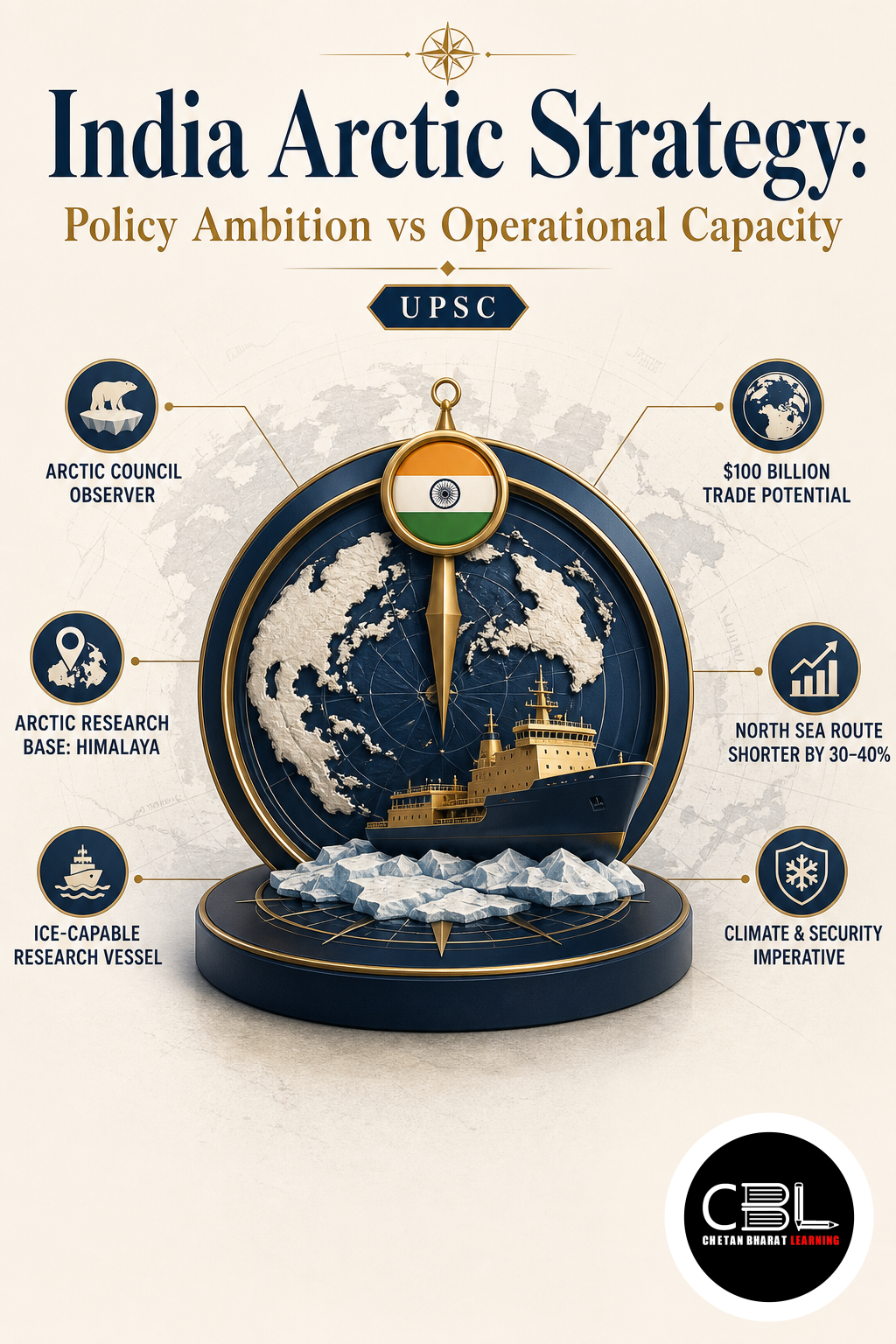
India Arctic Strategy is outlined in India’s Arctic Policy, 2022, which is built on six pillars: Science and Research, Climate and Environment, Economic Development, Connectivity and Logistics, Governance and Law, and Capacity Building. India’s engagement includes the Himadri Research Station in Svalbard, the IndARC deep-sea observatory, and participation in Arctic Council working groups. The Arctic is critical for India’s monsoon security, coastal inundation risks, transit connectivity (Northern Sea Route), resource access, and strategic balancing.
However, the Parliamentary Committee report highlights structural gaps: diplomatic fragmentation (no dedicated Polar Ambassador), a hardware deficit (no indigenous ice-class polar research vessel), a budgetary constraint (Rs 17.53 crore allocation, less than one-tenth of Antarctic funding), a regulatory void (no domestic Arctic law), and observer limitations in the Arctic Council.
Why is India Arctic Strategy in News?
India Arctic Strategy is in the news following the Parliamentary Standing Committee’s report, which highlighted the gap between ambition and capacity. The report recommends appointing a Special Envoy for Arctic Affairs, procuring or leasing a secondhand icebreaker, forming a Polar Quad with Japan, Singapore, and South Korea, and pursuing the recognition of the Arctic as a quasi-global commons.
The Arctic is warming four times faster than the global average, affecting the southwest monsoon, which supplies 70% of India’s rainfall. The Northern Sea Route can reduce maritime distance by 40% compared with the Suez route. For more details, refer to this PIB release.
Key Features of India Arctic Strategy
- Six Pillars: Science, Climate, Economy, Connectivity, Governance, Capacity Building.
- Svalbard Treaty: Original signatory (1920) with visa-free and commercial rights.
- Arctic Council Observer: Since 2013, participating in technical working groups.
- Northern Sea Route: Potential to reduce maritime distance by 40%.
- Monsoon Security: Arctic amplification affects the southwest monsoon.
Challenges in India Arctic Strategy
- Diplomatic Fragmentation: No dedicated Polar Ambassador; scattered MEA divisions.
- Hardware Deficit: No indigenous ice-class polar research vessel.
- Budgetary Constraint: Rs 17.53 crore allocation (less than one-tenth of Antarctic funding).
- Regulatory Void: No domestic Arctic law like the Indian Antarctic Act.
- Observer Limitations: No decision-making role in Arctic Council.
Way Forward for India Arctic Strategy
To bridge the gap in India Arctic Strategy, the government should appoint a Special Envoy for Arctic Affairs to centralise diplomatic engagement. Procuring or leasing a secondhand icebreaker immediately is essential for independent pan-Arctic research. Forming a Polar Quad with Japan, Singapore, and South Korea can pool resources and counterbalance dominant players.
Increasing the budget for Arctic research and enacting domestic legislation for Arctic expeditions are critical. Diplomatic efforts to recognise the Arctic as a quasi-global commons can prevent monopolisation by territorial states. For international best practices, refer to the Arctic Council.
Prelims Practice Corner
-
When did India become an observer in the Arctic Council?
- (a) 2008
- (b) 2013
- (c) 2018
- (d) 2022
Answer: (b) India has been an observer since 2013.
-
What is the name of India’s Arctic research station?
- (a) Bharati
- (b) Himadri
- (c) Maitri
- (d) Dakshin Gangotri
Answer: (b) Himadri is in Svalbard.
-
What is the budgetary allocation for Arctic research in 2024-25?
- (a) ₹5 crore
- (b) ₹17.53 crore
- (c) ₹50 crore
- (d) ₹100 crore
Answer: (b) The allocation is Rs 17.53 crore.
-
What is the Northern Sea Route?
- (a) A shipping route through the Suez Canal
- (b) A route along the Russian Arctic coast
- (c) A route through the Panama Canal
- (d) A trans-Pacific route
Answer: (b) The NSR is along the Russian Arctic coast.
-
What did the Parliamentary Committee recommend?
- (a) Withdraw from the Arctic
- (b) Appoint a Polar Ambassador
- (c) Stop all research
- (d) Reduce funding
Answer: (b) The Committee recommended appointing a Special Envoy for Arctic Affairs.
Mains Practice Questions
-
Critically examine India’s Arctic policy in the context of its strategic interests and the operational gaps identified by the Parliamentary Committee. (250 words, 15 marks)
Answer Structure:
- Intro: Introduce India’s Arctic interests and the policy-capacity gap.
- Body: Discuss the six pillars, strategic importance (monsoon, sea-level, resources), and gaps (diplomatic, hardware, budget). Evaluate the Committee’s recommendations and suggest a way forward.
- Conclusion: Emphasise the need for a comprehensive and well-funded Arctic strategy.
-
What is the significance of the Arctic region for India’s climate and economic security? (150 words, 10 marks)
Answer Structure:
- Intro: Highlight the Arctic’s climate and economic importance.
- Body: Explain climate links (monsoon, sea-level rise) and economic opportunities (shipping routes, resources).
- Conclusion: Conclude that the Arctic is strategically important for India’s future.
FAQs on India Arctic Strategy
- Why is the Arctic important for India?
- It affects the Indian monsoon, poses sea-level rise risks, and offers new shipping routes and resources.
- What is India’s Arctic Policy?
- It is a six-pillar framework focusing on science, climate, economy, connectivity, governance, and capacity building.
- What are the main gaps in India’s Arctic engagement?
- Lack of a dedicated polar ambassador, polar research vessel, adequate funding, and domestic Arctic legislation.
Related Current Affairs
Preparing for UPSC, PCS or HCS?
Talk to a mentor at Chetan Bharat Learning, Chandigarh. Free guidance on choosing the right exam and building a study plan.
Chat on WhatsAppCall 97793 53345UPSC / IAS / PCS coaching in Chandigarh · Trusted by aspirants across Punjab & Haryana
Leave a Reply
You must be logged in to post a comment.