

UPSC Mapping
| Exam | Topic |
|---|---|
| Prelims | Environment & Judiciary |
| Mains | GS Paper 2 (Judiciary) & GS Paper 3 (Environment) |
Quick Facts
| Key Case | T.N. Godavarman Thirumalpad v. Union of India |
|---|---|
| Concept | Public Interest Litigation (PIL) |
| Debate | Judicial Activism vs Restraint |
What is Judicial Environmentalism India?
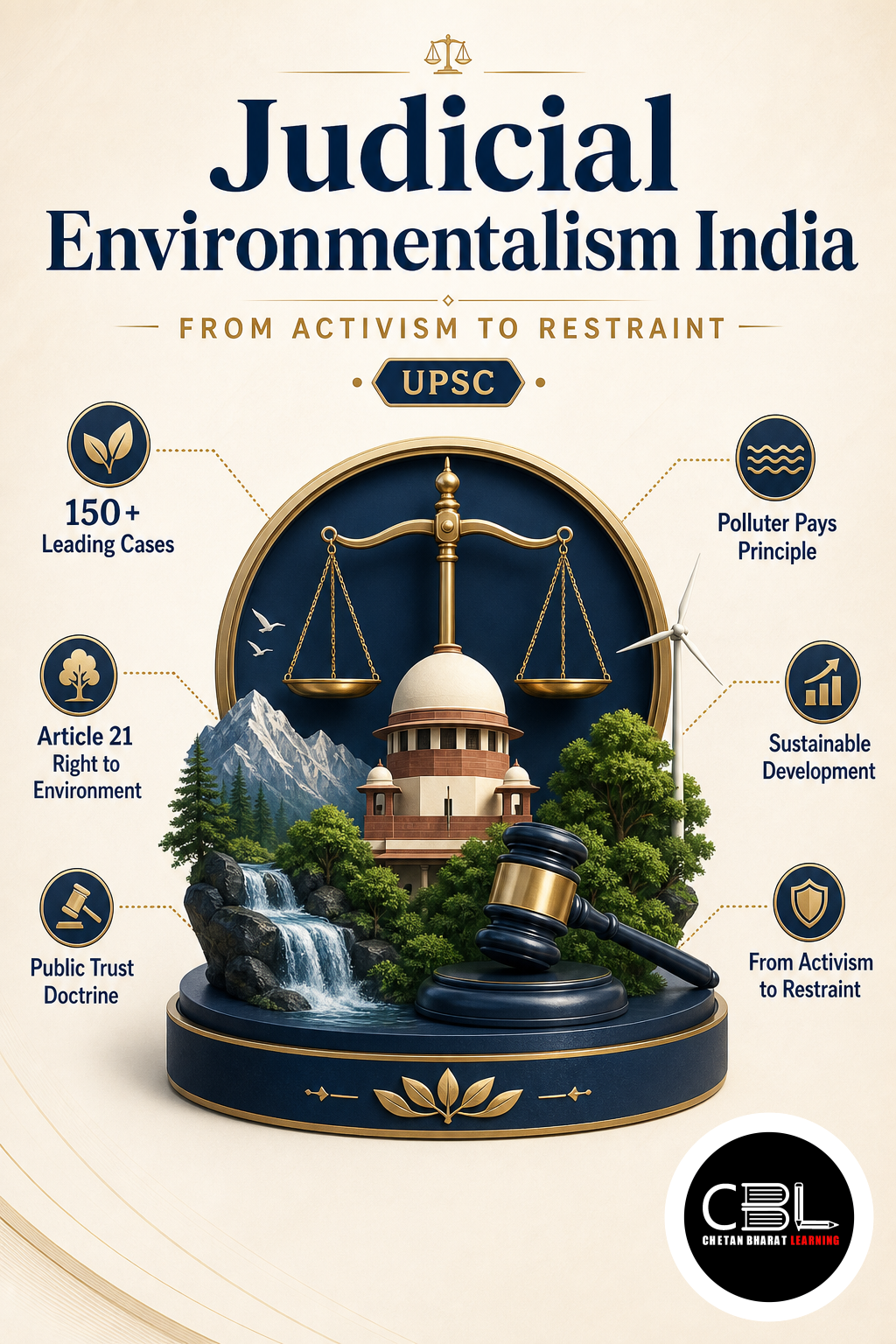
Judicial Environmentalism India refers to the role of the judiciary in environmental protection and governance. The Supreme Court, through Public Interest Litigation (PIL), has expanded access to environmental justice, often moving beyond adjudicating individual disputes toward continuous environmental governance.
Key cases like T.N. Godavarman Thirumalpad v. Union of India have led to the creation of the Compensatory Afforestation Fund (CAF) and monitoring of forest clearance. However, critics argue that courts sometimes overstep into policy-making, a phenomenon termed “judicial overreach.”
Why is Judicial Environmentalism India in News?
Judicial Environmentalism India is currently being debated because there is a perception that the court is becoming less active in environmental matters, showing greater deference to the executive. This is better interpreted as a shift from ad hoc interventions to institutional supervision of governance mechanisms.
The debate centres on whether courts should decide policy matters or defer to the executive. Proponents of judicial intervention argue that it remains necessary when governance mechanisms fail, while critics contend that courts lack technical expertise and democratic legitimacy to make policy choices. For more details, refer to this PIB release.
Key Features of Judicial Environmentalism India
- Public Interest Litigation: PIL expanded access to environmental justice, allowing citizens and NGOs to approach courts directly.
- Monitoring Role: Courts have taken on continuing monitoring roles, appointing committees to oversee compliance.
- Compensatory Mechanisms: The CAF Act, 2016, and the Green India Mission were influenced by judicial interventions.
- Constitutional Rights: The court has linked environmental protection to the right to life (Article 21).
- Institutional Supervision: Courts now focus on supervising executive actions rather than making policy decisions.
Challenges in Judicial Environmentalism India
- Judicial Overreach: Critics argue that courts sometimes make policy choices—such as where to build a highway—that should be left to the executive.
- Technical Expertise: Judges may lack the scientific and technical expertise required to assess complex environmental issues.
- Implementation Gaps: Judicial orders are not always implemented effectively due to lack of administrative capacity or political will.
- Resource Constraints: Continuous monitoring and oversight require significant judicial resources.
- Balancing Act: Courts must balance development needs with environmental protection. For more on environmental governance, visit the environment current affairs section.
Way Forward for Judicial Environmentalism India
To strengthen Judicial Environmentalism India, courts should continue to play a supervisory role while deferring to executive expertise on technical matters. Institutionalising environmental courts or tribunals—like the National Green Tribunal (NGT)—can enhance specialized adjudication.
Building administrative capacity to implement judicial orders and ensuring transparency in environmental decision-making can reduce the need for judicial intervention. The principle should be institutional restraint combined with constitutional vigilance—intervening only when governance mechanisms fail, not when policy choices are contested. For international best practices, refer to the UNEP.
Prelims Practice Corner
Q1. Which landmark case expanded judicial intervention in forest conservation in India?
- (a) Kesavananda Bharati
- (b) T.N. Godavarman Thirumalpad v. Union of India
- (c) Olga Tellis v. BMC
- (d) Maneka Gandhi v. Union of India
Answer: (b) The T.N. Godavarman case is the landmark case on forest conservation and judicial environmentalism.
Q2. What is the primary tool used by courts to hear environmental issues?
- (a) Original Suit
- (b) Public Interest Litigation
- (c) Criminal Complaint
- (d) Arbitration
Answer: (b) PIL is the primary tool for environmental justice.
Q3. What is judicial overreach?
- (a) Courts interpreting the Constitution
- (b) Courts making policy decisions that should be left to the executive
- (c) Courts reviewing executive actions
- (d) Courts upholding fundamental rights
Answer: (b) Judicial overreach refers to courts making policy decisions beyond their constitutional mandate.
Q4. Which constitutional right has been linked to environmental protection?
- (a) Article 14 (Equality)
- (b) Article 19 (Freedom of Speech)
- (c) Article 21 (Right to Life)
- (d) Article 25 (Freedom of Religion)
Answer: (c) Courts have linked environmental protection to the right to life under Article 21.
Q5. What is the Compensatory Afforestation Fund (CAF) Act?
- (a) A fund for afforestation
- (b) A law requiring companies to compensate for forest diversion
- (c) A fund created by judicial intervention
- (d) All of the above
Answer: (d) The CAF Act was influenced by judicial intervention and requires compensation for forest diversion.
Mains Practice Questions
Q1. Critically examine the role of the judiciary in environmental governance in India. Is judicial activism necessary or does it amount to overreach? (250 words, 15 marks)
Answer Structure
Intro: Frame the debate on judicial environmentalism.
Body: Discuss the evolution from PIL to continuous monitoring. Analyse arguments for judicial intervention: governance failures, constitutional rights. Arguments against: technical expertise, democratic legitimacy.
Conclusion: Suggest a balanced approach—institutional restraint with constitutional vigilance.
Q2. What are the advantages and limitations of using PIL as a tool for environmental protection? (150 words, 10 marks)
Answer Structure
Intro: Define PIL and its role in environmental cases.
Body: Advantages: access to justice, continuous monitoring, constitutional protection. Limitations: judicial overreach, lack of technical expertise, implementation gaps.
Conclusion: Conclude that PIL is a powerful tool but should be used judiciously.
FAQs on Judicial Environmentalism India
What is judicial environmentalism?
It is the role of the judiciary in environmental protection and governance, often through PIL, by interpreting constitutional rights and supervising executive actions.
Is judicial environmentalism a form of judicial overreach?
Critics argue that courts sometimes make policy decisions that should be left to the executive, but proponents contend that judicial intervention remains necessary when governance mechanisms fail.
What is the T.N. Godavarman case?
It is a landmark PIL that led to the creation of the Compensatory Afforestation Fund and continuous judicial monitoring of forest conservation in India.
Related Current Affairs
Preparing for UPSC, PCS or HCS?
Talk to a mentor at Chetan Bharat Learning, Chandigarh. Free guidance on choosing the right exam and building a study plan.
Chat on WhatsAppCall 97793 53345UPSC / IAS / PCS coaching in Chandigarh · Trusted by aspirants across Punjab & Haryana
Leave a Reply
You must be logged in to post a comment.