

UPSC Mapping
Prelims
- Landslides, Western Ghats, Disaster Management
Mains
- GS Paper III – Disaster Management & Environment
Quick Facts
| Region | Western Ghats |
|---|---|
| Recent Trigger | Exceptionally Heavy Rainfall |
| State Affected | Kerala |
| Primary Hazard | Rainfall-induced Landslides |
Article
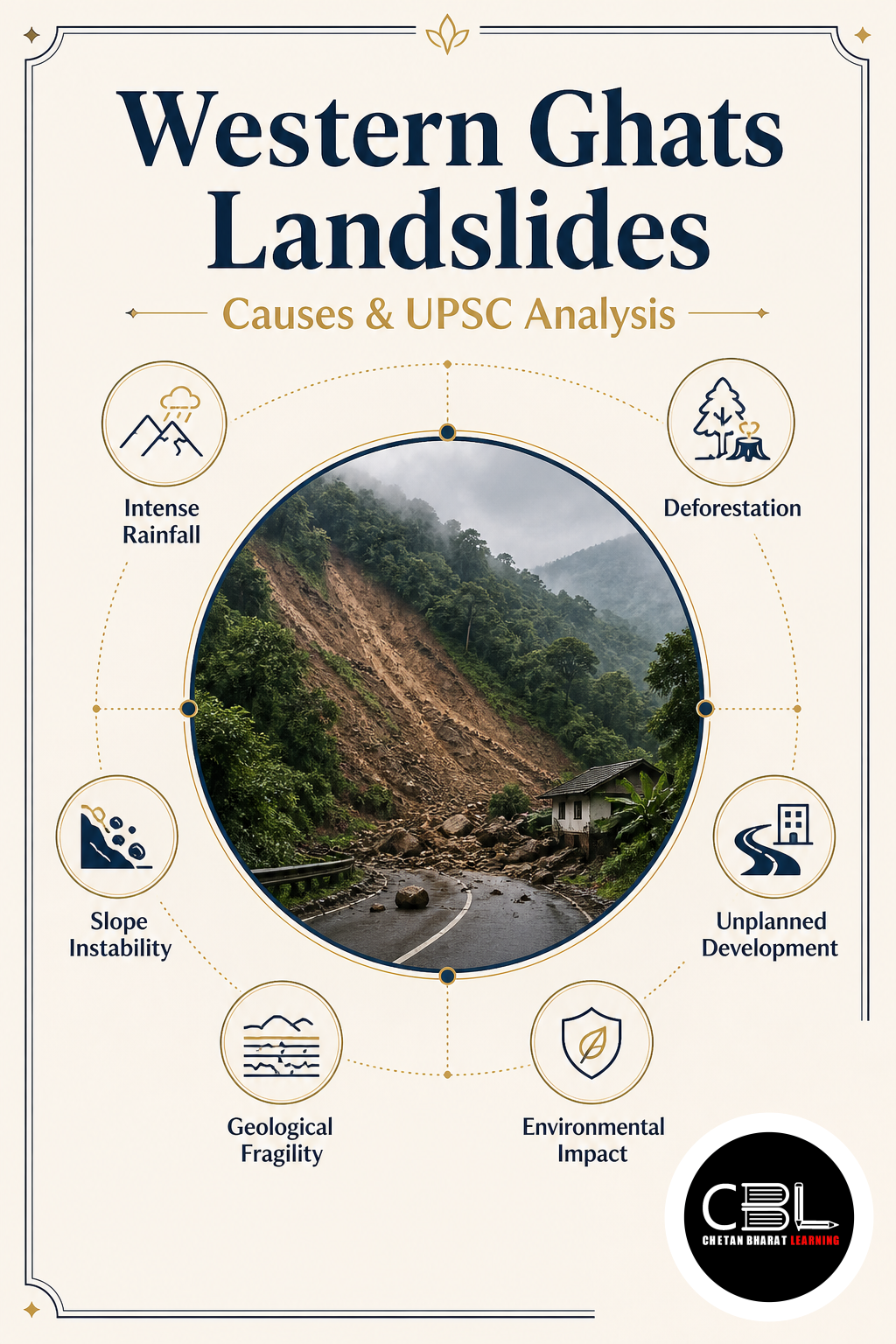
Western Ghats Landslides have once again drawn national attention after exceptionally heavy rainfall triggered fresh landslides, mudslides and flooding across Kerala. The issue is significant for UPSC because it links geography, disaster management, climate change and sustainable development. Aspirants can also revise related topics from the daily current affairs archive.
What are Western Ghats Landslides?
Western Ghats Landslides refer to the sudden downslope movement of rock, soil, earth or debris in the ecologically sensitive Western Ghats. Landslides are common natural disasters in mountainous regions where geological conditions, steep slopes and weather patterns create unstable terrain.
The Western Ghats possess a characteristic structure in which a layer of soil rests above hard rock. During prolonged rainfall, water infiltrates the soil and accumulates at the soil-rock interface, weakening the bond between the two layers and increasing the likelihood of slope failure.
Why are Western Ghats Landslides in News?
Exceptionally heavy rainfall triggered fresh landslides, mudslides and flooding across Kerala. The intense rainfall resulted from an offshore trough extending from the south Gujarat coast to Kerala, strong south-westerly winds over the Arabian Sea and a pronounced north-south pressure gradient along India’s west coast.
Such meteorological conditions produced persistent heavy rainfall that saturated hill slopes, increasing the risk of slope failures. Weather updates and advisories can be accessed through the India Meteorological Department (IMD).
Key Features
- Conditioning Factors: Soil characteristics, geology, geomorphology and steep slope angles determine slope stability.
- Rainfall Trigger: Intense and prolonged rainfall increases pore water pressure, reducing soil cohesion.
- Unique Terrain: Water flowing between soil and underlying hard rock weakens the binding force and promotes slope failure.
- Anthropogenic Influence: Unscientific construction, haphazard land use and deforestation aggravate landslide susceptibility.
- Climate Sensitivity: Changing rainfall patterns further increase disaster risk in the region.
Challenges
- Mining Activities: Expansion of mining weakens slopes and causes ecological, agricultural and social disruption.
- Hydropower Projects: Large dam projects alter natural drainage and contribute to ecological disturbances.
- Deforestation: Removal of vegetation reduces slope stability and increases soil erosion.
- Climate Change: Variations in rainfall intensity and duration increase the frequency of extreme events.
- Unplanned Development: Construction on fragile slopes without scientific assessment heightens disaster risk.
Students should also revise related topics from the Disaster Management current affairs section.
Way Forward
Reducing the impact of Western Ghats Landslides requires scientific land-use planning, strict regulation of mining and infrastructure projects, improved drainage systems and effective afforestation. Hazard zonation mapping and early warning systems should guide future development in vulnerable regions.
Strengthening coordination among disaster management authorities, local governments and scientific institutions can improve preparedness and minimise loss of life and property. Additional guidelines are available through the National Disaster Management Authority (NDMA).
Related Current Affairs
Preparing for UPSC, PCS or HCS?
Talk to a mentor at Chetan Bharat Learning, Chandigarh. Free guidance on choosing the right exam and building a study plan.
Chat on WhatsAppCall 97793 53345UPSC / IAS / PCS coaching in Chandigarh · Trusted by aspirants across Punjab & Haryana
Leave a Reply
You must be logged in to post a comment.