

UPSC Mapping
| Exam | Topic |
|---|---|
| Prelims | Tree Species, NTPS and Forest Produce |
| Mains | GS Paper III – Environment and Internal Security |
Article
Khair Tree conservation has entered focus after investigators uncovered an interstate timber-smuggling network. The alleged operators used forged digital permits to transport illegally sourced wood across several states. The case exposes weaknesses in forest-produce traceability, checkpoint verification and coordination between enforcement agencies. It also highlights the economic pressure on a valuable native species used for producing katha. Aspirants can follow related developments through the daily current affairs archive.
What is Khair Tree?
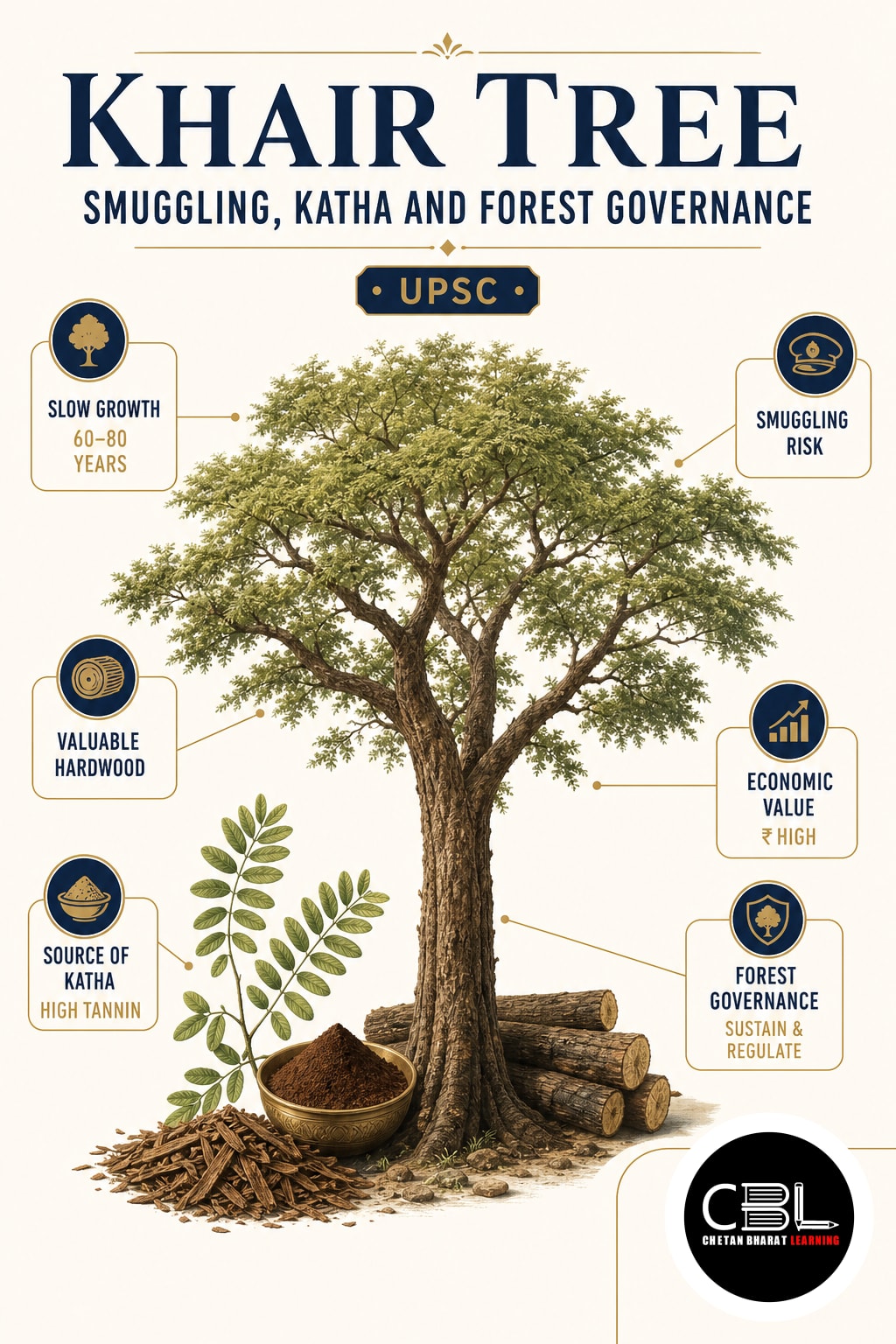
Khair Tree is a small to medium-sized thorny deciduous species scientifically called Senegalia catechu. Older botanical literature commonly identifies it as Acacia catechu. It belongs to the legume family and can improve soil fertility through biological nitrogen fixation. Its feathery leaves, pale flower spikes, dark pods and hard heartwood provide important identification features.
The species occurs across the Indian subcontinent and extends towards southern China and mainland Southeast Asia. It grows in tropical moist deciduous, dry deciduous and thorn forests. Porous sandy soils, riverbanks and fresh alluvial deposits provide favourable conditions for establishment. As a pioneer species, it can colonise disturbed riverine land and contribute to early ecological succession.
Why is Khair Tree in News?
Khair Tree entered the news after Chhattisgarh Police investigated the illegal movement of valuable wood. Investigators reportedly found forged National Transit Pass System documents presented as genuine forest clearances. The alleged network sourced timber across forest regions and transported it towards processing centres in northern India. Multiple routes, storage points and commercial entities complicated detection by individual state authorities.
The case demonstrates that digitisation cannot prevent smuggling when criminals forge documents or manipulate source information. Enforcement officers must verify the QR code, issuing authority, vehicle details, route and timber quantity against the central record. The official National Transit Pass System records permits for interstate and intrastate movement of timber, bamboo and other forest produce. A digital certificate facilitates lawful movement but does not independently prove that the forest produce was legally harvested.
Key Features
The species combines ecological functions with high-value commercial and traditional uses.
- Hard heartwood: The durable reddish-brown wood supports construction, agricultural implements, tool handles and other specialised applications.
- Katha production: Manufacturers extract an astringent substance from the heartwood for use in paan and traditional preparations.
- Tannin source: Bark and heartwood extracts provide tannins used in leather processing, colouring and related industries.
- Riverine pioneer: The Khair Tree establishes on porous alluvial deposits and contributes to vegetation recovery on newly formed surfaces.
- Agroforestry potential: Its drought tolerance, nitrogen-fixing ability and useful wood can support carefully managed dryland production systems.
Katha gives the heartwood exceptional commercial value and creates a strong extraction incentive. Producers prepare it by processing selected wood and concentrating the resulting extract. The product has established cultural and market demand, particularly through its use with betel leaves. Unsustainable harvesting becomes profitable when smugglers avoid royalty payments, transit rules and scientific felling restrictions.
The National Transit Pass System follows the One Nation–One Pass approach for lawful forest-produce movement. Applicants register online and submit species, source, quantity, vehicle and route information to the competent forest authority. Approved permits can carry QR codes that officers verify during transportation. The platform improves record-keeping and reduces physical paperwork while retaining state-specific felling and transit requirements.
Challenges
Conservation requires stronger source verification, interstate coordination and sustainable harvesting practices.
- Forged permits: Counterfeit documents can resemble valid certificates unless checkpoint personnel verify them directly through the official digital system.
- Interstate networks: Timber may cross several jurisdictions, allowing criminals to exploit differences in transit rules and enforcement capacity.
- Source concealment: Mixing illegally felled wood with material from private plantations or authorised depots can hide its true origin.
- Field limitations: Forest departments often lack adequate personnel, vehicles, digital equipment and species-identification expertise at remote checkpoints.
- Local depletion: A species classified globally as Least Concern may still experience serious decline within heavily exploited forest divisions.
The IUCN category reflects the species’ broad global distribution rather than the condition of every local population. Repeated removal of mature trees can reduce seed production, alter forest structure and affect associated organisms. Illegal felling also deprives governments and forest-dependent communities of legitimate revenue. Enforcement must therefore examine local regeneration and harvesting pressure alongside the global conservation category.
Forest laws vary across states because authorities regulate felling and transit through different rules and exemptions. A unified portal improves movement but cannot automatically harmonise every underlying legal condition. Smugglers may exploit inconsistent species lists, poorly connected databases or delayed verification. Aspirants can examine related conservation questions through the environment and ecology section.
Way Forward
Khair Tree protection requires traceability from the standing tree to the final processing unit. Forest departments should geotag authorised trees, record stump measurements and link timber markings with verified transit permits. Checkpoints need real-time QR verification instead of relying on printed copies or screenshots. Automatic alerts should flag duplicate passes, unusual routes, altered vehicle numbers and quantities exceeding the authorised harvest.
States should establish joint intelligence teams for high-value timber routes and share seizure data through interoperable systems. Independent audits of depots and katha-processing units can reconcile raw-material purchases with production capacity. Community monitoring and sustainable plantations can protect natural forests while supporting lawful livelihoods. The ICFRE species profile provides scientific information for management and cultivation. Combining digital permits with field enforcement, ecological assessments and commercial due diligence can reduce illegal extraction.
Prelims Practice Corner
Q1. What is the accepted scientific name of khair?
(a) Senegalia catechu (b) Prosopis juliflora (c) Tectona grandis (d) Dalbergia sissoo
Answer: (a) Senegalia catechu, formerly called Acacia catechu, is the accepted scientific name.
Q2. Khair belongs to which plant family?
(a) Poaceae (b) Fabaceae (c) Rutaceae (d) Dipterocarpaceae
Answer: (b) Khair belongs to Fabaceae, commonly called the legume family.
Q3. Katha is primarily obtained from which part of khair?
(a) Flowers (b) Roots (c) Heartwood (d) Seeds
Answer: (c) Katha is an astringent extract prepared principally from khair heartwood.
Q4. The National Transit Pass System is administered under which Union ministry?
(a) Ministry of Agriculture and Farmers Welfare (b) Ministry of Environment, Forest and Climate Change (c) Ministry of Commerce and Industry (d) Ministry of Tribal Affairs
Answer: (b) The Ministry of Environment, Forest and Climate Change administers the system.
Q5. Which statement about an NTPS permit is correct?
(a) It replaces every state forest law (b) It records and facilitates lawful forest-produce transit (c) It permits unrestricted tree felling (d) It applies only to imported timber
Answer: (b) NTPS digitises permit issuance and monitoring while retaining applicable state rules.
Mains Practice Questions
Q1. Digital transit permits can improve forest governance but cannot substitute field enforcement. Discuss. (250 words, 15 marks)
Answer Structure
Intro: Introduce NTPS as a digital system for monitoring forest-produce movement.
Body: Discuss transparency, forged documents, source verification, interstate coordination, field capacity and depot audits.
Conclusion: Recommend integrating digital traceability with intelligence-led physical enforcement.
Q2. Explain how commercial demand can threaten locally abundant forest species despite a favourable global conservation status. (150 words, 10 marks)
Answer Structure
Intro: Distinguish global IUCN status from local population trends.
Body: Cover market demand, selective felling, weak regeneration, habitat impacts and illegal supply chains.
Conclusion: Support local assessments, sustainable harvests and complete commercial traceability.
FAQs on Khair Tree
What is the main commercial product obtained from khair wood?
Katha is the best-known product extracted from its heartwood. The tree also supplies tannins and durable timber for several traditional uses.
Does Least Concern status mean that khair needs no protection?
No. A widespread species may remain globally secure while suffering severe depletion in heavily exploited local forests.
What is the purpose of the National Transit Pass System?
NTPS enables online issuance, monitoring and verification of permits for transporting timber, bamboo and other forest produce. It supports nationwide movement while incorporating applicable state procedures.
Related Current Affairs
Preparing for UPSC, PCS or HCS?
Talk to a mentor at Chetan Bharat Learning, Chandigarh. Free guidance on choosing the right exam and building a study plan.
Chat on WhatsAppCall 97793 53345UPSC / IAS / PCS coaching in Chandigarh · Trusted by aspirants across Punjab & Haryana
Leave a Reply
You must be logged in to post a comment.