
UPSC Mapping
- Prelims: Environment & Geography
- Mains: GS Paper III
Quick Facts
| Parameter | Value |
|---|---|
| Coverage | 54% of Earth’s land |
| Annual value | $21-47 trillion |
| Restoration ROI | $4-6 per $1 invested |
What is Rangeland Restoration?
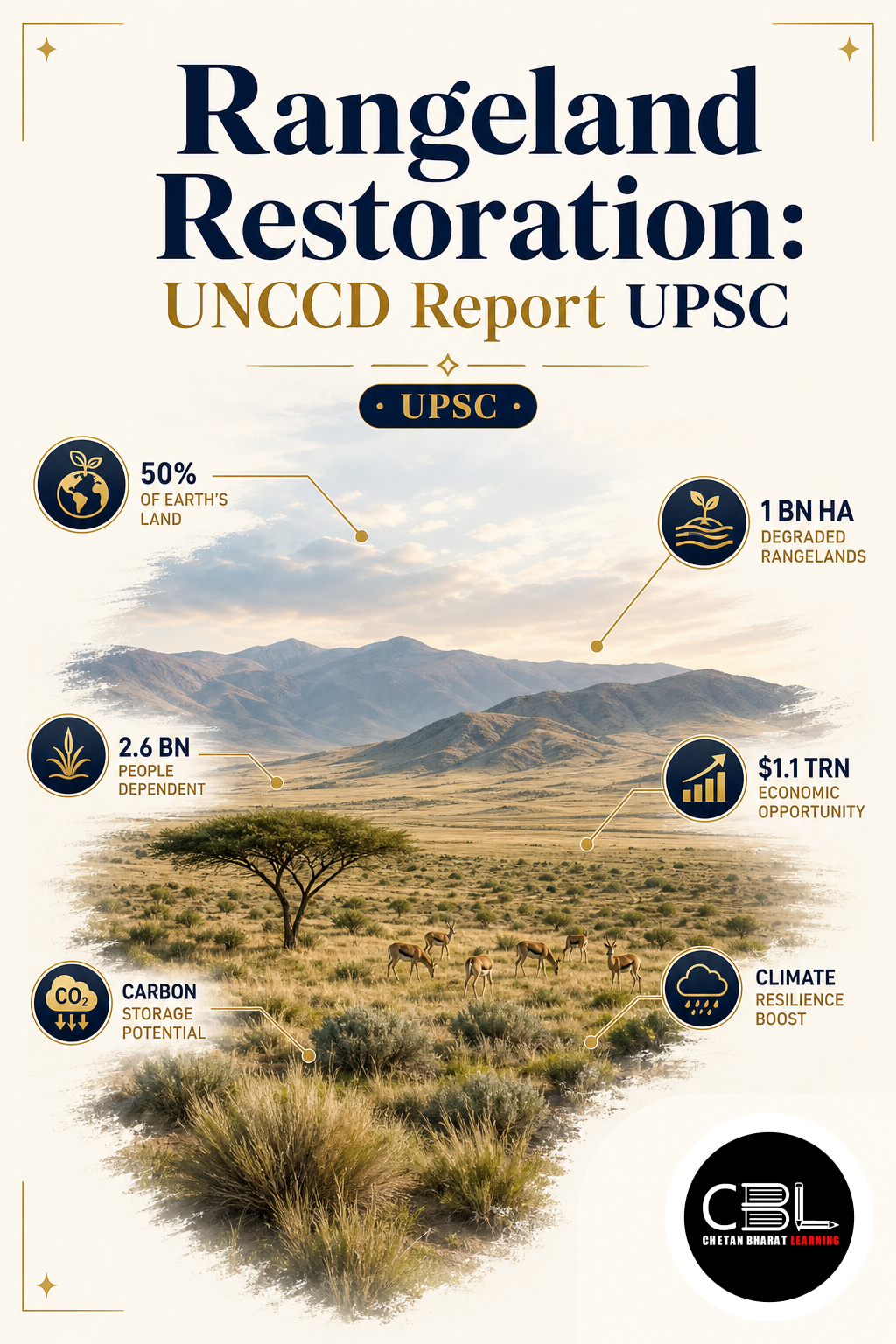
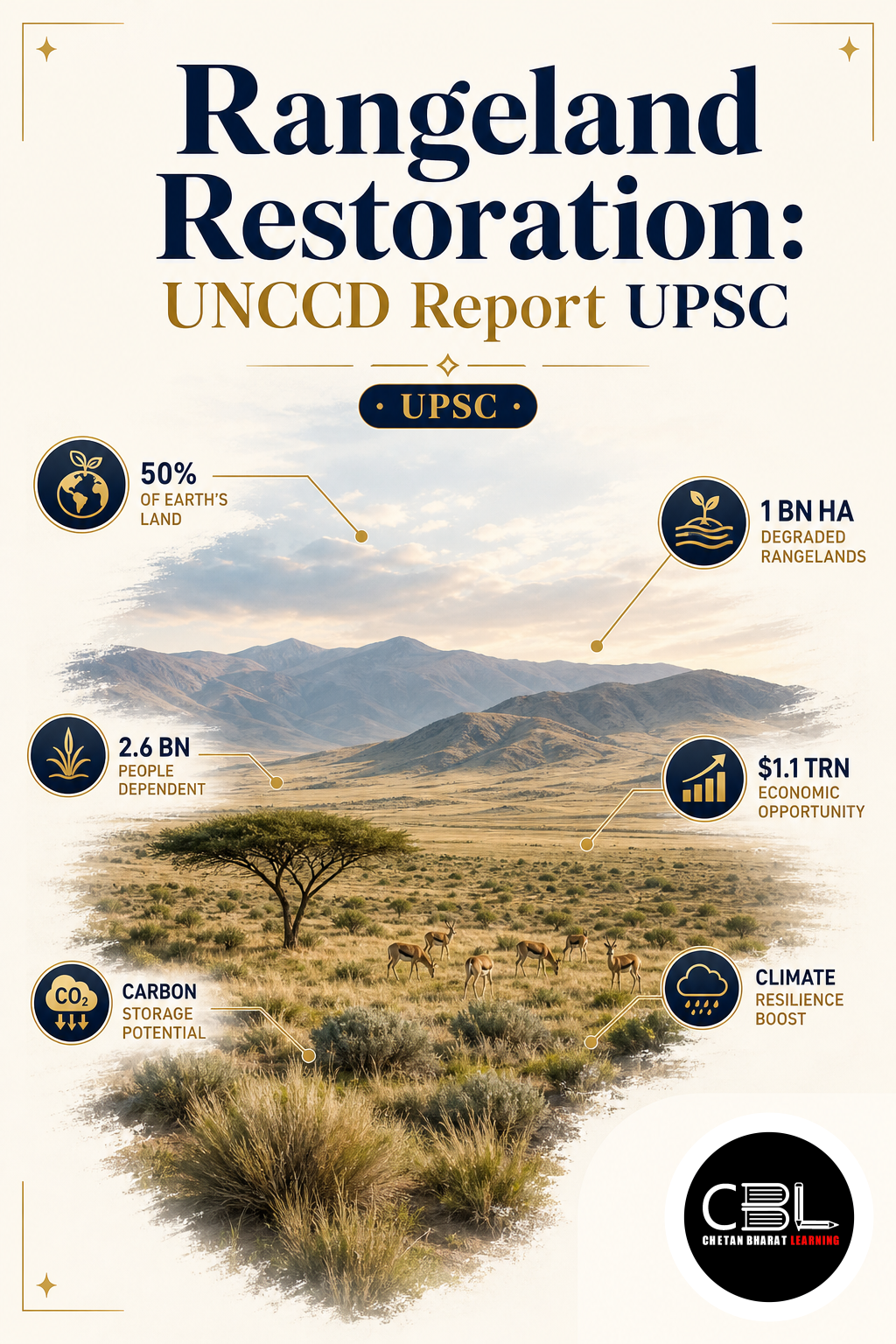
Rangeland restoration refers to the process of rehabilitating degraded grasslands, savannas, shrublands, and open woodlands to improve their ecological integrity and productivity. These ecosystems cover over 54% of Earth’s land and host nearly a third of key biodiversity areas, providing essential services like carbon storage, water regulation, and grazing resources.
Restoration involves measures such as controlled grazing, re-seeding native species, controlling invasive plants, and restoring water cycles. Rangeland restoration is not just about ecology—it also has profound economic and social benefits, particularly for the 500 million pastoralists who depend on these lands for their livelihoods.
Why is Rangeland Restoration in News?
The rangeland restoration agenda is in the spotlight due to the launch of the UNCCD report “Rangelands Rising” at COP17 in Mongolia. Jointly produced by UNCCD, the International Livestock Research Institute, and IUCN, the report makes a compelling economic case: rangelands generate $21 to $47 trillion annually in ecosystem services, and every $1 invested in restoration yields $4-6 in returns—rising to $36 when wider benefits like water supply are included.
India’s recent guide to Open Natural Ecosystems (ONEs) also underscores the importance of conserving grasslands and savannas, aligning with global restoration efforts. The report highlights that inaction costs at least $300 billion annually in drought-related losses. For official details, see the PIB release on India’s participation in UNCCD COP17.
Key Features of Rangeland Restoration
- High economic returns: Restoration offers a benefit-cost ratio of 4-6, making it one of the most cost-effective nature-based solutions.
- Biodiversity conservation: Rangelands support a third of global key biodiversity areas, including many endangered species.
- Carbon sequestration: Healthy rangelands store significant soil carbon, contributing to climate mitigation.
- Pastoral livelihoods: Restoration secures fodder and water for nomadic communities, reducing poverty and migration.
- Disaster risk reduction: Well-managed rangelands reduce the impact of droughts and floods, saving billions in humanitarian costs.
Challenges Facing Rangeland Restoration
- Climate blindspot: Rangelands appear in only 24 countries’ NDCs, compared to 181 for forests, limiting political attention and funding.
- Ecological damage: Inappropriate afforestation under tree-planting targets often permanently damages natural grasslands.
- Finance gap: The private sector provides only 6% of global financing for land degradation and drought, far below what is needed.
- Reactive spending: Governments spend more on drought relief than proactive restoration; Niger’s 2021 drought relief was ~7% of GDP, while timely support could save $3 for every $1 spent later.
- Land tenure issues: Pastoralists often lack secure rights, undermining community-led restoration efforts.
Way Forward for Rangeland Restoration
To scale rangeland restoration, governments must embed concrete conservation and restoration targets into their NDCs under the Paris Agreement. This would align climate action with land restoration, unlocking greater financing and political will. Additionally, institutional funding should shift from reactive post-disaster aid to proactive land management, building long-term resilience.
Securing land rights and establishing community-led governance for pastoralists is equally crucial, as indigenous stewards are best placed to manage these landscapes sustainably. International cooperation through platforms like UNCCD and the upcoming International Year of Rangelands and Pastoralists (IYRP 2026) can accelerate knowledge sharing and investment.
Prelims Practice Corner
Q1. What percentage of Earth’s land is covered by rangelands according to the UNCCD report?
(a) 30% (b) 40% (c) 54% (d) 70%
Answer: (c) Rangelands cover over 54% of Earth’s land, including grasslands, savannas, and shrublands.
Q2. What is the estimated annual value of ecosystem services provided by rangelands?
(a) $5-10 trillion (b) $21-47 trillion (c) $50-100 trillion (d) $100-200 trillion
Answer: (b) The report estimates rangelands generate $21 to $47 trillion annually.
Q3. How much does every $1 invested in rangeland restoration typically return?
(a) $1-2 (b) $2-3 (c) $4-6 (d) $10-15
Answer: (c) The return is $4-6 per $1 invested, rising to $36 when wider benefits are included.
Q4. Which country’s drought relief in 2021 amounted to ~7% of its GDP, highlighting the cost of inaction?
(a) India (b) Kenya (c) Niger (d) Ethiopia
Answer: (c) Niger’s 2021 drought relief was ~7% of GDP, underscoring the economic burden of reactive spending.
Q5. What is the current share of private sector financing for combating land degradation and drought?
(a) 6% (b) 15% (c) 25% (d) 40%
Answer: (a) As of 2025, the private sector provides only 6% of global financing for land degradation and drought.
Mains Practice Questions
Q1. Discuss the ecological and economic significance of rangelands and the need for their restoration in the context of climate change. (15 marks)
Answer Structure
- Intro: Define rangelands and their global coverage, citing the UNCCD report.
- Body: Cover ecosystem services, economic valuation, biodiversity, pastoral livelihoods, and climate benefits. Address challenges and restoration strategies.
- Conclusion: Emphasise policy integration and proactive financing as key to scaling restoration.
Q2. Examine the barriers to rangeland restoration and suggest measures to overcome them. (10 marks)
Answer Structure
- Intro: Briefly mention the current neglect of rangelands in climate and development agendas.
- Body: List barriers: policy blindspots, finance gaps, afforestation bias, tenure insecurity. Suggest solutions: NDC integration, redirecting funds, secure pastoral rights, and community-led governance.
- Conclusion: Highlight the role of international cooperation and the upcoming IYRP 2026.
FAQs on Rangeland Restoration
What are rangelands?
Rangelands are natural grasslands, savannas, shrublands, and open woodlands that are primarily used for grazing by livestock and wildlife. They cover 54% of Earth’s land.
What is the UNCCD report ‘Rangelands Rising’ about?
Launched at UNCCD COP17, the report highlights the immense economic value of rangelands ($21-47 trillion annually) and calls for urgent investment in restoration, showing that every $1 invested returns $4-6.
Why are rangelands often overlooked in climate policy?
Only 24 countries include rangelands in their NDCs, compared to 181 for forests, due to a bias toward tree-based solutions and a lack of awareness about their ecological and economic importance.
Related Current Affairs
Preparing for UPSC, PCS or HCS?
Talk to a mentor at Chetan Bharat Learning, Chandigarh. Free guidance on choosing the right exam and building a study plan.
Chat on WhatsAppCall 97793 53345UPSC / IAS / PCS coaching in Chandigarh · Trusted by aspirants across Punjab & Haryana
Leave a Reply
You must be logged in to post a comment.