UPSC Mapping
| Prelims | International Relations |
|---|---|
| Mains | GS Paper 2 (International Relations & International Law) |
Quick Facts
| Key Area | E1 (West Bank) |
|---|---|
| Housing Units | 1,234 (E1), 3,400 planned |
What are Israel West Bank Settlements?
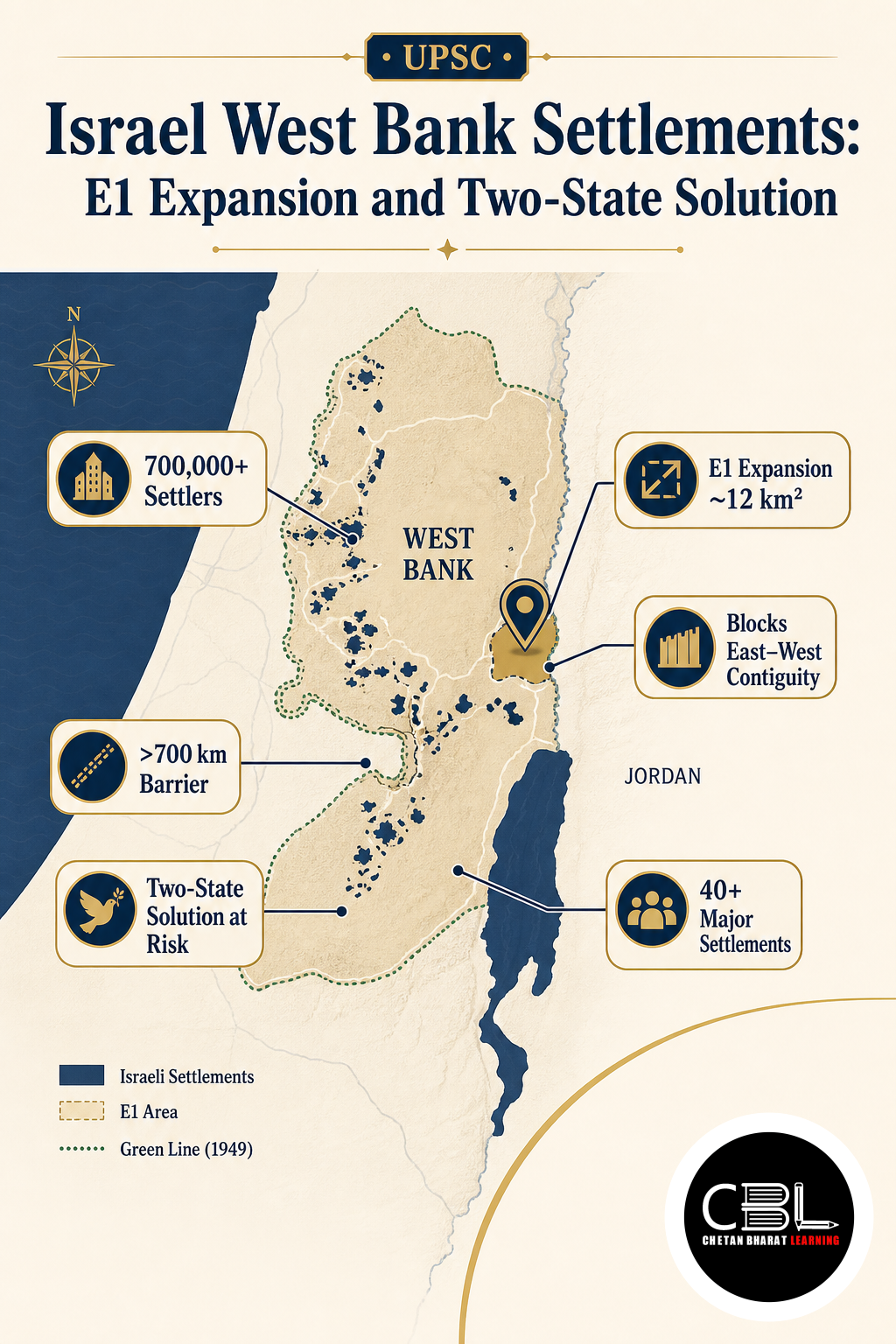
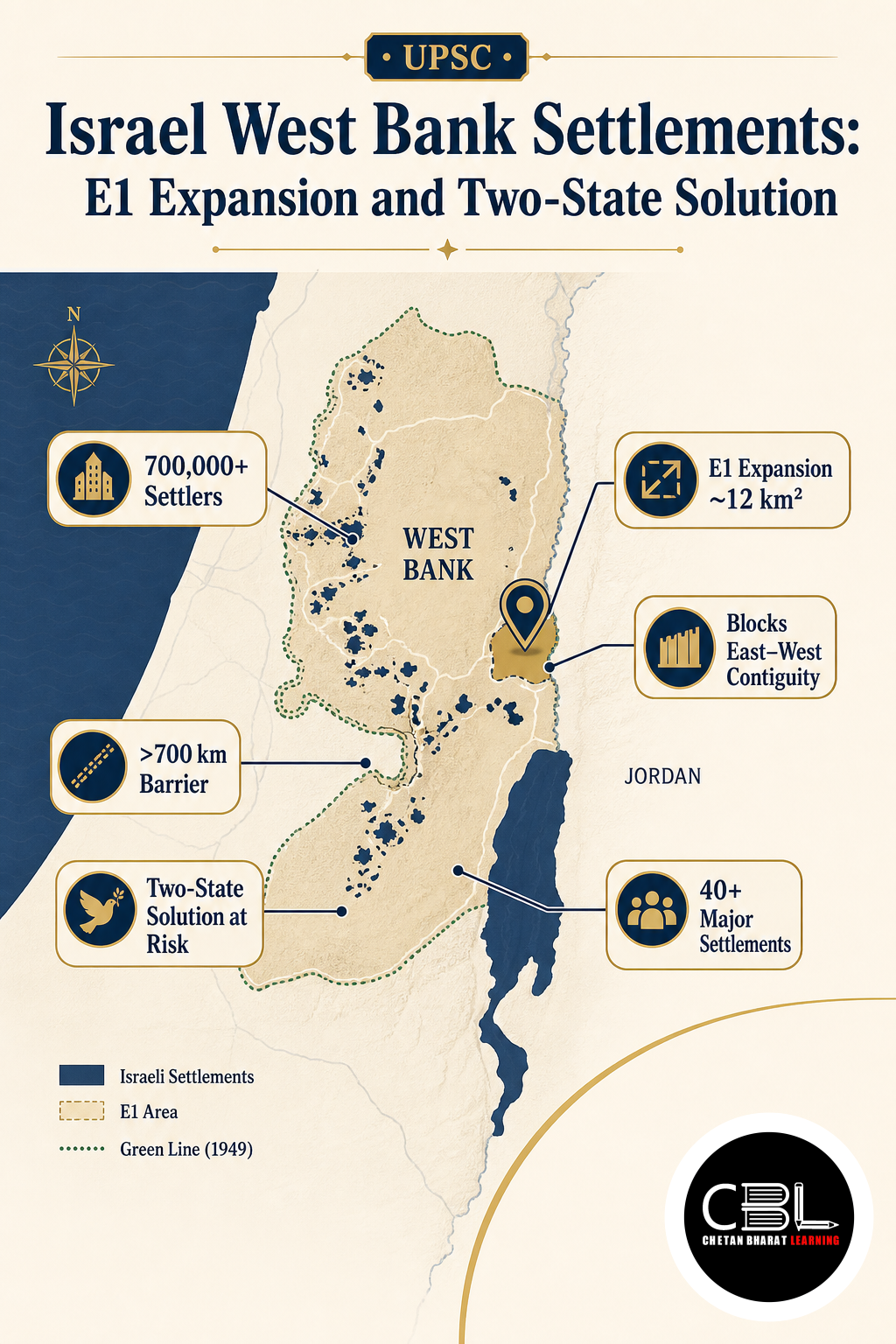
Israel West Bank Settlements are Israeli civilian communities established in territory occupied since the 1967 Arab-Israeli War. Large settlement blocs exist across the West Bank. The international community, including the UN, considers settlements illegal under international law. UNSC Resolution 2334 (2016) reaffirms that settlements have no legal validity. Israel disputes aspects of this legal interpretation.
E1 is a particularly sensitive area because it lies between Jerusalem and the Ma’ale Adumim settlement, effectively cutting the West Bank in two. Expansion in E1 fragments the West Bank, undermining Palestinian territorial contiguity and the viability of a two-state solution.
Why are Israel West Bank Settlements in News?
Israel West Bank Settlements are in the news because Israel opened tenders for 1,234 housing units in E1, part of a larger plan for 3,400 units. International concern is rising because E1 expansion fragments the West Bank and undermines Palestinian territorial contiguity. The move is seen as a major obstacle to the two-state solution.
The expansion is also significant under international law. The Fourth Geneva Convention (Article 49) prohibits an occupying power from transferring parts of its civilian population into occupied territory. UNSC Resolution 2334 (2016) and the ICJ’s 2024 Advisory Opinion have reinforced the illegality of settlements. For more details, refer to this PIB release.
Key Features of Israel West Bank Settlements
- Occupation: Established in territory occupied since 1967.
- Illegality: UN and international community consider them illegal under international law.
- E1 Area: Particularly sensitive because it fragments the West Bank.
- Two-State Solution: Settlement expansion undermines Palestinian territorial contiguity.
- International Law: Fourth Geneva Convention (Article 49) and UNSC Resolution 2334 (2016) are relevant.
Challenges in Israel West Bank Settlements
- Territorial Fragmentation: Settlements break the West Bank into enclaves, undermining Palestinian statehood.
- International Law: The legality of settlements is disputed, creating diplomatic tension.
- Two-State Solution: Continued expansion makes a viable Palestinian state increasingly difficult.
- Human Rights: Settlements restrict Palestinian movement and access to resources.
- Regional Stability: The conflict contributes to broader regional instability. For more on international law, visit the international relations section.
Way Forward for Israel West Bank Settlements
To preserve the possibility of a two-state solution, Israel should halt settlement expansion, particularly in the E1 area. The international community, including the UN, should continue to pressure Israel to comply with international law and UNSC resolutions. A negotiated settlement based on the 1967 borders with mutually agreed land swaps is the most viable path to peace.
However, the political realities make a resolution difficult. The international community must maintain the legal and diplomatic framework while encouraging dialogue between the parties. For international best practices, refer to the UN.
Prelims Practice Corner
Q1. What is the E1 area?
(a) A military base (b) A sensitive area in the West Bank that fragments Palestinian territory (c) A Palestinian city (d) An Israeli port
Answer
Answer: (b) E1 is a sensitive area that fragments the West Bank.
Q2. Which UN resolution reaffirms the illegality of Israeli settlements?
(a) UNSC 1325 (b) UNSC 2334 (c) UNGA 194 (d) UNSC 242
Answer
Answer: (b) UNSC Resolution 2334 (2016) reaffirms the illegality of settlements.
Q3. What is the two-state solution?
(a) A solution with two Israeli states (b) An independent Palestinian state alongside Israel (c) A single state for all (d) A confederation
Answer
Answer: (b) The two-state solution envisages an independent Palestinian state alongside Israel.
Q4. What does the Fourth Geneva Convention (Article 49) prohibit?
(a) Use of chemical weapons (b) Transfer of civilian population into occupied territory (c) Trade with occupied territory (d) Diplomatic relations
Answer
Answer: (b) Article 49 prohibits the transfer of civilian population into occupied territory.
Q5. How many housing units were tendered in E1?
(a) 500 (b) 1,234 (c) 2,500 (d) 3,400
Answer
Answer: (b) Tenders were opened for 1,234 housing units in E1.
Mains Practice Questions
Q1. Discuss the implications of Israeli settlement expansion in the West Bank for the two-state solution and international law. (250 words, 15 marks)
Answer Structure:
- Intro: Introduce the Israeli settlement expansion and its significance.
- Body: Discuss the E1 expansion, its impact on Palestinian contiguity, and the two-state solution. Analyse the legal framework (Fourth Geneva Convention, UNSC 2334).
- Conclusion: Emphasise the need to halt settlements for a viable peace process.
Q2. What is the legal status of Israeli settlements in the West Bank under international law? (150 words, 10 marks)
Answer Structure:
- Intro: State the international position.
- Body: Explain that the UN and the ICJ consider settlements illegal under the Fourth Geneva Convention and UNSC resolutions. Israel disputes this interpretation.
- Conclusion: Conclude that the majority of the international community views settlements as illegal.
FAQs on Israel West Bank Settlements
What are Israeli settlements?
Civilian communities established in occupied territory since 1967.
What is the E1 area?
A sensitive area in the West Bank that, if settled, would fragment Palestinian territory.
What is the two-state solution?
A peace framework envisaging an independent Palestinian state alongside Israel.
Related Current Affairs
Preparing for UPSC, PCS or HCS?
Talk to a mentor at Chetan Bharat Learning, Chandigarh. Free guidance on choosing the right exam and building a study plan.
Chat on WhatsAppCall 97793 53345UPSC / IAS / PCS coaching in Chandigarh · Trusted by aspirants across Punjab & Haryana
Leave a Reply
You must be logged in to post a comment.