

UPSC Mapping
| Prelims | Polity, Constitution and Tribunals |
|---|---|
| Mains | GS Paper II – Judiciary and Governance |
| Constitutional basis | Articles 323A and 323B |
|---|---|
| Constitutional change | 42nd Amendment, 1976 |
| Proposed institution | National Tribunals Commission |
| Core concern | Efficient specialised adjudication |
What is the Tribunals Reforms Bill?
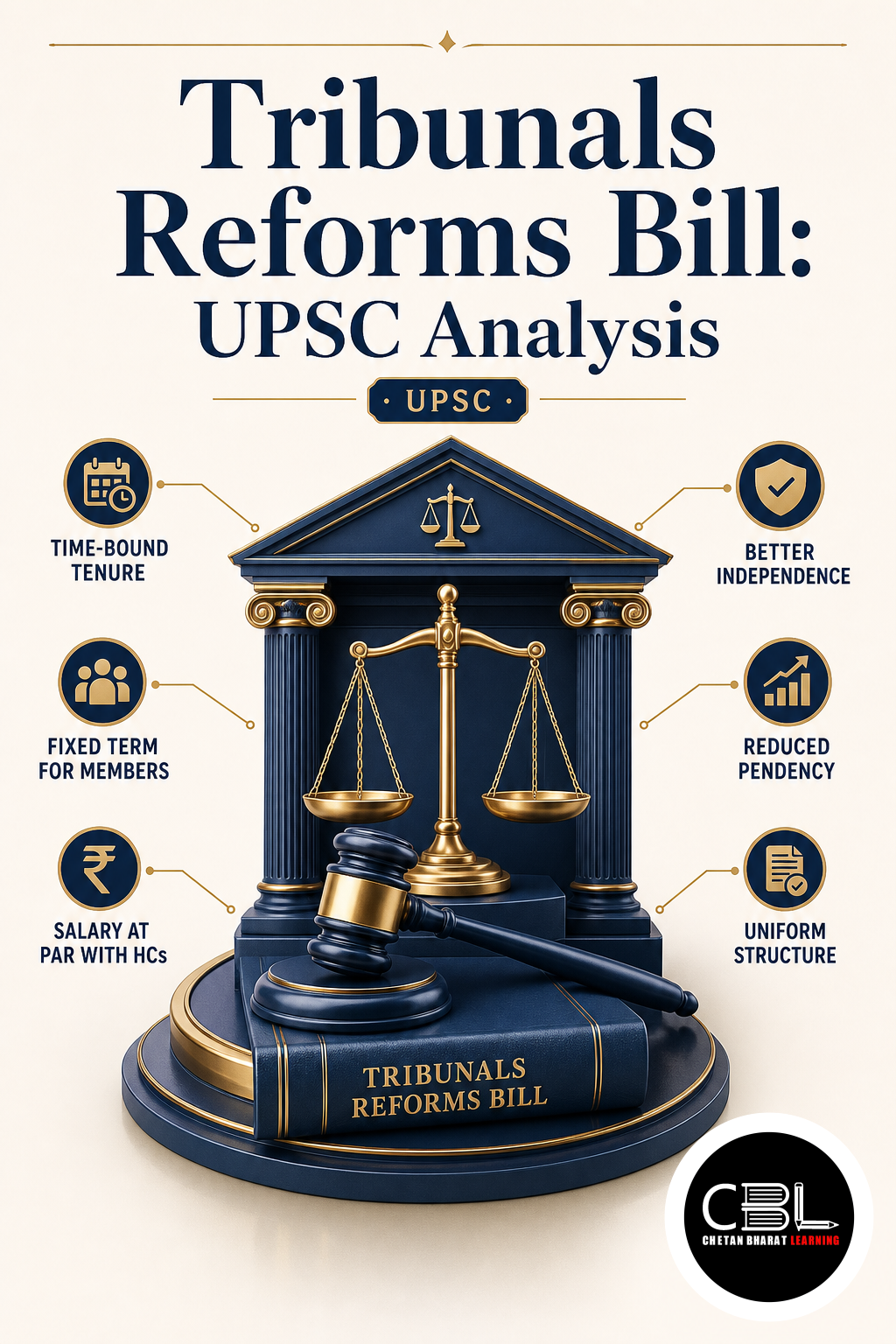
The Tribunals Reforms Bill is presented as a legislative attempt to improve the institutional framework governing tribunals. Its major proposal is the creation of a National Tribunals Commission (NTC) to oversee administration and appointments.
A tribunal is a specialised adjudicatory body created to decide disputes requiring particular expertise. Tribunals handle technical, regulatory, administrative or sector-specific questions to combine expertise, speed and specialisation.
The constitutional foundation comes from the 42nd Amendment Act, 1976, which inserted Articles 323A (administrative tribunals) and 323B (other specified matters) into the Constitution.
Why is the Tribunals Reforms Bill in News?
The Lok Sabha has passed the Bill, proposing a National Tribunals Commission for greater institutional structure, transparency and efficiency. This responds to policy problems such as vacancies, delays, infrastructure shortages, administrative dependence and fragmented jurisdiction that hinder speedy adjudication.
Aspirants should track the India Code and relevant parliamentary material alongside official releases.
Key Features
- National Tribunals Commission: Central mechanism to oversee tribunal functioning and administration.
- Appointment framework: Transparent and efficient institutional mechanism for tribunal appointments.
- Specialised adjudication: Disputes requiring sector-specific or technical expertise.
- Constitutional foundation: Articles 323A and 323B.
- Administrative reform: Address vacancies, infrastructure shortages and administrative fragmentation.
Article 323A deals with administrative tribunals (service conditions of public servants), while Article 323B covers areas like taxation, land reforms, industrial disputes and more.
Why Were Tribunals Created?
Tribunals address limitations of conventional courts in specialised disputes, bringing expertise into adjudication and reducing judicial workload. Yet vacancies, delays and infrastructure shortages challenge their effectiveness.
Challenges
- Vacancies: Unfilled positions increase case backlogs.
- Infrastructure shortages: Inadequate facilities hamper tribunal functions.
- Administrative dependence: Executive control concerns over independence.
- Fragmented jurisdiction: Multiple tribunals complicate navigation.
- Frequent litigation: Challenges to structures and decisions add delays.
Reform must ensure tribunals deliver speedy specialised justice without reproducing court-like delays.
Way Forward
Focus on independence, adequate staffing, transparent appointments and infrastructure. A central coordinating mechanism should enhance accountability while preserving adjudicatory independence. Jurisdictional clarity is essential for citizen access and reducing litigation.
The UPSC lesson: Institutional design determines whether specialised justice becomes efficient justice.
Prelims Practice Corner
Q1. Which Constitutional Amendment inserted the provisions relating to tribunals under Articles 323A and 323B?
(a) 24th Amendment (b) 42nd Amendment (c) 44th Amendment (d) 73rd Amendment
Answer: (b) The 42nd Constitutional Amendment Act, 1976.
Q2. Article 323A primarily deals with which of the following?
(a) Administrative tribunals (b) Panchayats (c) Election Commission (d) Finance Commission
Answer: (a) Administrative tribunals.
Q3. Which of the following is associated with Article 323B?
(a) Tribunals for other specified matters (b) Only recruitment to public services (c) Fundamental Duties (d) Emergency provisions
Answer: (a) Tribunals for other specified matters.
Q4. What is the principal rationale for creating specialised tribunals?
(a) To eliminate the judiciary (b) To provide specialised expertise and reduce court burden (c) To replace Parliament (d) To remove all judicial review
Answer: (b) Tribunals bring specialised expertise and help address court workloads.
Q5. Which of the following was identified as a problem affecting tribunals?
(a) Vacancies and infrastructure shortages (b) Excessive rainfall (c) Lack of constitutional recognition (d) Absence of specialised disputes
Answer: (a) Vacancies and infrastructure shortages.
Mains Practice Questions
Q1.
Explain the constitutional basis of tribunals in India and examine their role in specialised adjudication. (10 marks)
Answer Structure:
- Intro: Introduce tribunals and Part XIV-A.
- Body: 42nd Amendment, Articles 323A and 323B, rationale and concerns.
- Conclusion: Need for independence, capacity and accountability.
Q2.
Tribunalisation can reduce the burden on courts only when institutional independence and administrative efficiency are ensured. Discuss. (15 marks)
Answer Structure:
- Intro: Define tribunalisation and objectives.
- Body: Examine vacancies, infrastructure, jurisdiction, appointment mechanisms and NTC.
- Conclusion: Recommend a coherent system balancing expertise, speed and accountability.
FAQs on Tribunals Reforms Bill
What is the Tribunals Reforms Bill about?
The Bill seeks to reform the administration and framework of tribunals, proposing a National Tribunals Commission to oversee appointments and processes.
What are Articles 323A and 323B?
Article 323A provides for administrative tribunals; Article 323B covers tribunals for other specified matters, both introduced by the 42nd Amendment.
Why are tribunals important for UPSC?
Tribunals combine specialised adjudication with reduced court burden. Their constitutional basis and performance are relevant for GS Paper II and Prelims Polity.
Related Current Affairs
Preparing for UPSC, PCS or HCS?
Talk to a mentor at Chetan Bharat Learning, Chandigarh. Free guidance on choosing the right exam and building a study plan.
Chat on WhatsAppCall 97793 53345UPSC / IAS / PCS coaching in Chandigarh · Trusted by aspirants across Punjab & Haryana
Leave a Reply
You must be logged in to post a comment.