
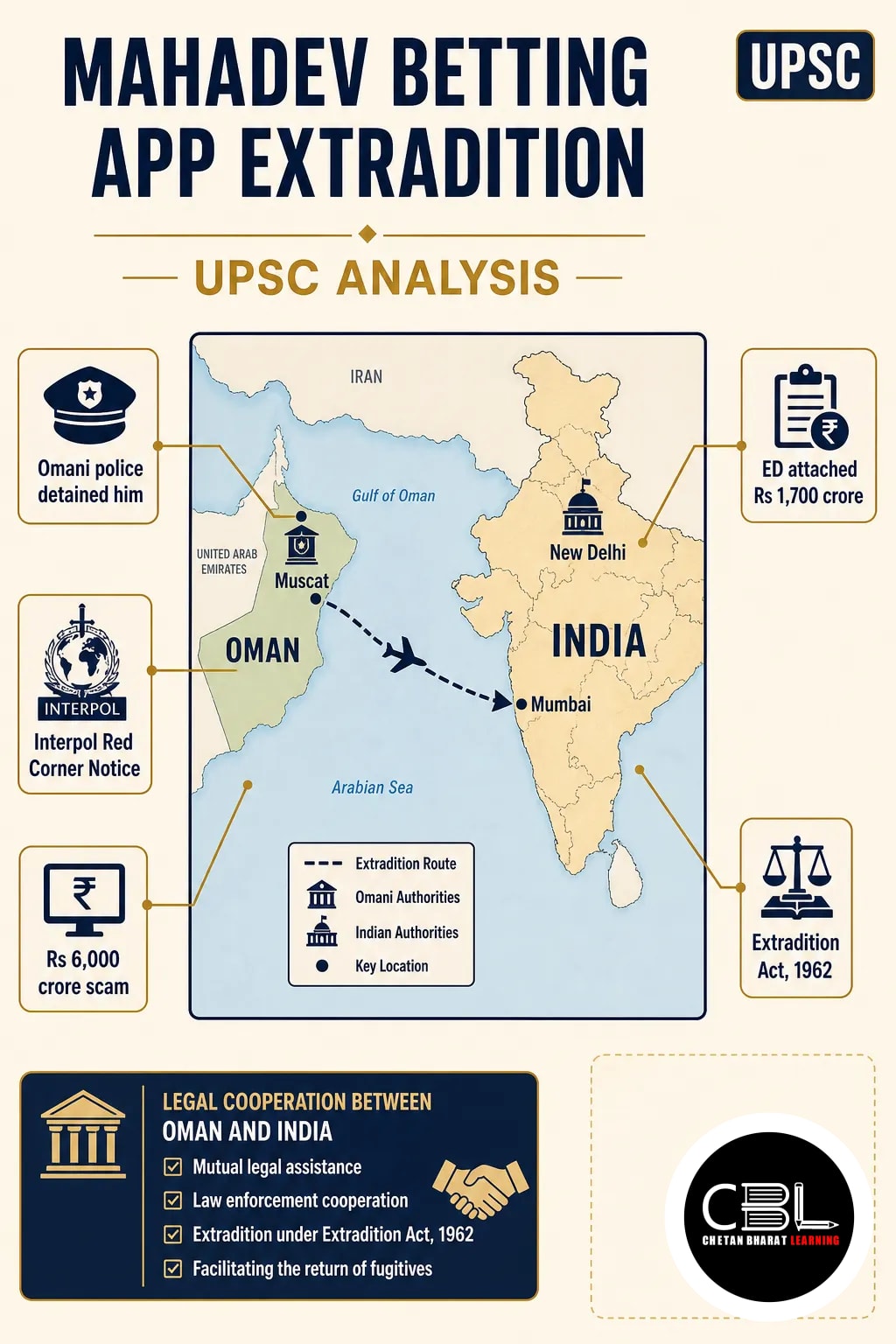

Mahadev betting app extradition has brought key accused Saurabh Chandrakar back to India from Oman. The case connects online gambling allegations with money laundering and cross-border enforcement, themes relevant to national security and governance.
Quick answer: In the Mahadev betting app extradition, a Central Bureau of Investigation team brought promoter Saurabh Chandrakar from Oman to India on Sunday. He faces cases connected to an alleged Rs 6,000-crore illegal betting and money laundering operation. Omani police detained him after an Interpol notice, and Indian agencies sought his extradition.
What happened in the Mahadev betting app extradition?
Indian agencies secured Chandrakar’s return after the Royal Oman Police located and detained him. The Central Bureau of Investigation (CBI) said the detention followed an Interpol Red Corner Notice.
Indian authorities had sought to trace him since 2023. The Enforcement Directorate (ED) then found he was in Oman, prompting coordination with Omani authorities. Subsequently, the CBI and ED submitted formal extradition proposals with evidence.
The CBI said Chandrakar would undergo a medical examination. After transit remand, the agency planned to take him to Raipur and produce him before the CBI Special Judge. Extradition is not a finding of guilt; the allegations remain subject to judicial proceedings.
What do investigators allege?
The CBI alleges that the Mahadev Online Book syndicate ran an illegal betting operation from outside India. It took up the investigation at the Chhattisgarh government’s request.
According to the agency, proceeds passed through numerous mule bank accounts and multiple transactions before moving abroad through hawala channels. A mule account receives or transfers funds for another person, potentially obscuring the beneficial actor. Hawala transfers value through informal networks outside conventional banking channels.
The CBI also alleges that part of the proceeds financed protection payments to public servants. However, these claims must be tested through the legal process. In March, the ED attached assets worth Rs 1,700 crore, including Dubai villas and apartments.
| Case detail | Reported position |
|---|---|
| CBI proceedings | Chargesheets filed in two cases |
| ED proceedings | Prosecution complaint lodged in one case |
| Attached assets | Rs 1,700 crore, including Dubai properties |
How do extradition and an Interpol notice differ?
Extradition transfers a person between countries for prosecution or punishment, whereas an Interpol notice supports international police cooperation. The Extradition Act, 1962 provides India’s statutory framework for extradition.
A Red Notice asks law enforcement agencies worldwide to locate and provisionally arrest a person, subject to national law. It is not itself an international arrest warrant. Therefore, locating a person and obtaining extradition are distinct steps.
In this case, Indian agencies coordinated with the Interpol National Central Bureau and Omani authorities. The notice aided the location and detention; formal proposals then supported the extradition request.
Which laws are relevant to the investigation?
The reported chargesheets invoke corruption, criminal offence and state gambling provisions. The table separates those reported charges from the broader legal framework for extradition and laundering.
| Act or law | Relevance |
|---|---|
| Prevention of Corruption Act, 1988 | Cited in the CBI chargesheets; addresses specified corruption offences. |
| Bharatiya Nyaya Sanhita | The chargesheets cite provisions on criminal conspiracy, cheating and forgery. |
| Chhattisgarh Gambling (Prohibition) Act | The CBI chargesheets also invoke this state gambling law. |
| Prevention of Money-laundering Act, 2002 | Provides the framework for investigating money laundering and dealing with proceeds of crime. |
| Extradition Act, 1962 | Provides India’s legal framework for extradition. |
Why is the case significant for internal security?
The case illustrates how online operations can span jurisdictions while their alleged financial trail passes through Indian accounts. Consequently, investigators must connect digital evidence, account holders and persons directing transactions.
The alleged sequence also illustrates layering: moving funds through transactions to make their origin harder to trace. Moreover, overseas property attachment and prosecution serve different purposes; attachment preserves assets under legal processes, while courts determine criminal liability.
The Financial Action Task Force (FATF) sets international standards against money laundering and terrorist financing. Its risk-based approach highlights cooperation and scrutiny of suspicious transactions. However, the source does not allege that this case financed terrorism.
What challenges and responses does the case highlight?
Cross-border evidence gathering and identification of the people controlling funds are central challenges. A coordinated response must also protect due process.
- Financial trails: Multiple accounts and transactions complicate tracing; therefore, agencies should link account records with evidence of control.
- International cooperation: Evidence and assets may lie abroad; consequently, timely requests and cooperation with foreign authorities matter.
- State–Centre coordination: The Chhattisgarh request shows why state police and central agencies need clear information-sharing channels.
- Prosecution and safeguards: Investigators should preserve admissible digital and financial evidence while respecting court supervision and the accused’s rights.
Overall, the Mahadev betting app extradition demonstrates the value of cooperation, but effective prosecution still depends on proving the alleged offences in court.
Source: The Indian Express, 1 November 2026
Asked in UPSC: Previous Year Questions
- UPSC CSE Mains 2021 (GS Paper III): How do emerging technologies and globalisation contribute to money laundering? Elaborate national and international measures to tackle it.
UPSC links money laundering with technology and globalisation; therefore, revise both domestic and international responses.
State PCS General Studies can test gambling laws, financial crime and coordination between state police and central agencies. In addition, candidates should distinguish a Red Notice from extradition.
Prelims Practice Corner
Mains Practice Questions
Frequently Asked Questions
Who is Saurabh Chandrakar?
Saurabh Chandrakar is a promoter of Mahadev Online Book and a key accused in the case. Indian agencies brought him from Oman following an extradition request.
Is an Interpol Red Notice an international arrest warrant?
No, a Red Notice is a request to locate and provisionally arrest a person, subject to national law. Therefore, extradition requires a separate legal process.
What is the alleged value of the Mahadev betting scam?
The reported alleged scam is worth Rs 6,000 crore. Separately, the ED attached assets worth Rs 1,700 crore in the case.
Does extradition establish guilt?
No, extradition transfers a person for legal proceedings and does not establish guilt. The court must determine liability on the evidence.
Related Current Affairs
Preparing for UPSC, PCS or HCS?
Talk to a mentor at Chetan Bharat Learning, Chandigarh. Free guidance on choosing the right exam and building a study plan.
Chat on WhatsAppCall 97793 53345UPSC / IAS / PCS coaching in Chandigarh · Trusted by aspirants across Punjab & Haryana

 Ananya RanaIAS · AIR 60
 Aditya SharmaIAS · AIR 70
 Ria Kaur SethiIPS · AIR 89
 Aman AloonIRS · AIR 295
 Sumer Singh VirkIRS · AIR 335
 Shivani PanchalIAS

Leave a Reply
You must be logged in to post a comment.