
UPSC Mapping
| Prelims | Polity and Governance |
|---|---|
| Mains | GS Paper 2 (Polity) |
| Recommended By | Law Commission (255th Report) |
|---|---|
| Current Status | Under Supreme Court scrutiny |
| Primary Objective | Prevent post-election intimidation |
What is the Totaliser Machine?
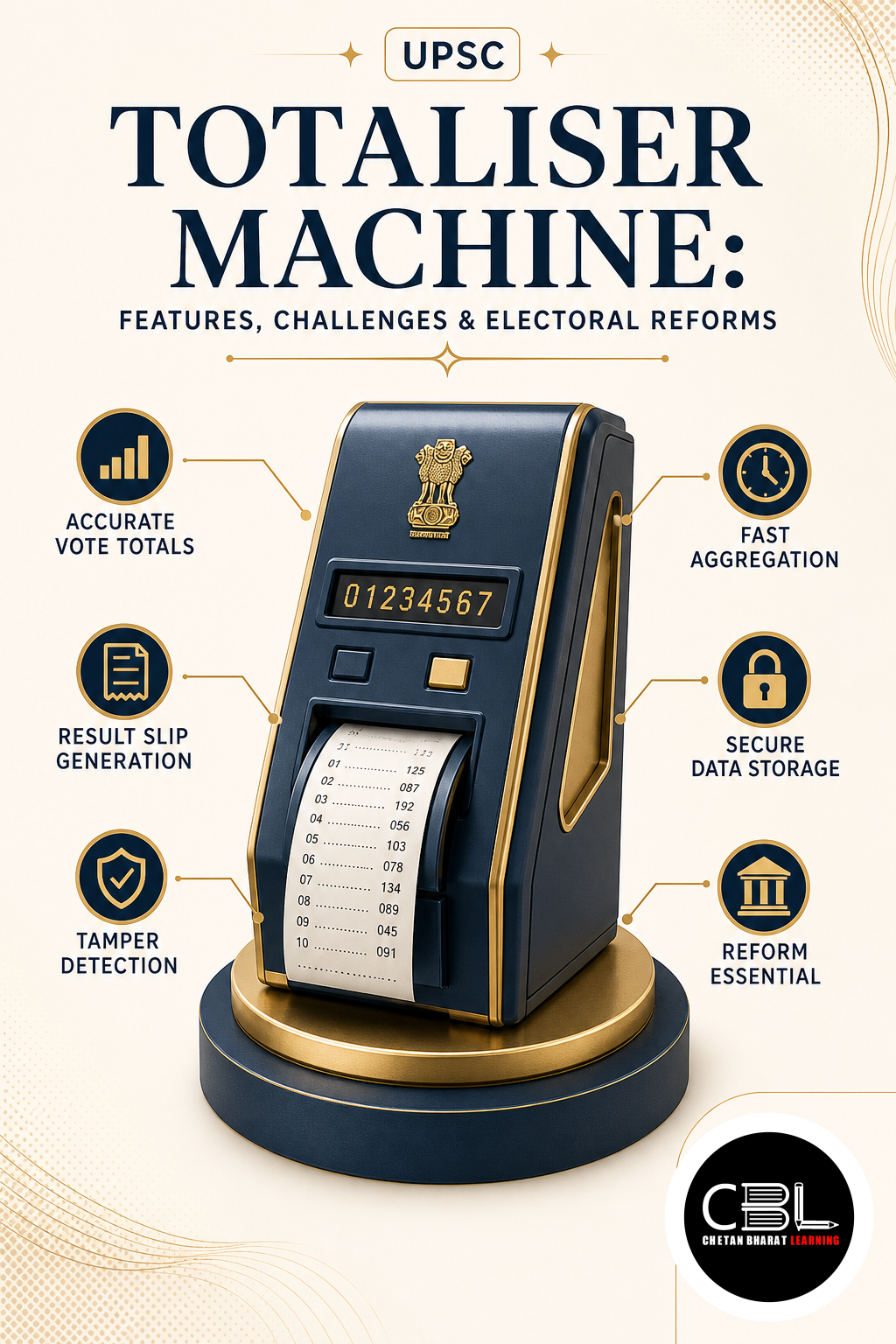
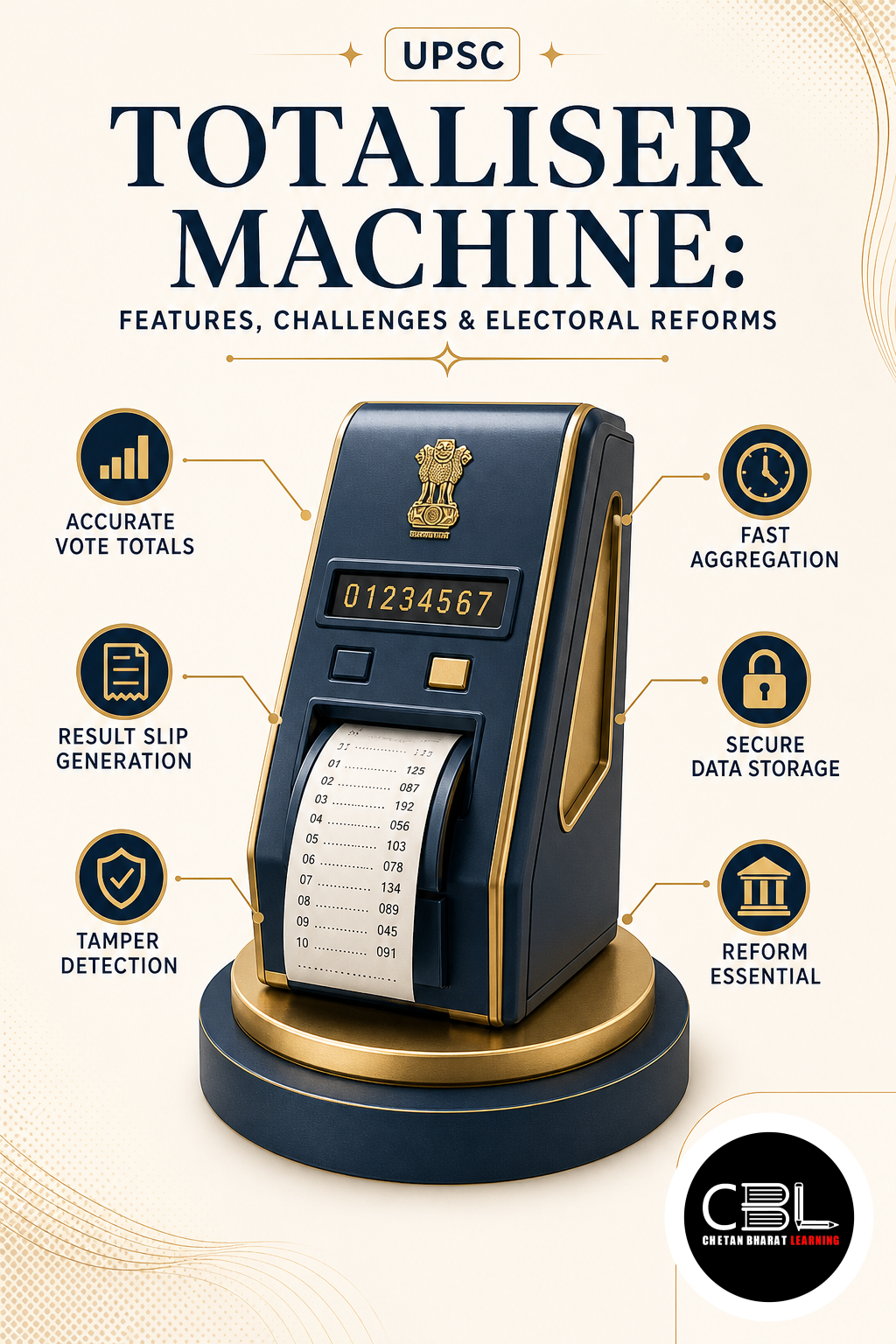
The Totaliser Machine operates as an electronic device that aggregates votes recorded across multiple Electronic Voting Machines. Instead of revealing the result of each individual polling station separately, it combines the data into a single tally. This process ensures political parties only know the total votes a candidate received from a grouped cluster of booths. The Election Commission of India has historically supported this innovation to safeguard vulnerable voters in sensitive areas.
This concept is not entirely new to Indian electoral history. Rule 59A of the Conduct of Elections Rules, 1961, previously provided for the aggregation of paper ballots in specific circumstances involving apprehension of intimidation. The modern Totaliser Machine adapts this protective principle for the digital age. It functions strictly as a counting aid without altering the fundamental voting process or the sanctity of the Voter Verifiable Paper Audit Trail. The device merely delays the disaggregation of data until after the final result declaration.
The Law Commission of India explicitly endorsed this mechanism in its 255th Report published in 2015. The Commission argued that booth-wise results often expose local voting patterns, making minority communities or political dissenters easy targets for retribution. By masking individual booth data, the totaliser creates a protective shield around the voter’s choice. This institutional backing provides a strong constitutional foundation for its potential implementation.
Why is the Totaliser Machine in News?
The Totaliser Machine recently gained prominence after the Supreme Court actively sought the Union Government’s stance on its widespread implementation. Petitioners argued that current booth-wise counting results expose voters to severe post-election intimidation and victimization. The ongoing debate highlights a growing public demand for stricter voter anonymity during the crucial counting phase.
Furthermore, the Election Commission has previously indicated its willingness to introduce totalisers on a pilot basis. However, the lack of explicit statutory authorization in the Representation of the People Act, 1951, has stalled progress. The government must now balance the legitimate need for voter protection with the competing demand for electoral transparency. This legal ambiguity places the judiciary in a pivotal role to interpret the boundaries of electoral secrecy.
Recent political developments in various states have reignited concerns about booth-wise victimization. Localized political monopolies often use granular voting data to identify and penalize dissenting neighborhoods. The introduction of the totaliser directly addresses this systemic vulnerability. It forces political actors to focus on broader demographic appeals rather than micro-targeting specific polling stations for retribution.
Key Features
- Data Aggregation: It combines vote counts from multiple EVMs, typically grouping ten to fifteen machines, before displaying the final tally.
- Booth Anonymity: It completely masks the voting pattern of individual polling stations, preventing the identification of local political preferences.
- Statutory Precedent: It aligns with the protective spirit of Rule 59A of the Conduct of Elections Rules, 1961, which allowed paper ballot aggregation.
- Non-Intrusive Operation: The device functions solely during the counting phase and does not interfere with the actual voting process or VVPAT generation.
- Targeted Deployment: The Election Commission can strategically deploy totalisers only in politically sensitive or conflict-prone constituencies.
Challenges
- Weakens Booth-Wise Verification: Aggregating multiple EVMs makes it difficult to identify the specific machine responsible for a discrepancy, complicating routine verification.
- VVPAT Verification Concerns: Totalisation may severely complicate existing booth-wise and machine-wise verification mechanisms involving VVPAT slips and Form 17C.
- Transparency Versus Secrecy Dilemma: While booth-wise results help parties analyze legitimate electoral trends, totalisers prioritize voter privacy by concealing such granular data.
- Lack of Clear Statutory Framework: The Election Commission has pointed to the absence of explicit legal provisions authorizing totalisers, necessitating complex parliamentary amendments.
- Operational Complexity: Training counting staff to handle grouped machines increases the risk of human error during the high-pressure counting process.
Way Forward
To maximize the benefits of the totaliser concept, the government must prioritize comprehensive legislative amendments. Parliament should explicitly define the conditions under which the Election Commission can deploy these devices. Providing clear statutory backing will eliminate legal ambiguities and prevent protracted judicial battles. Strengthening the technical capabilities of VVPAT verification protocols will also ensure that aggregation does not compromise auditability.
Additionally, conducting limited pilot projects in identified sensitive constituencies could provide valuable empirical data. Policymakers should establish clear guidelines to mandate transparent reporting of the grouping methodology used during counting. A robust, transparent, and legally sound system will ultimately strengthen India’s democratic framework.
Continuous public awareness campaigns will further refine the operational acceptance of this reform. The success of this initiative depends entirely on maintaining strict procedural integrity. India has the opportunity to set a global benchmark for protecting voter anonymity. Future iterations of the policy must remain adaptable to emerging technological capabilities in vote counting.
Prelims Practice Corner
- Q1. With reference to the Totaliser Machine, consider the following statements:
1. It aggregates votes from multiple EVMs to mask booth-wise voting patterns.
2. Its use is currently mandated by the Representation of the People Act, 1951.
3. The Law Commission recommended its use in its 255th Report.
Answer: (b) 1 and 3 only. - Q2. Rule 59A of the Conduct of Elections Rules, 1961, is significant in the totaliser debate because it:
(a) Mandates the use of VVPAT in all constituencies
(b) Provided for the aggregation of paper ballots in specific circumstances
(c) Defines the penalty for electoral malpractice
(d) Regulates the Model Code of Conduct.
Answer: (b) Provided for the aggregation of paper ballots. - Q3. What is the primary argument against the widespread use of the Totaliser Machine?
(a) It increases the cost of elections significantly
(b) It weakens booth-wise verification and complicates VVPAT matching
(c) It requires internet connectivity for operation
(d) It is banned under international electoral standards.
Answer: (b) Weakens booth-wise verification. - Q4. Which constitutional or statutory body is primarily responsible for proposing and implementing electoral reforms like the Totaliser Machine?
(a) Ministry of Home Affairs
(b) Election Commission of India
(c) Supreme Court of India
(d) Law Ministry.
Answer: (b) Election Commission of India. - Q5. The debate surrounding the Totaliser Machine primarily revolves around the conflict between:
(a) Federalism and Unitary governance
(b) Electoral transparency and voter secrecy
(c) Judicial review and Executive privilege
(d) Digital India and traditional voting.
Answer: (b) Electoral transparency vs. voter secrecy.
Mains Practice Questions
- Q1. Discuss the significance of the Totaliser Machine in protecting voter secrecy. What are the operational challenges in its implementation? (150 words, 10 marks)
Answer Structure:- Intro: Define the Totaliser Machine and its objective of aggregating EVM data to prevent booth-wise intimidation.
- Body: Significance (protects vulnerable voters, aligns with Rule 59A) and challenges (weakens verification, VVPAT issues, lack of statutory framework).
- Conclusion: Suggest pilot testing and legislative clarity.
- Q2. The introduction of the Totaliser Machine represents a conflict between electoral transparency and voter secrecy. Critically analyze this statement. (250 words, 15 marks)
Answer Structure:- Intro: Contextualize the debate between granular data needs and voter protection.
- Body: Analyze transparency argument (booth-wise data, VVPAT audit) vs. secrecy argument (prevents intimidation, protects minorities).
- Conclusion: Advocate targeted deployment with statutory backing.
FAQs on Totaliser Machine
- What is the primary function of a Totaliser Machine?
- The primary function is to aggregate vote counts from multiple Electronic Voting Machines before displaying the final tally, preventing disclosure of booth-wise patterns.
- Is the use of Totaliser Machines currently mandatory in India?
- No. The Election Commission has proposed their use, but the lack of explicit statutory authorization in the Representation of the People Act, 1951, has stalled implementation.
- How does the Totaliser Machine affect VVPAT verification?
- It complicates verification because aggregated data makes matching specific VVPAT slips to individual EVMs difficult, weakening the booth-wise audit trail.
Related Current Affairs
Preparing for UPSC, PCS or HCS?
Talk to a mentor at Chetan Bharat Learning, Chandigarh. Free guidance on choosing the right exam and building a study plan.
Chat on WhatsAppCall 97793 53345UPSC / IAS / PCS coaching in Chandigarh · Trusted by aspirants across Punjab & Haryana
Leave a Reply
You must be logged in to post a comment.