

UPSC Mapping
Prelims
- Environment & International Relations
Mains
- GS Paper II
- GS Paper III
Quick Facts
| Host City | Ulaanbaatar, Mongolia |
|---|---|
| Theme | Restoring Land. Restoring Hope. |
| India’s Restoration (2011–20) | 21.76 million ha |
What is UNCCD COP17?
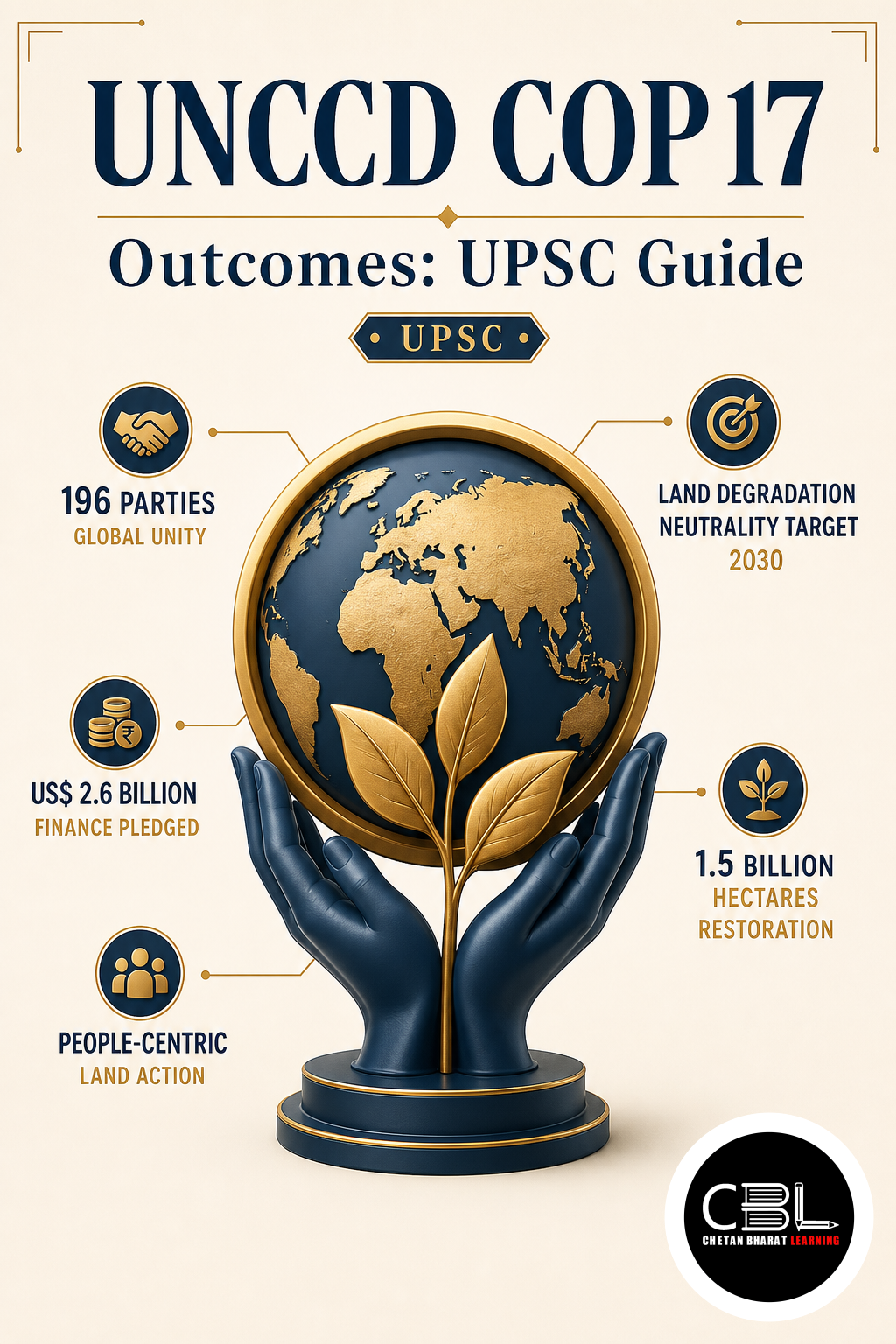
UNCCD COP17 is the 17th session of the Conference of the Parties to the United Nations Convention to Combat Desertification, held in Ulaanbaatar, Mongolia. The convention is one of the three Rio Conventions, alongside UNFCCC and CBD, focusing on land degradation, desertification, and drought. COP17 took place against the backdrop of the UN International Year of Rangelands and Pastoralists (IYRP 2026).
The conference adopted the theme “Restoring Land. Restoring Hope.” to galvanise action on land restoration and drought resilience. Over 190 countries participated, with a strong emphasis on rangeland conservation, the land-water nexus, and nature-based infrastructure solutions.
Why is UNCCD COP17 in News?
UNCCD COP17 is in the spotlight for several key outcomes. The conference launched the Rangelands Valuation Report which valued rangeland ecosystem services at $21–47 trillion annually and highlighted restoration returns of $4–6 per dollar invested. It also adopted the Steppe Action Agenda, converting political commitments into measurable restoration projects.
India played a prominent role, presenting its second progress report on the Bonn Challenge, showing that 21.76 million hectares of degraded land were restored between 2011–2020, generating 1.22 billion person-days of employment. India also launched the first-ever guide to Open Natural Ecosystems (ONEs).
Key Features of UNCCD COP17 Outcomes
- Steppe Action Agenda: A platform to implement rangeland conservation, land-water nexus, and nature-based solutions.
- Rangelands Valuation Report: Provided economic valuation and restoration cost-benefit analysis.
- Drought Resilience Capacity Index (DRCI): A UNEP tool to help nations assess drought preparedness.
- FRAME-ECO methodology: Developed by UNEP, UNDRR, and UNU-EHS to integrate ecosystem losses into Land Degradation Neutrality monitoring.
- Ulaanbaatar Declaration: Committed local and regional leaders to sustainable land management and drought resilience.
Challenges Highlighted at UNCCD COP17
- Finance gap: Private sector provides only 6% of global financing for land degradation and drought, far below needs.
- Reactive spending: Most funding goes to post-disaster relief rather than proactive land management.
- Policy integration gap: Rangelands appear in only 24 NDCs, limiting climate-land synergy.
- Afforestation bias: Inappropriate tree planting continues to damage natural grasslands.
- Data and capacity gaps: Many developing countries lack robust monitoring systems for land degradation.
Way Forward from UNCCD COP17
The outcomes of UNCCD COP17 provide a clear roadmap for action. Countries must integrate concrete rangeland targets into their NDCs and mobilize diversified, predictable financing. The DRCI and FRAME-ECO tools offer technical support for monitoring and planning. India’s experience with green bonds and the Green Credit Program can serve as a financing model for other nations.
Strengthening community-led governance and securing pastoral land rights are equally essential. The Ulaanbaatar Declaration commits local leaders to action, and the upcoming IYRP 2026 will maintain momentum.
Prelims Practice Corner
Q1. Where was the 17th Conference of the Parties (COP17) to the UNCCD held?
(a) New Delhi (b) Ulaanbaatar (c) Nairobi (d) Geneva
Q2. What is the theme of UNCCD COP17?
(a) Land for Life (b) Restoring Land. Restoring Hope. (c) Drought and Desertification (d) Sustainable Land Management
Q3. How much degraded land did India restore between 2011 and 2020, as per its second progress report?
(a) 10 million ha (b) 21.76 million ha (c) 26 million ha (d) 30 million ha
Q4. What is the Drought Resilience Capacity Index (DRCI) developed by UNEP?
(a) A tool to measure drought impacts (b) A tool to assess drought preparedness capacity (c) A funding mechanism for drought relief (d) A treaty on water sharing
Q5. Which declaration was adopted at the Mayors’ Forum during UNCCD COP17?
(a) Paris Declaration (b) Ulaanbaatar Declaration (c) Nairobi Declaration (d) Geneva Declaration
Mains Practice Questions
Q1. Discuss the major outcomes of UNCCD COP17 and their implications for India’s land restoration efforts. (15 marks)
Answer Structure:
- Intro: Briefly introduce UNCCD and the significance of COP17.
- Body: Highlight key outcomes—Steppe Action Agenda, valuation report, DRCI, FRAME-ECO, Ulaanbaatar Declaration. Discuss India’s progress and its guide to ONEs. Analyse implications for policy, financing, and community engagement.
- Conclusion: Emphasise the need for integrated land-water-climate action and domestic policy alignment.
Q2. Evaluate the role of international cooperation in combating desertification and land degradation, with reference to UNCCD COP17. (10 marks)
Answer Structure:
- Intro: Mention UNCCD as a key international framework.
- Body: Discuss cooperation mechanisms: knowledge sharing, financing, policy dialogues, and community partnerships. Evaluate strengths and gaps.
- Conclusion: Stress the importance of inclusive, multi-stakeholder approaches and sustained political will.
FAQs on UNCCD COP17
What is UNCCD?
The United Nations Convention to Combat Desertification (UNCCD) is one of the three Rio Conventions, focusing on land degradation, desertification, and drought in arid, semi-arid, and dry sub-humid areas.
What is the significance of the Steppe Action Agenda adopted at COP17?
The Steppe Action Agenda converts political commitments into measurable restoration projects, focusing on rangeland conservation, the land-water nexus, and nature-based infrastructure solutions.
How did India perform on its Bonn Challenge target?
India restored 21.76 million hectares between 2011 and 2020, reaching 84% of its 26-million-hectare target set for 2030, and generated 1.22 billion person-days of employment.
Related Current Affairs
Preparing for UPSC, PCS or HCS?
Talk to a mentor at Chetan Bharat Learning, Chandigarh. Free guidance on choosing the right exam and building a study plan.
Chat on WhatsAppCall 97793 53345UPSC / IAS / PCS coaching in Chandigarh · Trusted by aspirants across Punjab & Haryana
Leave a Reply
You must be logged in to post a comment.