

UPSC Mapping
- Prelims: Health and Government Schemes
- Mains: GS Paper 2 – Health and Social Justice
What is the TB Free India Mission?
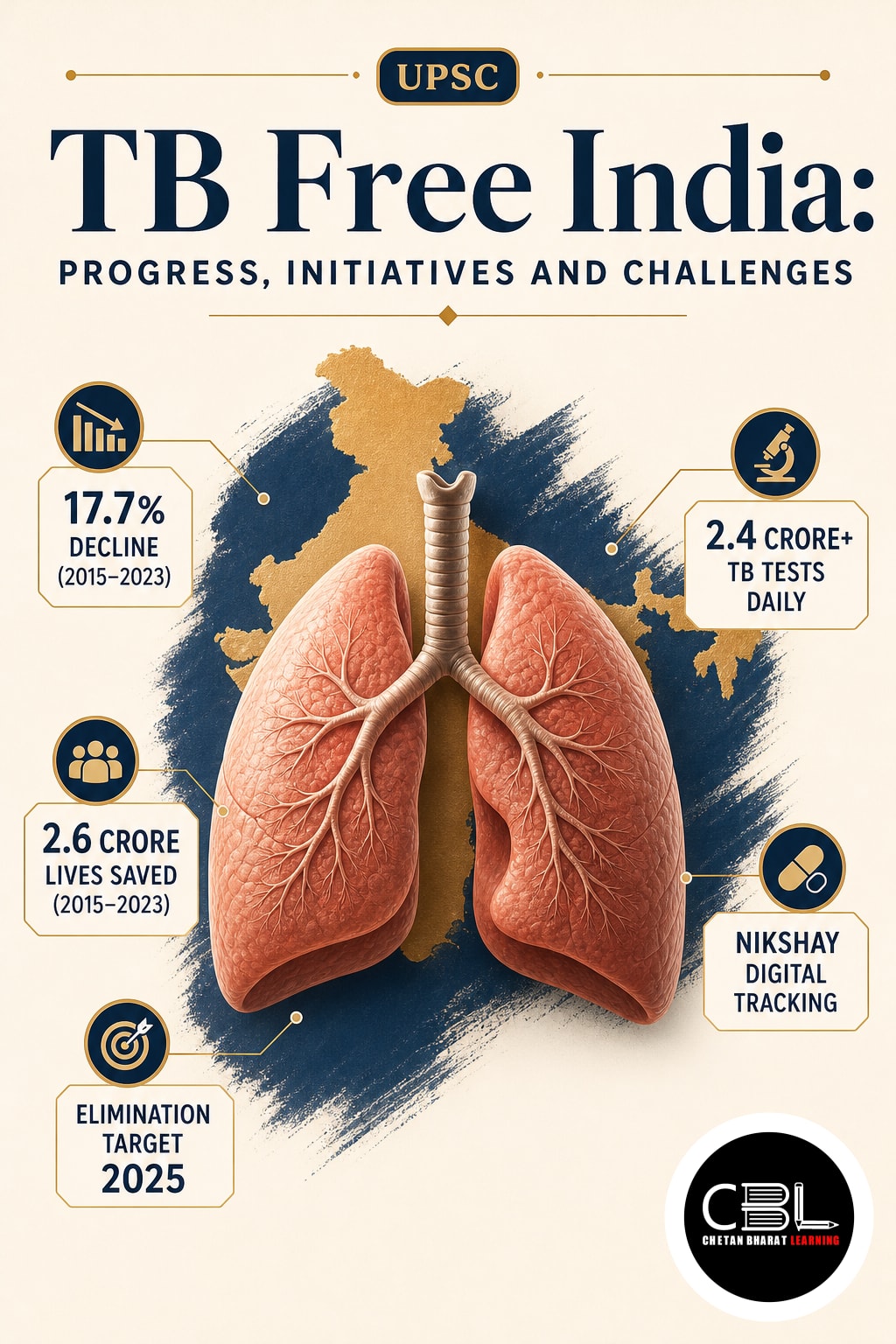
India adopted an ambitious national goal to eliminate tuberculosis by 2025, five years before the global Sustainable Development Goal timeline. The National Tuberculosis Elimination Programme (NTEP) leads national efforts through early detection, effective treatment, preventive care and stronger health systems.
Although India has made progress, the original 2025 elimination target has not been achieved. The strategy increasingly treats tuberculosis as a medical, nutritional and socioeconomic challenge requiring coordinated action.
What is Tuberculosis?
Tuberculosis (TB) is an infectious disease caused by the bacterium Mycobacterium tuberculosis. It mainly affects the lungs but can also damage the brain, spine, kidneys and lymph nodes. Pulmonary TB spreads through airborne particles released by individuals with active disease.
- Latent TB infection: Bacteria remain in the body without causing active disease. Individuals with latent infection do not transmit TB.
- Active TB: Bacteria multiply and cause illness, requiring appropriate treatment.
- Pulmonary and extrapulmonary TB: Disease may affect the lungs or organs outside the lungs.
- Drug-resistant TB: Some bacterial strains resist standard medicines. Multidrug-resistant TB involves resistance to at least isoniazid and rifampicin.
Why in News?
The government introduced the JOSH campaign to strengthen community mobilisation against tuberculosis. It covers 55 districts in 11 states and encourages youth networks, NCC cadets and local institutions to participate in public awareness activities.
The initiative reflects the broader shift from hospital-centred disease management to a Jan Andolan, or people’s movement. Community involvement can encourage symptom reporting, reduce stigma and improve treatment adherence.
Key Findings: Tuberculosis in India
India has recorded measurable improvements in tuberculosis control. The figures below summarise the progress highlighted in government updates and WHO estimates.
| Indicator | Reported Progress |
|---|---|
| Estimated incidence, 2015 | 236.7 per 100,000 population |
| Estimated incidence, 2024 | 186.6 per 100,000 population |
| Incidence reduction, 2015–2024 | Approximately 21% |
| Mortality reduction, 2015–2024 | 28% |
| Treatment coverage | 92% |
| Reported treatment success | 90% |
| TB-Free Panchayat certifications | Over 46,118 reported by 2026 |
Source: Ministry of Health and Family Welfare and WHO estimates as presented in the reported article. Incidence measures estimated new and relapse cases per population, not the absolute number of cases. More information: WHO Global Tuberculosis Reports.
Key Government Initiatives
- Pradhan Mantri TB Mukt Bharat Abhiyaan: Encourages community participation through Ni-kshay Mitras, who support patients with nutritional assistance and other forms of care.
- Ni-kshay Poshan Yojana: Provides eligible notified TB patients with ₹1,000 monthly nutritional assistance during treatment.
- BPaLM treatment regimen: Introduces a shorter, six-month, all-oral treatment option for eligible patients with drug-resistant TB using bedaquiline, pretomanid, linezolid and moxifloxacin.
- AI-supported screening: Digital chest X-rays and AI-assisted interpretation help identify people who require confirmatory testing.
- Molecular diagnostics: CBNAAT and Truenat technologies improve the speed of diagnosis and detection of certain forms of drug resistance.
- TB-Free Panchayat Initiative: Promotes local accountability, awareness, case identification and community participation in elimination efforts.
The TB Free India strategy combines these interventions with enhanced surveillance, preventive therapy and patient-centred care. Official policy updates are available through the Central TB Division.
Challenges to Tuberculosis Elimination
- Underreporting in private healthcare: Incomplete notification and inconsistent treatment practices can delay diagnosis and weaken surveillance.
- Undernutrition: Inadequate dietary intake increases vulnerability to TB disease and complicates recovery, particularly among economically disadvantaged populations.
- Drug resistance: Treatment interruptions and inappropriate prescriptions can contribute to resistance and more complex treatment requirements.
- Social stigma: Fear of discrimination can discourage patients from seeking testing or continuing treatment.
- Geographical inequality: Remote, tribal and mountainous communities often face longer journeys to diagnostic and treatment facilities.
- Transmission in crowded settings: Poor ventilation in prisons, workplaces and congested settlements increases airborne infection risks.
These barriers demonstrate why TB elimination cannot depend solely on drug availability. Public health responses must address poverty, housing conditions, nutrition and access to primary healthcare.
Way Forward
- Expand preventive treatment: Improve screening and provide appropriate TB preventive therapy to eligible household contacts and high-risk groups.
- Strengthen private-sector integration: Improve timely notification and coordination through Ni-skshay while safeguarding patient privacy.
- Decentralise molecular testing: Expand access to rapid diagnostics at suitable primary and sub-district healthcare facilities.
- Improve infection prevention: Promote ventilation, respiratory protection and appropriate infection-control measures in high-risk settings.
- Extend social protection: Link treatment with nutritional support, income protection and rehabilitation services for vulnerable patients.
- Build community ownership: Involve Panchayati Raj Institutions, civil society and local volunteers in awareness and treatment support.
The long-term success of tuberculosis elimination requires sustained financing, reliable medicines, accurate surveillance and equitable healthcare access. Public engagement must complement clinical interventions rather than replace them.
Prelims Practice Corner
-
Which microorganism causes tuberculosis?
- (a) Plasmodium vivax
- (b) Mycobacterium tuberculosis
- (c) Vibrio cholerae
- (d) Salmonella Typhi
- Answer: (b) Mycobacterium tuberculosis is the bacterium responsible for TB.
-
Consider the following statements about tuberculosis:
1. Latent TB infection is generally non-infectious.
2. Tuberculosis can affect organs other than the lungs.
3. All forms of tuberculosis are resistant to rifampicin.
Which statements are correct?- (a) 1 only
- (b) 2 and 3 only
- (c) 1 and 2 only
- (d) 1, 2 and 3
- Answer: (c) Statements 1 and 2 are correct. Drug resistance is not present in every TB infection.
-
The Ni-skshay Poshan Yojana primarily aims to provide:
- (a) Free accommodation for health workers
- (b) Scholarships for medical students
- (c) Vaccination assistance to newborns
- (d) Nutritional financial assistance to TB patients
- Answer: (d) The scheme supports notified TB patients through nutritional assistance during treatment.
-
Which of the following drugs is NOT a component of the BPaLM regimen?
- (a) Ethambutol
- (b) Bedaquiline
- (c) Pretomanid
- (d) Linezolid
- Answer: (a) BPaLM consists of bedaquiline, pretomanid, linezolid and moxifloxacin.
-
Which Sustainable Development Goal specifically includes ending the tuberculosis epidemic by 2030?
- (a) SDG 1.2
- (b) SDG 3.3
- (c) SDG 6.1
- (d) SDG 10.4
- Answer: (b) SDG 3.3 calls for ending the epidemics of AIDS, tuberculosis, malaria and certain other communicable diseases by 2030.
Mains Practice Questions
-
India has one of the highest burdens of tuberculosis globally. Examine the major impediments to ending tuberculosis in India and suggest measures to strengthen disease elimination efforts. (15 marks)
Answer Structure:
- Intro: Introduce India’s TB burden, NTEP and the original 2025 elimination target.
- Body: Discuss undernutrition, drug resistance, private-sector underreporting, healthcare gaps and stigma. Evaluate diagnostics, nutritional assistance and community participation.
- Conclusion: Emphasise integrated healthcare, social protection and accountable local implementation.
-
Tuberculosis elimination requires a whole-of-society approach rather than a purely biomedical response. Discuss with reference to recent government initiatives. (10 marks)
Answer Structure:
- Intro: Explain the social and economic dimensions of tuberculosis transmission and treatment.
- Body: Discuss Ni-skshay Mitras, JOSH, Panchayat participation, nutrition, stigma reduction and primary healthcare.
- Conclusion: Highlight the need to combine clinical innovation with community-led public health action.
Frequently Asked Questions
- What is India’s national tuberculosis elimination target?
- India adopted 2025 as its national target for TB elimination, ahead of the global 2030 timeline. The 2025 goal was not achieved, and elimination efforts continue through NTEP and related initiatives.
- What is the JOSH campaign?
- JOSH stands for Joint Squad for Health. The campaign mobilises youth networks, NCC cadets and grassroots communities to strengthen tuberculosis awareness and prevention across 11 states and 55 districts.
- Why is tuberculosis elimination difficult in India?
- Undernutrition, delayed diagnosis, drug resistance, social stigma and unequal access to healthcare remain major obstacles. Sustained elimination efforts must integrate medical treatment with nutritional, social and community support.
Related Current Affairs
Preparing for UPSC, PCS or HCS?
Talk to a mentor at Chetan Bharat Learning, Chandigarh. Free guidance on choosing the right exam and building a study plan.
Chat on WhatsAppCall 97793 53345UPSC / IAS / PCS coaching in Chandigarh · Trusted by aspirants across Punjab & Haryana
Leave a Reply
You must be logged in to post a comment.