

UPSC Mapping
| Prelims | Mains |
|---|---|
| Security & Transport | GS Paper 3 (Internal Security) |
Important Quick Facts
| Rules Effective | Jan 31, 2022 |
|---|---|
| Random Testing | 10% of pilots & ATC |
| Drug Categories | 6 (incl. cannabis, opiates) |
| First Offence Penalty | Rehabilitation |
What is Aviation Drug Testing?
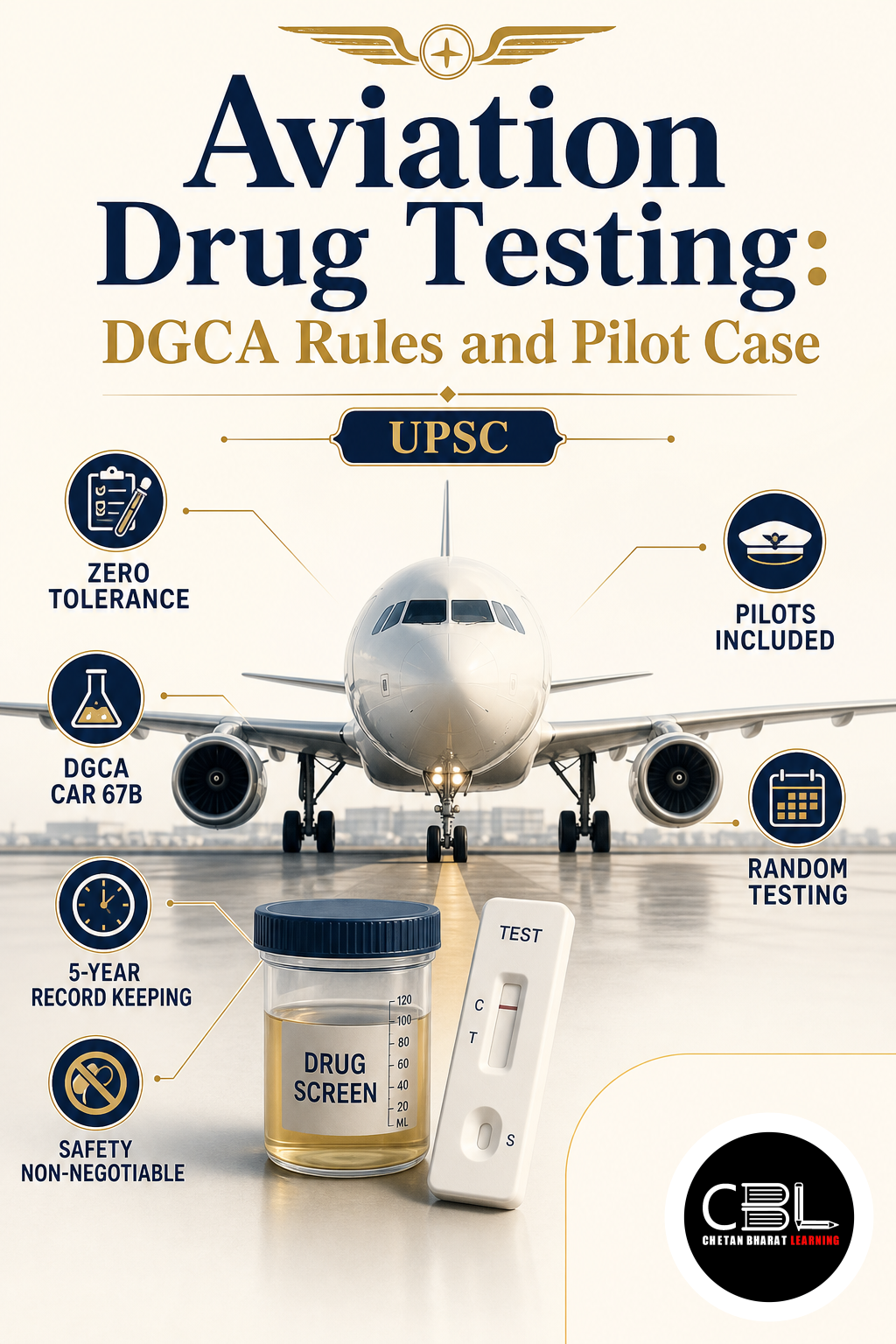
Aviation Drug Testing refers to the mandatory screening of safety-sensitive aviation personnel for psychoactive substances under the DGCA’s Civil Aviation Requirement (CAR) released in September 2021 and implemented from January 31, 2022. The primary focus is on pilots and air traffic controllers, but it also covers maintenance engineers, certifying staff, trainee pilots, instructors, and examiners.
The testing regime requires a 10% annual random check for flight crew and ATC personnel, while others are tested at hiring or after incidents. Urine samples are screened for six categories: amphetamines, opiates, cannabis (THC), cocaine, barbiturates, and benzodiazepines. A non-negative screening leads to immediate removal from duty pending confirmatory lab analysis using GC/MS or LC-MS.
Why is Aviation Drug Testing in News?
Aviation Drug Testing is currently in the spotlight following the Air India incident on the Phuket-Delhi route, where the pilot-in-command’s confirmatory test returned positive for marijuana. The aircraft suffered a sudden 300-feet loss in altitude, injuring 24 passengers, and the Aircraft Accident Investigation Bureau (AAIB) is investigating both the drug result and possible hydraulic snags.
This case underscores the critical role of the DGCA’s drug testing protocol in ensuring aviation safety. It also highlights the graded disciplinary action – rehabilitation for a first offence, three-year licence suspension for a second, and permanent cancellation after a third. For official guidelines, refer to the DGCA website.
Key Features of Aviation Drug Testing
- Mandatory Random Testing: 10% of all pilots and air traffic controllers are randomly tested each year, ensuring a deterrent effect.
- Incident-Based Testing: Any safety-related event, such as an altitude loss or system failure, triggers immediate drug tests for the crew involved.
- Two-Stage Process: A rapid screening test; if non-negative, a confirmatory GC/MS test is performed on a second sample.
- Medical Review Officer (MRO) Check: The MRO verifies whether a positive result could be due to legitimate medication before confirming abuse.
- Graded Penalties: Rehabilitation for the first offence, three-year suspension for the second, and licence cancellation for the third.
Challenges with Aviation Drug Testing
- False Positives: Certain over-the-counter medications can produce false positives for opiates or amphetamines, requiring careful MRO review.
- Rehabilitation Efficacy: The rehabilitation programme for first-time offenders may not be uniformly effective across all organisations.
- Coverage Gaps: While pilots and ATC are covered, other personnel (like cabin crew) are not subject to random testing, though they are tested post-incident.
- Consent and Refusal: Refusal to test is treated as a positive result, but enforcement of this provision can be legally contentious.
- Cost and Logistics: Regular random testing and confirmatory lab work impose significant costs on airlines and training organisations.
Way Forward for Aviation Drug Testing
To strengthen the Aviation Drug Testing regime, the DGCA and airlines must ensure strict compliance with the CAR and expedite the MRO review process to avoid delays in clearing false positives. Regular training for medical staff and increased awareness among personnel about the consequences of substance abuse are also essential.
Additionally, the government could consider expanding random testing to cover more safety-sensitive roles, such as cabin crew and ground handling staff. As substance abuse concerns grow globally, continuous refinement of testing protocols and penalties will be vital to maintain public confidence in aviation safety.
Prelims Practice Corner
Q1. When did the DGCA’s Civil Aviation Requirement on drug testing come into effect?
- (a) September 2021
- (b) January 31, 2022
- (c) April 2022
- (d) October 2022
Answer: (b) The CAR was released in September 2021 but came into effect on January 31, 2022.
Q2. What is the mandatory annual random testing percentage for pilots and air traffic controllers under the DGCA rules?
- (a) 5%
- (b) 10%
- (c) 15%
- (d) 20%
Answer: (b) The rules mandate a 10% annual random testing for flight crew and air traffic controllers.
Q3. Which of the following is NOT one of the six psychoactive substance categories tested in aviation drug screening?
- (a) Amphetamines
- (b) Cannabinoids
- (c) Alcohol
- (d) Barbiturates
Answer: (c) Alcohol is not included in the six categories; it is tested separately, but the CAR covers amphetamines, opiates, cannabis, cocaine, barbiturates, and benzodiazepines.
Q4. What happens to a pilot who tests positive for drug use for the first time under the DGCA rules?
- (a) Licence suspended for 1 year
- (b) Referred for rehabilitation
- (c) Licence cancelled
- (d) Fine of Rs. 1 lakh
Answer: (b) The first offence results in referral to a specialist or de-addiction centre, with return to duty after a negative test.
Q5. What is the penalty for a third offence of confirmed drug use?
- (a) 1-year suspension
- (b) 3-year suspension
- (c) Permanent licence cancellation
- (d) Rehabilitation again
Answer: (c) The third offence leads to permanent cancellation of the licence.
Mains Practice Questions
Q1. Discuss the role of the DGCA’s drug testing framework in ensuring aviation safety, and evaluate its effectiveness in light of recent incidents. (250 words, 15 marks)
Answer Structure:
Intro: Introduce the DGCA’s drug testing CAR and its objective of ensuring a substance-free cockpit.
Body: Discuss the key provisions – random testing, incident-based testing, MRO review, penalties. Evaluate strengths (deterrence, graded penalties) and weaknesses (false positives, limited coverage).
Conclusion: Suggest enhancements like expanded coverage and faster MRO processes.
Q2. What are the ethical and legal challenges in implementing mandatory drug testing for aviation personnel? (150 words, 10 marks)
Answer Structure:
Intro: Frame mandatory testing as a balance between safety and individual rights.
Body: Discuss ethical issues – privacy, informed consent, false positives. Legal challenges – refusal to test, due process in suspensions.
Conclusion: Conclude that transparent procedures and robust MRO oversight can mitigate these challenges.
FAQs on Aviation Drug Testing
What is the DGCA’s drug testing requirement for pilots?
The DGCA requires 10% of pilots and air traffic controllers to undergo random drug testing annually, and all crew involved in safety incidents must be tested.
What happens if a pilot refuses a drug test?
Refusal is treated as a positive result. The pilot is removed from duty and must clear a test within 48 hours; failure leads to suspension.
Are cabin crew also subjected to random drug testing?
No, random testing is mandatory only for flight crew and air traffic controllers. Cabin crew are tested only after safety-related incidents.
Related Current Affairs
Preparing for UPSC, PCS or HCS?
Talk to a mentor at Chetan Bharat Learning, Chandigarh. Free guidance on choosing the right exam and building a study plan.
Chat on WhatsAppCall 97793 53345UPSC / IAS / PCS coaching in Chandigarh · Trusted by aspirants across Punjab & Haryana
Leave a Reply
You must be logged in to post a comment.