

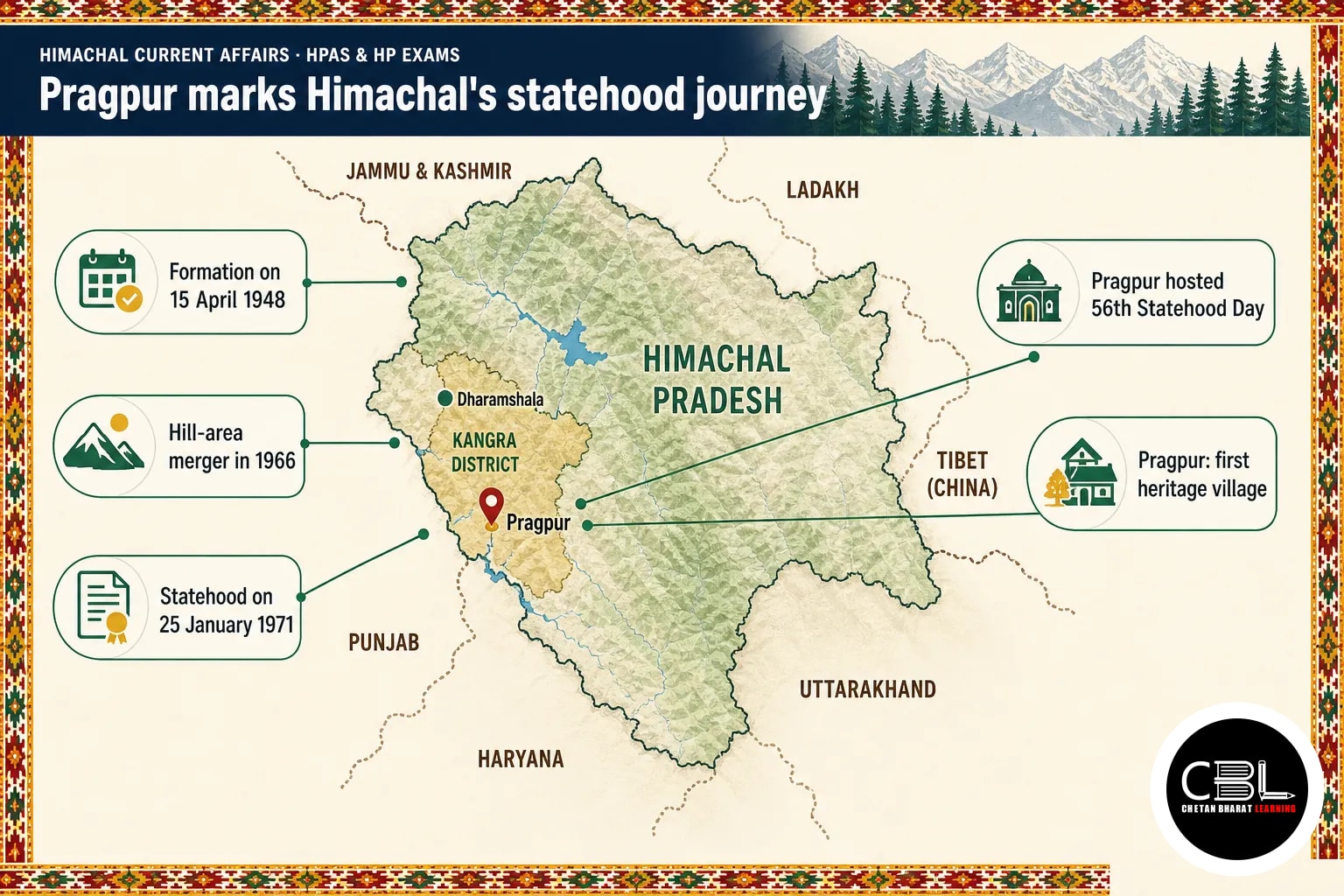
Himachal Pradesh marked its 56th Statehood Day on 25 January 2026 at Pragpur in Kangra district. Chief Minister Sukhvinder Singh Sukhu unfurled the flag and announced a farmers’ commission, pension-related payments and local offices. The day recalls full statehood on 25 January 1971, after Himachal’s formation in 1948 and subsequent territorial changes. The proposed commission was also announced in the state Budget for 2026-27.
Timeline: from hill states to statehood
- 15 Apr1948Formation
Himachal Pradesh emerged from about 30 princely hill states, with four districts.
- 1950and 1954Early changes
Himachal became a Part C state in 1950; Bilaspur merged in 1954.
- 1 Nov1956Union Territory
Himachal became a Union Territory.
- 1 Nov1966Hill merger
Punjab’s hill areas joined Himachal under the Punjab Reorganisation Act, 1966.
- 25 Jan1971Statehood
Under the 1970 Act, Himachal became India’s 18th state.
- 25 Jan2026Pragpur
Kangra district hosted the state-level 56th Statehood Day function.
- Himachal Pradesh was formed on 15 April 1948.
- Full statehood came on 25 January 1971.
- Himachal became India’s 18th state.
- The 2026 state-level function took place at Pragpur in Kangra.
- Y.S. Parmar was Himachal’s first Chief Minister.
How did Himachal Pradesh become a state?
Himachal Pradesh was formed by merging about 30 princely hill states. Its original districts were Chamba, Mandi, Mahasu and Sirmaur. It became a Part C state in 1950, absorbed Bilaspur in 1954 and became a Union Territory in 1956.
In 1966, Punjab’s hill areas, including Kangra, Kullu, Lahaul-Spiti, Shimla and other parts, joined Himachal. The State of Himachal Pradesh Act, 1970 paved the way for full statehood on 25 January 1971. Dr Y.S. Parmar, the first Chief Minister, is known as the architect of Himachal.
Why it matters
Agriculture and Horticulture Commission, also called the State Kisan Commission, was proposed to represent farmers and orchardists.
The announcements included about Rs 90 crore for arrears of pensioners and family pensioners aged 70 and above.
A sub-divisional magistrate (SDM) office at Pragpur and a primary health centre (PHC) at Nalsuha were announced.
- Heritage village: Pragpur was notified as India’s first heritage village in 1997.
- District headquarters: Dharamshala is the headquarters of Kangra district.
- First Chief Minister: Dr Y.S. Parmar is known as the architect of Himachal.
Key data
| Point | Details |
|---|---|
| Formation | 15 April 1948; about 30 princely hill states |
| Original districts | Chamba, Mandi, Mahasu and Sirmaur |
| Punjab hill-area merger | 1 November 1966; Punjab Reorganisation Act, 1966 |
| Statehood | 25 January 1971; 18th state under the State of Himachal Pradesh Act, 1970 |
| 2026 function | 56th Statehood Day at Pragpur, Kangra |
| Pension-related announcements | About Rs 90 crore for eligible pensioners and family pensioners; about Rs 96 crore for additional gratuity and leave encashment arrears of Class IV retirees of 2016–2021 |
| Farm representation | State Kisan Commission proposed; also announced in the 2026-27 Budget |
Way forward
- Farmer representation: Give farmers and orchardists a meaningful voice in the proposed commission.
- Transparent payments: Publish eligibility and payment progress for pension-related arrears.
- Local services: Plan staffing and access for the announced Pragpur office and Nalsuha health centre.
- Ecological care: Assess local infrastructure needs while respecting the fragile Himalayan environment.
- Public awareness: Use statehood commemorations to explain Himachal’s institutional and territorial history.
HPAS Mains practice questions
Explain the stages through which Himachal Pradesh attained full statehood. (150 words)
Answer pointers:
- Begin with formation in 1948.
- Trace Part C status, Bilaspur’s merger and Union Territory status.
- Discuss the 1966 hill-area merger and the 1970 Act.
- Conclude with statehood on 25 January 1971.
Critically examine the governance significance of the announcements made at Pragpur on Statehood Day. (250 words)
Answer pointers:
- Introduce the 56th Statehood Day function.
- Discuss potential representation for farmers and local access to services.
- Consider fiscal demands, implementation capacity and transparent arrears payments.
- Conclude with accountable delivery and ecological safeguards.
As SDM in Kangra district, how would you plan accessible public services around the announced Pragpur office? (150 words)
Answer pointers:
- Identify service needs across nearby communities.
- Coordinate premises, staff and departmental responsibilities.
- Provide accessible information and grievance channels.
- Review delivery regularly and protect local heritage and ecology.
Discuss how Himachal’s statehood journey relates to the reorganisation of states in India. (150 words)
Answer pointers:
- Introduce Himachal’s changing territorial and administrative status.
- Link the 1966 merger to the Punjab Reorganisation Act.
- Explain the role of the State of Himachal Pradesh Act, 1970.
- Conclude with the importance of representative state institutions.
For Himachal Pradesh Administrative Service (HPAS) prelims, memorise the formation and statehood dates, the 1966 merger and Pragpur’s role. Himachal Pradesh Rajya Chayan Aayog (HPRCA) papers may also test the venue and first Chief Minister.
MCQ Practice Corner
Q1. Which law paved the way for Himachal Pradesh’s full statehood in 1971?
(a) Punjab Reorganisation Act, 1966 (b) State of Himachal Pradesh Act, 1970 (c) Government of India Act, 1935 (d) Indian Independence Act, 1947
Show answer
Answer: (b) because the State of Himachal Pradesh Act, 1970 paved the way for statehood.
Q2. Consider the following statements:
1. Himachal Pradesh was formed in 1948.
2. Punjab’s hill areas joined Himachal in 1966.
3. Himachal became India’s 18th state in 1956.
Which statements are correct?
(a) 1 and 2 only (b) 2 and 3 only (c) 1 and 3 only (d) 1, 2 and 3
Show answer
Answer: (a) because Himachal became the 18th state in 1971, not 1956.
Q3. Where was the 2026 state-level Statehood Day function held?
(a) Chamba (b) Pragpur (c) Mandi (d) Kullu
Show answer
Answer: (b) because Pragpur in Kangra hosted the function.
Q4. Who was Himachal Pradesh’s first Chief Minister?
(a) Y.S. Parmar (b) Sukhvinder Singh Sukhu (c) B.R. Ambedkar (d) Jawaharlal Nehru
Show answer
Answer: (a) because Dr Y.S. Parmar was the first Chief Minister.
Frequently Asked Questions
When did Himachal Pradesh become a full state?
Himachal Pradesh became a full state on 25 January 1971. It was India’s 18th state.
Where was Himachal Statehood Day celebrated in 2026?
The state-level function was held at Pragpur in Kangra district. It marked the 56th Statehood Day.
What is the difference between Himachal Day and Statehood Day?
Himachal Day marks formation on 15 April 1948; Statehood Day marks full statehood on 25 January 1971. The two dates commemorate different stages of Himachal’s history.
Sources: The Hawk, Himachal Guardian, News Arena India
Related Current Affairs
More Himachal topics for HPAS & HP exams
Preparing for UPSC, PCS or HCS?
Talk to a mentor at Chetan Bharat Learning, Chandigarh. Free guidance on choosing the right exam and building a study plan.
Chat on WhatsAppCall 97793 53345UPSC / IAS / PCS coaching in Chandigarh · Trusted by aspirants across Punjab & Haryana



Leave a Reply
You must be logged in to post a comment.