
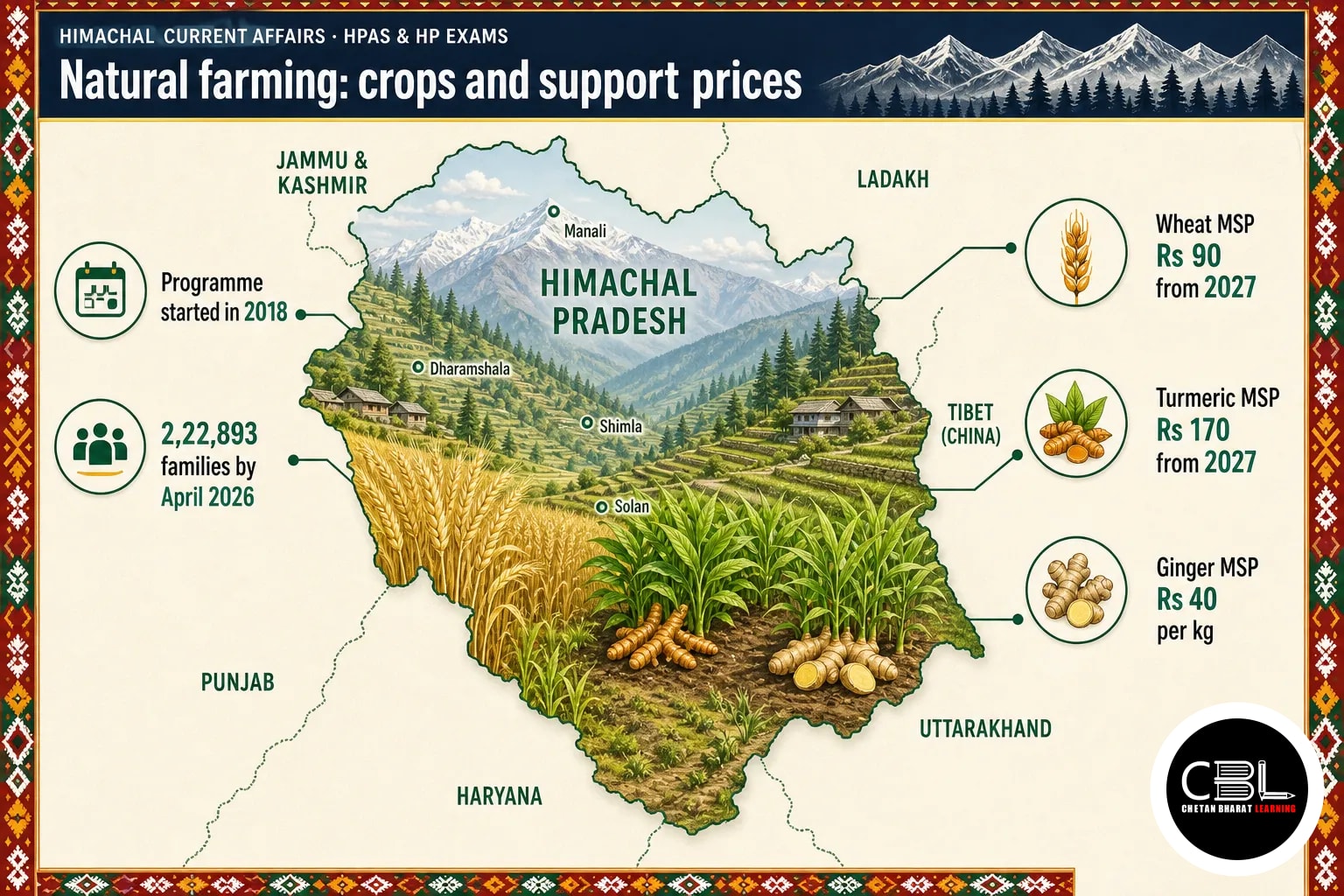
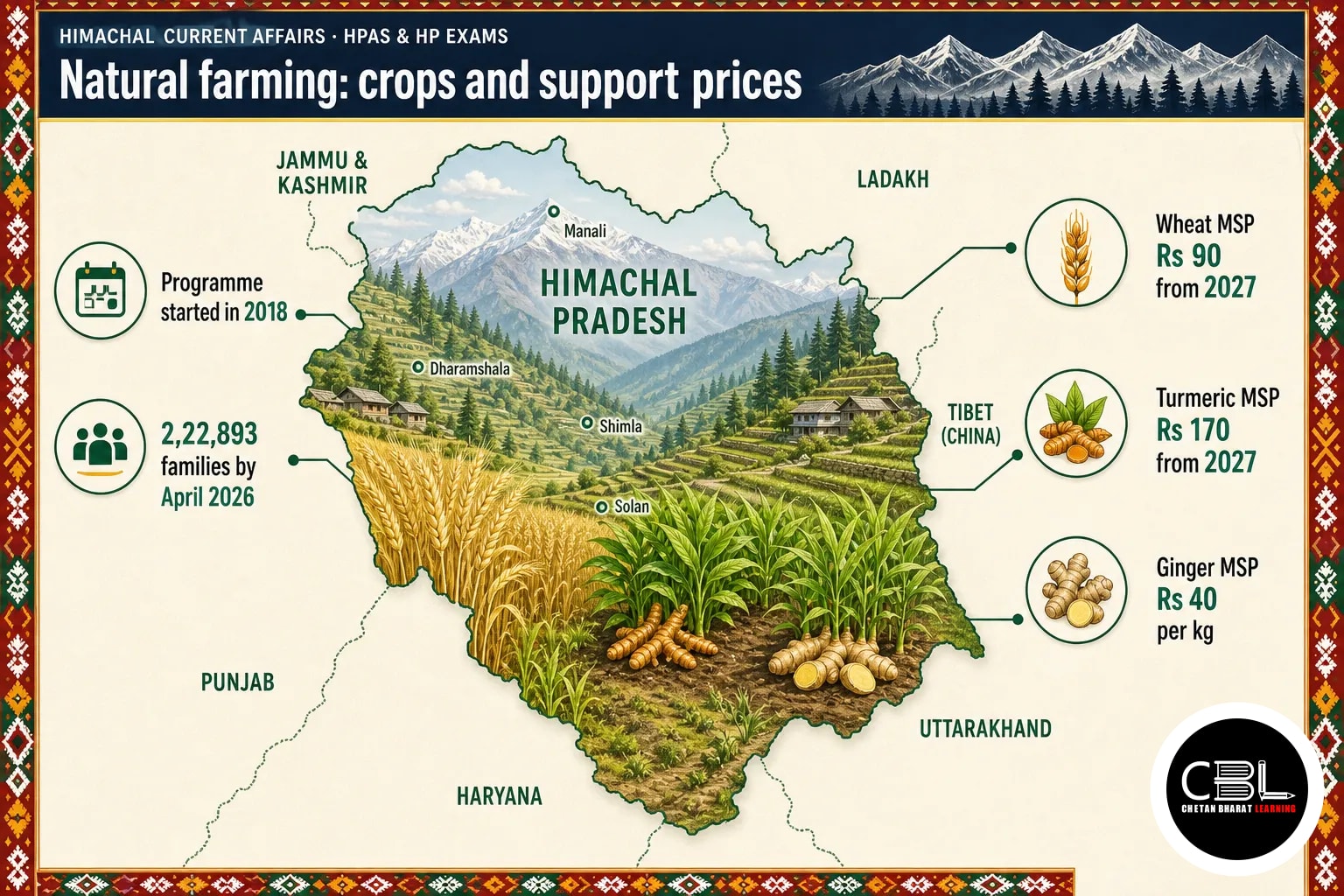
Himachal Pradesh began its natural farming programme in 2018. By April 2026, 2,22,893 farmer and horticulturist families had adopted the approach. The state has announced minimum support prices (MSPs) for selected naturally grown crops. On 19 November 2026, the Chief Minister announced that wheat and turmeric rates would rise to Rs 90 and Rs 170 per kg respectively from 2027. The cabinet had raised the ginger rate earlier that month.
Timeline: the natural farming price journey
- 2018ProgrammeLaunched
Himachal started natural farming under the approach associated with Subhash Palekar.
- 2024Crop pricesPrice support
The state announced MSPs for naturally grown maize and wheat.
- April2026Adoption
2,22,893 farmer and horticulturist families had adopted natural farming.
- 13 Nov2026Ginger hike
The cabinet raised the naturally grown ginger MSP from Rs 30 to Rs 40 per kg.
- 19 Nov2026Next rates
Wheat and turmeric MSPs were announced at Rs 90 and Rs 170 per kg from 2027.
- Himachal started its natural farming programme in 2018.
- MSPs for naturally grown wheat and maize were announced in 2024.
- The ginger MSP was raised to Rs 40 per kg in November 2026.
- The announced wheat MSP from 2027 is Rs 90 per kg.
- Natural farming adoption reached 2,22,893 families by April 2026.
What is the Prakritik Kheti model?
Natural farming emphasises farm practices that reduce reliance on synthetic fertilisers and pesticides. The Himachal programme began with Subhash Palekar Natural Farming and was later called Prakritik Kheti Khushhal Kisan Yojana.
It was subsequently renamed Rajiv Gandhi Prakritik Kheti Khushhal Kisan Yojana. Crop-specific MSP announcements add a price-support dimension to the farming programme. The 2026-27 budget also announced a State Kisan Commission.
Why it matters
Announced support prices can improve price expectations for selected crops. Access to buyers and procurement arrangements also matters for farmers.
Reduced reliance on synthetic inputs can support a less chemical-intensive farming approach. Its effects depend on local practices and soil conditions.
The state must coordinate farmer outreach, crop verification and market access. It targeted one lakh additional farmers for natural farming in 2026.
- District: Hamirpur is a district of Himachal Pradesh, with headquarters at Hamirpur.
- Region: Salooni is in Chamba district, where safed makka is grown.
- Institution: The Himachal Pradesh Agriculture Department administers agricultural programmes in the state.
Key data
| Point | Details |
|---|---|
| Programme start | 2018; initially associated with Subhash Palekar Natural Farming |
| Adoption | 2,22,893 farmer and horticulturist families by April 2026 |
| 2026 target | One lakh more farmers under natural farming |
| Wheat MSP | Earlier raised from Rs 60 to Rs 80 per kg; Rs 90 announced from 2027 |
| Maize MSP | Earlier raised from Rs 40 to Rs 50 per kg |
| Ginger MSP | Raised from Rs 30 to Rs 40 per kg by the cabinet on 13 November 2026 |
| Turmeric MSP | Increase from Rs 150 to Rs 170 per kg announced from 2027 |
Way forward
- Farmer outreach: Offer practical training suited to local crops and hill conditions.
- Transparent access: Explain crop eligibility, verification and procurement procedures in accessible formats.
- Market links: Strengthen collection, storage and connections with reliable buyers.
- Ecological safeguards: Monitor soil health and water use while respecting fragile Himalayan landscapes.
- Evidence and review: Assess farm costs, yields and realised prices before expanding interventions.
HPAS Mains practice questions
Explain Himachal Pradesh’s natural farming model and its price-support measures. (150 words)
Answer pointers:
- Introduce the programme’s 2018 start.
- Describe the natural farming approach and adoption.
- Give examples of crop-specific MSPs.
- Conclude with the importance of market access.
Critically examine the potential and challenges of natural farming in Himachal Pradesh. (250 words)
Answer pointers:
- Introduce adoption and the hill farming context.
- Discuss possible input and ecological benefits.
- Examine yield, verification and market-access concerns.
- Conclude with monitoring and crop-specific support.
As Sub-Divisional Magistrate (SDM) in Hamirpur, how would you improve access to natural farming support? (150 words)
Answer pointers:
- Identify local farmer and market needs.
- Coordinate training with agriculture officials.
- Communicate eligibility and procurement procedures.
- Track grievances and review outcomes with farmers.
Discuss how natural farming policy can be assessed alongside Article 48 of the Constitution. (150 words)
Answer pointers:
- Introduce Article 48 as a Directive Principle.
- Explain its reference to agriculture on modern and scientific lines.
- Relate evidence on soils, yields and farm incomes to policy design.
- Conclude with scientific evaluation and farmer participation.
For Himachal Pradesh Administrative Service (HPAS) prelims and Himachal Pradesh Rajya Chayan Aayog (HPRCA) papers, memorise the programme year and crop-wise rates. For mains, connect price support with market access and ecological monitoring.
MCQ Practice Corner
Q1. Consider the following statements:
1. Himachal started its natural farming programme in 2018.
2. MSPs for naturally grown maize and wheat were announced in 2024.
3. The announced wheat MSP from 2027 is Rs 170 per kg.
Which statements are correct?
(a) 1 and 2 only (b) 2 and 3 only (c) 1 and 3 only (d) 1, 2 and 3
Show answer
Answer: (a) because the announced wheat MSP from 2027 is Rs 90 per kg.
Q2. Which constitutional provision directs the state to organise agriculture and animal husbandry on modern and scientific lines?
(a) Article 14 (b) Article 21 (c) Article 48 (d) Article 280
Show answer
Answer: (c) because Article 48 contains this Directive Principle of State Policy.
Q3. What ginger MSP did the Himachal cabinet approve in November 2026?
(a) Rs 30 per kg (b) Rs 40 per kg (c) Rs 80 per kg (d) Rs 170 per kg
Show answer
Answer: (b) because the cabinet raised the naturally grown ginger MSP to Rs 40 per kg.
Q4. How many farmer and horticulturist families had adopted natural farming by April 2026?
(a) 22,893 (b) 1,00,000 (c) 2,22,893 (d) 2,00,000
Show answer
Answer: (c) because adoption was reported at 2,22,893 families.
Frequently Asked Questions
When did natural farming start in Himachal Pradesh?
Himachal started its natural farming programme in 2018. It began with the approach associated with Subhash Palekar.
What is the natural wheat MSP in Himachal from 2027?
The announced MSP is Rs 90 per kg from 2027. The earlier rate was Rs 80 per kg.
What is the MSP for naturally grown ginger in Himachal Pradesh?
The cabinet raised it to Rs 40 per kg on 13 November 2026. The earlier rate was Rs 30 per kg.
Sources: The Tribune, Rural Voice, Daily Excelsior, HP Agriculture Department
Related Current Affairs
More Himachal topics for HPAS & HP exams
Preparing for UPSC, PCS or HCS?
Talk to a mentor at Chetan Bharat Learning, Chandigarh. Free guidance on choosing the right exam and building a study plan.
Chat on WhatsAppCall 97793 53345UPSC / IAS / PCS coaching in Chandigarh · Trusted by aspirants across Punjab & Haryana



Leave a Reply
You must be logged in to post a comment.