

UPSC Mapping
Prelims
- Supreme Court, Money Bill, Ordinance
Mains
- GS Paper II – Parliament, Judiciary and Constitutional Governance
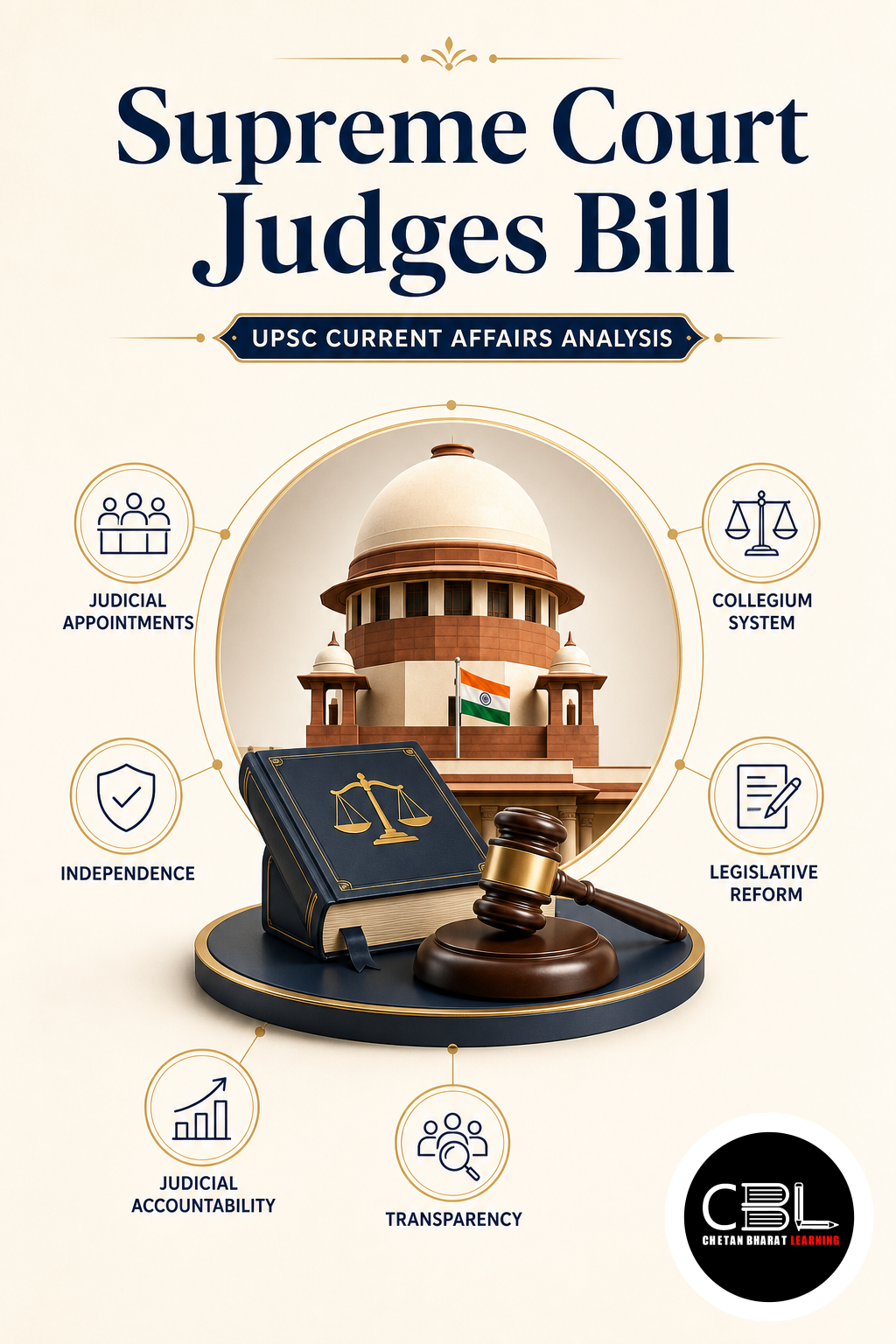
What is Supreme Court Judges Bill?
The Bill increases the sanctioned strength of the Supreme Court from 34 to 38 judges, including the Chief Justice of India. The government argues that this will help address the growing pendency of cases. The Supreme Court hears constitutional matters, appeals, Public Interest Litigations (PILs), Centre–State disputes, election matters, death penalty cases and review petitions.
Why is Supreme Court Judges Bill in News?
Parliament passed the legislation, while opposition parties criticised the government’s legislative approach. The debate focused on the Money Bill route, the Ordinance route and concerns relating to diversity in the judiciary.
Key Features
- Higher judicial strength: Increase from 34 to 38 judges.
- Reduce pendency: Intended to improve disposal of cases.
- More Constitution Benches: Additional judges may enable faster hearing of constitutional matters.
- Improved access to justice: Greater judicial capacity can reduce delays.
- Institutional efficiency: Supports faster handling of diverse categories of litigation.
Challenges
- Money Bill controversy: Opposition argues the Rajya Sabha’s role may be limited if this route is used.
- Ordinance route: Debate over whether extraordinary powers were necessary.
- Diversity deficit: Calls for greater representation of women, SC, ST, OBC, minorities and regions in higher judiciary.
- Constitutional questions: Legal issues regarding legislative procedure remain important.
- Broader judicial reforms: Increasing judges alone may not resolve structural issues.
Way Forward
Increasing judicial strength can help reduce pendency, but constitutional procedures should be respected. There is also a need for broader judicial reforms, transparency and strengthening the lower judiciary.
Prelims Practice Corner
- Q1. The Bill increases the sanctioned strength of Supreme Court judges to?
(a) 34 (b) 36 (c) 38 (d) 40
Answer: (c). - Q2. Which Article deals with Money Bills?
(a) Article 110 (b) Article 123 (c) Article 356 (d) Article 368
Answer: (a). - Q3. Ordinances are issued under?
(a) Article 123 (b) Article 352 (c) Article 324 (d) Article 280
Answer: (a). - Q4. One stated objective of increasing judges is?
(a) Increase taxes (b) Reduce pendency (c) Amend Constitution (d) Increase tribunals
Answer: (b). - Q5. According to the uploaded material, one continuing concern is?
(a) Diversity in judiciary (b) GST reform (c) Census (d) MSP
Answer: (a).
Mains Practice Questions
- Q1. Examine the significance of increasing the sanctioned strength of Supreme Court judges. (10 marks)
- Answer Structure:
Intro: Explain the purpose of the Bill.
Body: Pendency, access to justice, constitutional benches, limitations.
Conclusion: Judicial capacity must be complemented by broader reforms.
- Answer Structure:
- Q2. Discuss the constitutional debates surrounding the Money Bill and Ordinance routes in recent legislation. (15 marks)
- Answer Structure:
Intro: Define both legislative mechanisms.
Body: Constitutional provisions, arguments of government and opposition, judicial scrutiny.
Conclusion: Emphasise constitutional balance and legislative accountability.
- Answer Structure:
FAQs
- Why is the Bill important for UPSC?
- It covers Parliament, Judiciary, constitutional provisions and governance issues under GS Paper II.
- What are the major controversies mentioned in the uploaded material?
- The source highlights the Money Bill route, Ordinance route and diversity in the higher judiciary.
- Does increasing judges alone solve judicial delays?
- The material states that increasing judges helps, but broader judicial reforms and strengthening lower courts remain necessary.
Related Current Affairs
Preparing for UPSC, PCS or HCS?
Talk to a mentor at Chetan Bharat Learning, Chandigarh. Free guidance on choosing the right exam and building a study plan.
Chat on WhatsAppCall 97793 53345UPSC / IAS / PCS coaching in Chandigarh · Trusted by aspirants across Punjab & Haryana
Leave a Reply
You must be logged in to post a comment.