

UPSC Mapping
| Prelims | Deep-Tech Innovation, National Research Foundation, Innovation Funding |
|---|---|
| Mains | GS Paper III – Science & Technology and Innovation |
| Proposed Corpus | ₹1 lakh crore |
|---|---|
| Institution | National Research Foundation |
| Core Focus | Deep-Tech Research and Commercialisation |
What is Research Development Innovation Fund?
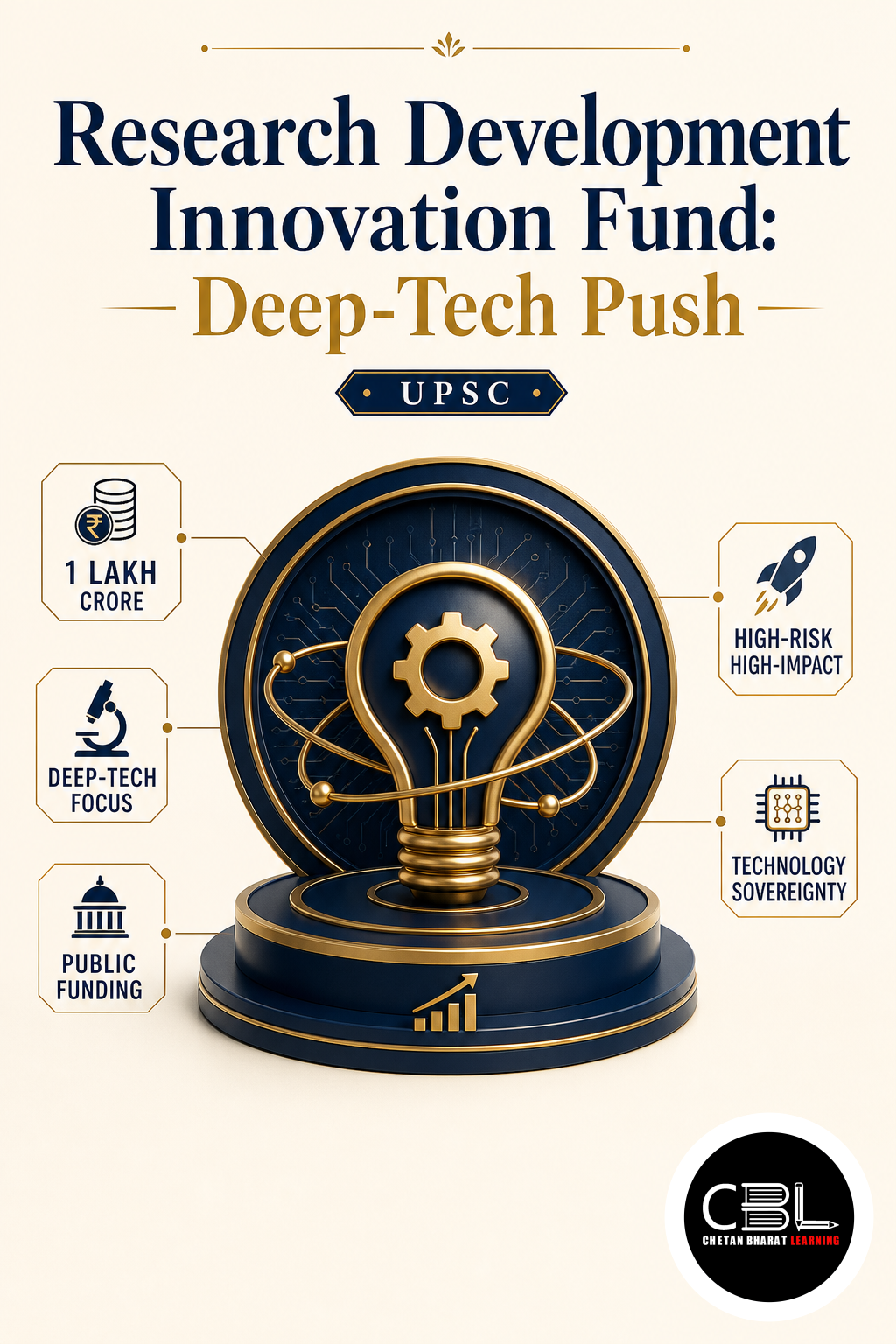
The Research Development Innovation Fund (RDI Fund) is a proposed financing mechanism for India’s deep-tech ecosystem, aimed at supporting technology development, commercialisation, incubation, indigenous capabilities and enhanced private-sector participation. With a proposed corpus of ₹1 lakh crore, the National Research Foundation is envisaged as the implementing institution. The fund addresses high upfront investment, specialised infrastructure needs and lengthy development periods, using public capital to bridge gaps where immediate commercial returns are uncertain.
Why is Research Development Innovation Fund in News?
India’s deep-tech ecosystem faces a significant financing gap as conventional venture capital prefers quicker returns and lower technological uncertainty. The RDI Fund aims to provide patient capital for high-risk innovation areas—such as artificial intelligence, semiconductors, robotics, quantum technologies, biotechnology, advanced materials, space and clean energy—until they reach commercial viability. Governance and accountability concerns arise due to potential conflicts of interest among policy designers and investment decision-makers.
Key Features
- Deep-tech focus: Supports high scientific, technological and financial risk projects.
- Strategic sectors: Includes AI, semiconductors, robotics, quantum tech, biotechnology, materials, space and clean energy.
- Public financing: Addresses market failures where private capital is insufficient.
- Commercialisation: Moves research towards viable technologies and products.
- Institutional structure: Layered oversight, specialised implementation and project execution.
Challenges
- Financing gap: High uncertainty, large capital needs and long gestation periods hamper funding.
- Conflict of interest: Requires safeguards when policy experts influence investments.
- Transparency: Demands clear selection, evaluation and monitoring procedures.
- Long gestation: Delayed commercial returns necessitate extended support.
- Institutional coordination: Collaboration among government, academia and industry is critical.
Way Forward
Combine strategic public investment with strong governance safeguards—transparent technical evaluation, performance criteria, disclosure rules and independent oversight. Strengthen academia-industry links to facilitate development, incubation, testing and market deployment. Align deep-tech funding with goals of indigenous capability, technological resilience and industrial competitiveness to complement private investment and maintain accountability.
Prelims Practice Corner
Q1. According to the passage, the proposed Research Development Innovation Fund primarily aims to support:
- (a) Consumer lending
- (b) Deep-tech innovation
- (c) Rural housing
- (d) Food subsidies
Answer: (b) Deep-tech innovation — the proposed fund addresses financing gaps in high-risk technological research and development.
Q2. Which institution is mentioned in the passage in relation to the proposed fund?
- (a) National Research Foundation
- (b) Election Commission of India
- (c) Finance Commission
- (d) National Disaster Management Authority
Answer: (a) National Research Foundation — identified as the implementing body.
Q3. Which of the following is identified as a deep-tech sector in the uploaded material?
- (a) Artificial intelligence
- (b) Retail banking
- (c) Tourism
- (d) Conventional retail
Answer: (a) Artificial intelligence — listed among strategic deep-tech areas.
Q4. Why does the passage support public financing for deep-tech innovation?
- (a) Deep-tech projects always provide immediate returns
- (b) Deep-tech projects can face high risk, long gestation and financing gaps
- (c) Private investment is prohibited
- (d) Technology projects require no infrastructure
Answer: (b) Deep-tech projects can face high risk, long gestation and financing gaps — limiting early private investment.
Q5. Which governance safeguards are highlighted in the passage?
- (a) Disclosure and recusal
- (b) Secrecy and unrestricted discretion
- (c) Removal of technical evaluation
- (d) Elimination of oversight
Answer: (a) Disclosure and recusal — stresses conflict-of-interest safeguards and transparent decision-making.
Mains Practice Questions
Q1. Explain the rationale for public financing of deep-tech innovation in India. (10 Marks)
Answer Structure:
- Intro: Define deep-tech innovation and its high-risk, long-gestation nature.
- Body: Cover financing gaps, market failure, strategic technologies, public investment, private-sector participation and commercialisation.
- Conclusion: Public funding should catalyse private participation while maintaining transparency and accountability.
Q2. Discuss the governance challenges associated with public innovation funds and suggest suitable safeguards. (15 Marks)
Answer Structure:
- Intro: Explain why public innovation funds require strong institutional governance.
- Body: Discuss conflict of interest, disclosure, recusal, transparent evaluation, independent oversight, accountability and long-term monitoring.
- Conclusion: Robust governance can improve credibility, efficiency and public value of innovation funding.
FAQs on Research Development Innovation Fund
Why is the Research Development Innovation Fund needed?
Deep-tech projects face high technological risk, long development timelines and inadequate private financing. The proposed fund aims to bridge this financing gap.
What is the proposed corpus of the RDI Fund?
The proposed corpus is ₹1 lakh crore, treated as a source-derived figure rather than an independently verified current amount.
Which sectors can benefit from the proposed fund?
Identified deep-tech sectors include artificial intelligence, semiconductors, robotics, quantum technologies, biotechnology, advanced materials, space and clean energy.
What is the role of public funding in deep-tech?
Public funding addresses market failures by financing high-risk projects with long gestation periods until they become investable.
What governance concern does the passage highlight?
Potential conflicts of interest when policy designers also influence investment decisions, necessitating disclosure, recusal and transparent decision-making.
Why do deep-tech projects have long gestation periods?
They require substantial research, specialised infrastructure and face technological uncertainty, delaying commercial returns compared to less research-intensive ventures.
How can India strengthen its deep-tech ecosystem?
Through strategic public investment, stronger academia-industry collaboration, transparent evaluation and effective commercialisation mechanisms.
Why is this topic important for UPSC?
It links Science and Technology with innovation policy, public finance, governance, industrial development and strategic technologies, relevant to GS Paper III, Prelims and Mains preparation.
Related Current Affairs
Preparing for UPSC, PCS or HCS?
Talk to a mentor at Chetan Bharat Learning, Chandigarh. Free guidance on choosing the right exam and building a study plan.
Chat on WhatsAppCall 97793 53345UPSC / IAS / PCS coaching in Chandigarh · Trusted by aspirants across Punjab & Haryana
Leave a Reply
You must be logged in to post a comment.