

UPSC Mapping
| Prelims | Environment & Biodiversity |
|---|---|
| Mains | GS Paper 3 (Environment & Biodiversity) |
| IUCN Status (Buru) | Vulnerable |
|---|---|
| Genus | Babyrousa |
| Threat | African swine fever |
What is the Buru Babirusa?
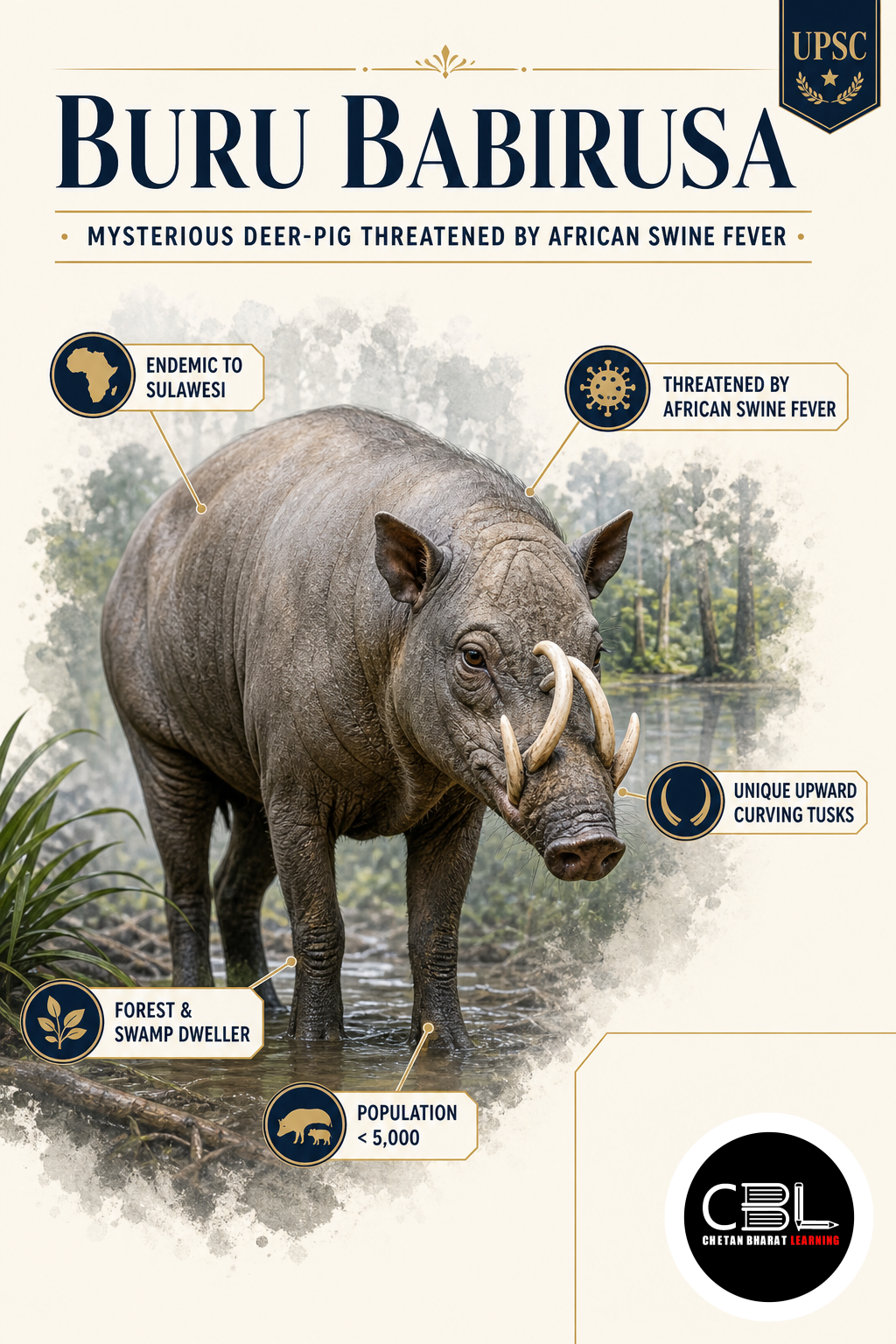
The Buru Babirusa (Babyrousa babyrussa) is one of three extant species of babirusa, also called deer-pigs, belonging to the genus Babyrousa in the swine family. They are found only on the remote Indonesian islands of Buru, Mangole, and Taliabu, inhabiting tropical lowland and hill forests near riverbanks, swampy areas, and forest ponds rich in aquatic plants.
They are distinguished by their unusual tusks—the upper canines grow upward through the snout and curve backward. The Buru babirusa is classified as Vulnerable (VU) on the IUCN Red List, while the North Sulawesi babirusa is also Vulnerable, and the Togian babirusa is Endangered.
Why is the Buru Babirusa in News?
The Buru Babirusa is in the news because Chester Zoo in the UK celebrated the birth of a babirusa at a critical time, as African swine fever threatens the species with extinction. African swine fever is a highly contagious viral disease affecting pigs, with a near-100% mortality rate, and poses a severe threat to wild babirusa populations.
The birth at Chester Zoo is significant for conservation breeding programmes, which aim to maintain a viable captive population and potentially reintroduce individuals to protected habitats. For more details, refer to this PIB release.
Key Features of the Buru Babirusa
- Unusual Tusks: Upper canines grow upward through the snout and curve backward—a unique feature among pigs.
- Island Endemism: Found only on Buru, Mangole, and Taliabu in Indonesia.
- Habitat: Tropical lowland and hill forests near water sources.
- Diet: Omnivorous, feeding on fruits, leaves, roots, and small invertebrates.
- Conservation Status: Buru babirusa (Vulnerable), North Sulawesi (Vulnerable), Togian (Endangered).
Challenges in Buru Babirusa Conservation
- African Swine Fever: A highly contagious viral disease with near-100% mortality, threatening wild populations.
- Habitat Loss: Deforestation and conversion of forests to agriculture and plantations.
- Hunting: Despite protection, babirusas are hunted for bushmeat.
- Limited Distribution: Endemic to a few islands, making them vulnerable to localized threats.
- Conservation Capacity: Limited resources for monitoring and conservation in remote islands.
Way Forward for Buru Babirusa
To protect the Buru Babirusa, urgent action is needed to prevent the spread of African swine fever to babirusa habitats through strict biosecurity measures. Conservation breeding programmes, like the one at Chester Zoo, are critical for maintaining genetic diversity and providing a safety net against extinction.
Protecting and restoring forest habitats, strengthening anti-poaching efforts, and engaging local communities in conservation are essential. International collaboration for disease surveillance and habitat protection can support Indonesia’s conservation efforts. For international best practices, refer to the IUCN.
Prelims Practice Corner
-
Q1. What is the IUCN status of the Buru babirusa?
- (a) Least Concern
- (b) Vulnerable
- (c) Endangered
- (d) Critically Endangered
Answer: (b) The Buru babirusa is listed as Vulnerable.
-
Q2. Where is the Buru babirusa found?
- (a) Borneo
- (b) Indonesia (Buru, Mangole, Taliabu)
- (c) Philippines
- (d) Malaysia
Answer: (b) It is endemic to the Indonesian islands of Buru, Mangole, and Taliabu.
-
Q3. What is the common name for babirusa?
- (a) Deer-pig
- (b) Wild boar
- (c) Warthog
- (d) Peccary
Answer: (a) Babirusas are also called deer-pigs.
-
Q4. Which disease threatens the babirusa with extinction?
- (a) Foot-and-mouth disease
- (b) African swine fever
- (c) Classical swine fever
- (d) Porcine reproductive syndrome
Answer: (b) African swine fever is a major threat.
-
Q5. Which zoo celebrated the birth of a babirusa?
- (a) London Zoo
- (b) Chester Zoo
- (c) Edinburgh Zoo
- (d) Berlin Zoo
Answer: (b) Chester Zoo celebrated the birth.
Mains Practice Questions
Q1. Discuss the conservation challenges facing endemic island species like the Buru babirusa and the role of zoos in conservation breeding. (250 words, 15 marks)
Answer Structure
Intro: Introduce the Buru babirusa and its vulnerability.
Body: Discuss threats: African swine fever, habitat loss, hunting. Analyse the role of conservation breeding programmes, like at Chester Zoo, in maintaining genetic diversity. Suggest habitat protection and community engagement.
Conclusion: Emphasise the need for integrated conservation—in situ and ex situ.
Q2. What is the significance of the genus Babyrousa in the swine family? (150 words, 10 marks)
Answer Structure
Intro: Define the genus Babyrousa.
Body: Explain that babirusas are unique among pigs for their upward-growing tusks and island endemism. They are evolutionary and ecologically distinct, with three recognised species of varying conservation status.
Conclusion: Conclude that their conservation is important for biodiversity.
FAQs on Buru Babirusa
What is a babirusa?
It is a genus of wild pigs, also called deer-pigs, found only in Indonesia, known for their unusual upward-growing tusks.
Why is the Buru babirusa threatened?
African swine fever, habitat loss, and hunting are major threats.
What is the IUCN status of the Buru babirusa?
It is listed as Vulnerable (VU) on the IUCN Red List.
Related Current Affairs
Preparing for UPSC, PCS or HCS?
Talk to a mentor at Chetan Bharat Learning, Chandigarh. Free guidance on choosing the right exam and building a study plan.
Chat on WhatsAppCall 97793 53345UPSC / IAS / PCS coaching in Chandigarh · Trusted by aspirants across Punjab & Haryana
Leave a Reply
You must be logged in to post a comment.