

UPSC Mapping
| Prelims | Mains |
|---|---|
| Modern History | GS Paper 1 (Modern History & Philosophy) |
| Birth | Key Demand | Philosophy |
|---|---|---|
| 1872 | Purna Swaraj | Integral Yoga |
Who was Sri Aurobindo?
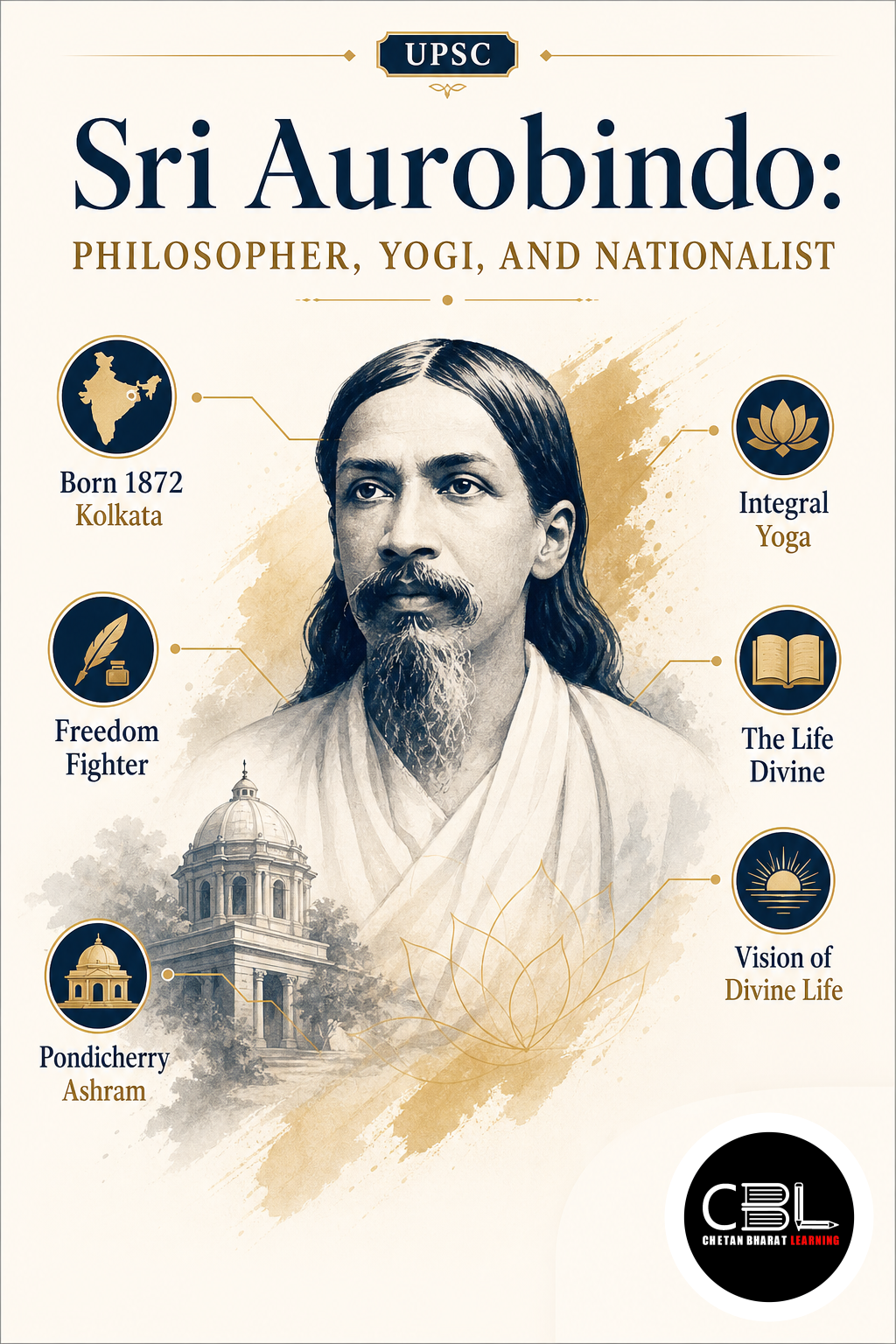
Sri Aurobindo (born Aurobindo Ghose, 1872–1950) was a philosopher, yogi, poet, and nationalist who pioneered Integral Yoga. He was the first Indian leader to publicly demand absolute independence (Purna Swaraj) from British rule. He wrote ‘New Lamps for Old’ in Indu Prakash, criticising the moderate Indian National Congress.
Following the Partition of Bengal (1905), he moved to Calcutta and became principal of Bengal National College. He was arrested in the Alipore Bomb Case (1908), defended by Chittaranjan Das, and acquitted after a year in prison. In 1910, he left British India for the French enclave of Pondicherry to devote himself to spiritual work, founding the Sri Aurobindo Ashram in 1926 with Mirra Alfassa (‘The Mother’).
Why is Sri Aurobindo in News?
Sri Aurobindo is in the news because the Prime Minister paid tribute to him on his 154th birth anniversary on 15 August 2026. His contributions to India’s freedom struggle and his spiritual philosophy continue to inspire.
His integral philosophy advocates a divine life on Earth through the evolution of human consciousness, unlike traditional paths to Moksha. His literary works include ‘The Life Divine,’ ‘The Synthesis of Yoga,’ ‘The Human Cycle,’ ‘The Ideal of Human Unity,’ and the blank-verse epic ‘Savitri.’ For more details, refer to this PIB release.
Key Features of Sri Aurobindo’s Contributions
- Political Nationalism: First to demand Purna Swaraj; edited Bande Mataram, Karmayogin, and Dharma.
- Integral Yoga: A spiritual philosophy that seeks the evolution of human consciousness and a divine life on Earth.
- Literary Works: ‘The Life Divine,’ ‘The Synthesis of Yoga,’ ‘Savitri’ (epic poem).
- Alipore Bomb Case: Arrested in 1908, defended by Chittaranjan Das, and acquitted.
- Ashram: Founded Sri Aurobindo Ashram in Pondicherry in 1926.
Challenges in Sri Aurobindo’s Era
- Colonial Repression: He was arrested and faced trial for sedition.
- Political Fragmentation: The nationalist movement was divided between moderates and extremists.
- Spiritual vs Political: His transition from politics to spirituality was seen by some as a retreat from the freedom struggle.
- Recognition: His philosophical contributions were not widely appreciated in his lifetime.
- Legacy: Balancing his political and spiritual legacy requires careful interpretation.
Way Forward for Sri Aurobindo’s Legacy
To honour Sri Aurobindo‘s legacy, his philosophical and political contributions should be integrated into educational curricula. Research on his integral philosophy and its relevance to modern challenges—such as climate change, artificial intelligence, and social harmony—can be promoted.
The Sri Aurobindo Ashram and its archives should be preserved and made accessible to scholars. His vision of a unified humanity and evolutionary consciousness offers a unique framework for addressing contemporary global issues. For international best practices, refer to the UNESCO.
Prelims Practice Corner
-
Who was the first Indian leader to demand Purna Swaraj?
- Bal Gangadhar Tilak
- Sri Aurobindo
- Mahatma Gandhi
- Jawaharlal Nehru
Answer: Sri Aurobindo was the first to publicly demand Purna Swaraj.
-
In which year was Sri Aurobindo arrested in the Alipore Bomb Case?
- 1905
- 1908
- 1910
- 1915
Answer: He was arrested in 1908.
-
Who defended Sri Aurobindo in the Alipore Bomb Case?
- Motilal Nehru
- Chittaranjan Das
- Jawaharlal Nehru
- M.A. Jinnah
Answer: Chittaranjan Das defended him.
-
Where did Sri Aurobindo establish his ashram?
- Calcutta
- Pondicherry
- Auroville
- Baroda
Answer: He established the Sri Aurobindo Ashram in Pondicherry.
-
What is the name of Sri Aurobindo’s spiritual philosophy?
- Advaita
- Integral Yoga
- Bhakti Yoga
- Jnana Yoga
Answer: He pioneered Integral Yoga.
Mains Practice Questions
Q1. Discuss the contributions of Sri Aurobindo to India’s freedom struggle and his philosophical legacy. (250 words, 15 marks)
- Intro: Introduce Sri Aurobindo and his dual legacy.
- Body: Discuss his political nationalism: Purna Swaraj, Alipore Bomb Case, editorial work. Analyse his spiritual philosophy: Integral Yoga, literary works. Evaluate his transition from politics to spirituality.
- Conclusion: Emphasise the enduring relevance of his vision.
Q2. What is Integral Yoga, and how does it differ from traditional paths to liberation? (150 words, 10 marks)
- Intro: Define Integral Yoga.
- Body: Explain that unlike traditional paths seeking Moksha (liberation from the world), Integral Yoga seeks the evolution of human consciousness and a divine life on Earth.
- Conclusion: Conclude that it offers a unique vision of spiritual and worldly integration.
FAQs on Sri Aurobindo
Who was Sri Aurobindo?
He was a philosopher, yogi, poet, and nationalist who pioneered Integral Yoga and first demanded Purna Swaraj.
What is Integral Yoga?
A spiritual philosophy that seeks the evolution of human consciousness and a divine life on Earth.
What are Sri Aurobindo’s major literary works?
‘The Life Divine,’ ‘The Synthesis of Yoga,’ ‘Savitri’ (epic poem), and ‘The Ideal of Human Unity.’
Related Current Affairs
Preparing for UPSC, PCS or HCS?
Talk to a mentor at Chetan Bharat Learning, Chandigarh. Free guidance on choosing the right exam and building a study plan.
Chat on WhatsAppCall 97793 53345UPSC / IAS / PCS coaching in Chandigarh · Trusted by aspirants across Punjab & Haryana
Leave a Reply
You must be logged in to post a comment.